Lord Justice Leveson in Australia, fear of ‘mob rule’ on the internet — and a case of wobbly telepathy?

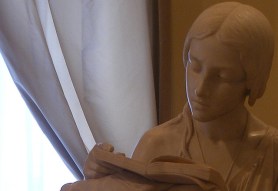
Barbarians on the net? A blogger, even a putative 'troll,' could easily be a civilised, cerebral girl like this one'La leggitrice' -- Photograph by MIL22

Barbarians on the net? A blogger, even a putative ‘troll,’ could easily be a civilised, cerebral girl like this one
‘La leggitrice’ — Photograph by MIL22

Zounds. The original header for this entry, first published a day and a half ago, was:

‘Congratulations, #Leveson LJ, for leaving the blogosphere and online publishing alone — and for declining to succumb to neurotic fear of the “mob”‘

We linked to an announcement of Lord Justice Leveson’s speaking engagement in Sydney, at a symposium held there today. And … guess what we have just found on Google? A BBC News report, still warm from the oven, with this fragment from his speech: ‘Laws are needed to prevent “mob rule” on the internet and “trial by Twitter”, Lord Justice Justice Leveson has said … .’ This is the first record we at post-Gutenberg have ever heard or seen of him mentioning ‘mob’ in the same sentence as ‘internet’, even though we would hardly be surprised if he did so in some exchange in his Inquiry. Might telepathy explain this astonishing development — or (but, no, surely not) did an aide to Leveson LJ draw his attention to re-tweets about this post by the two most constructive blogs on the Inquiry, Hacked Off and INFORRM (the International Forum for Responsible Media)? 

If it was indeed a telepathic connection, it was a bit spotty, because, according to the BBC bulletin, the judge is every bit as worried as the rest of the Establishment about the lawlessness of the net. What we said in our post (below) is still perfectly accurate. He deserves high praise for not warping the evolution of the internet as a radically democratic medium with poorly conceived and premature rules for online publishing. He could have used his Inquiry to do the wrong thing and copy King Canute commanding the sea to roll back — as so many newspaper proprietors and obtuse columnists had hoped he would. 

He did not.

We should note, here, that post-Gutenberg is as keen as anyone else on the arrival of the day on which we finally have a wise and far-sighted set of rules for online life — not least because we care passionately about protecting artists’ and writers’ right to eat, through reasonable copyright enforcement. (See ‘Might audience jealousy of artists explain why copyright is being officially destroyed on the internet?‘)

As for our apparent anticipation of the Inquiry leader’s interest in the topic of ‘mob rule,’ we hope that he reads all the way to the end of this post. 

Quel wheeze. 

Many journalists are worried about the impact of the Leveson report. […] What I’m worried about is about how Leveson will empower the people who lurk below the line […] How will Leveson empower these people? […] The scum below the line will mobilise and use the regulatory system to complain online, and en masse. Plenty of people already dedicate their time to making the lives of journalists a misery …

Columnist ranting in The Telegraph about reader comments on newspaper websites

Like certain unwitting colonisers from the Northern Hemisphere in the late 1700s, the eponymous judge leading the Leveson Inquiry into press behaviour and standards has gone to Australia. Never mind if he is a willing transportee serving the aims of H. M.’s government, whereas so many English who travelled the same route two centuries earlier were not. In the hostile unease in today’s Establishment that Lord Justice Leveson went to pains to pacify in his report published last Thursday, there are echoes from the past — from Establishment debates and anxieties that inspired the founding of the penal colony Down Under.

Judging by what we at post-Gutenberg have been able to read of the Leveson report, so far — in a true annus horribilis leaving us scarcely any time for blogging — his execution of the judiciary’s task of restoring calm and order to society has been thorough and careful.

But especially commendable is this: he did not let the hysteria of the ruling class — especially the segment of it that the press represents — force him into any unwise, premature attempt to draft rules for the blogosphere, or indeed any online publishing competing with old print media.

Lord Justice Leveson appears to understand perfectly that it is too soon to check or discipline a medium so new that it still has slippery fragments of afterbirth clinging to it, and will not be mature enough to be teachable for a while. ‘If we wish to compress something,‘ — for instance, constrain online publishing — ‘we must first let it fully expand,‘ was the advice we ourselves relayed from a sage of long ago, in answering the Inquiry’s request for public comment and suggestions.

The traditional press, railing at the Leveson report, sounds like online publishing’s envious, vengeful sibling, demanding that a parent impose equal punishment on all offspring regardless of culpability. Why must newspapers face new controls and rules, with or without statutory underpinning, when the Inquiry made no such recommendations for, eg., bloggers? Under the headline, ‘Leveson angers press over internet control,’ The Financial Times recorded this fury:

Lord Justice Leveson has angered UK newspaper bosses …

In an editorial on Friday, The Sun, Rupert Murdoch’s flagship tabloid, wrote “an over-regulated press in parallel with an unregulated internet spells chaos and will be the nail in the coffin for the newspaper industry”.

Yet again, newspaper reporting on the Inquiry has been wickedly selective. Leveson LJ notes in his findings that ‘the work of very many bloggers and websites … should rightly and fairly be characterised as valuable and professional’ — but scarcely anyone in old print media was brave enough to record that statement.

Only Private Eye and a few blogs like this one have been drawing attention to such omissions and distortions over the eighteen months of the Inquiry. How has the traditional press been getting away with this crime against honest journalism?

Irrational fear of ‘the mob’ is the answer we suggest. In the past, this sanctioned rank injustice actually codified in law. Robert Hughes’ references, in his magisterial history, The Fatal Shore, include the habit in Georgian England of referring to the masses beneath the elite as ‘the mobbish class of persons’. You could easily substitute ‘bloggers’ or ‘the internet’ for ‘mob’ where he notes,

The ‘mob,’ as the urban proletariat was called, had become an object of terror and contempt, but little was known about it. It was seen as a malign fluid, a sort of magma that would burst through any crack in law and custom, … easily inflamed…

and especially, here:

The ‘mob’ was Georgian society’s id — the sump of forbidden thoughts and proscribed actions …

The irrational terror meant that no one in any position of responsibility went to the trouble of doing any research into the factual basis for the elite’s misconceptions of the proletariat. The actual rise in crime that followed the population explosion that in turn followed the Industrial Revolution was vastly exaggerated, and used to justify ever more unjust laws that especially victimised the poor:

One could be hanged for burning a house or hut, a standing rick of corn, or an insignificant pile of straw; for poaching a rabbit, for breaking down ‘the head or mound’ of a fishpond, or even cutting down an ornamental shrub; or for appearing on a high-road with a sooty face.

What made all this particularly dire was that there was, increasingly, no competing authority to keep the judiciary in check. Eighteenth-century England, Hughes observes, witnessed

the growth of the Rule of Law … into a supreme ideology, a form of religion which, it has since been argued, began to replace the waning moral power of the Church of England.

That is even truer today, in an officially secular society in which the upper crust is free to speak of religion with spitting contempt. We should be all the more grateful to Lord Justice Leveson for his resistance to Establishment pressure to recommend legal controls and disciplinary action for the expression of thoughts and ideas, and dissemination of facts, on the internet.

Perhaps, in his time in the Antipodes, he can congratulate himself on his moderation as he is reminded, simply by being there — haunted in his dreams, perhaps, by the clanking chains of convicts — of the excesses of his predecessors in judicial robes:

The belief in a swelling wave of crime was one of the great social facts of Georgian England. It shaped the laws, and the colonisation of Australia was the partial result.

#Leveson, as anticipated by Elie Wiesel, 83 – in his turn, trailing fellow-activist Zhou Youguang, 106, in the blogosphere

‘Giant pawn’ MIL22

Earlier this month, a post-Gutenberg entry on the Leveson Inquiry had the honour of being put in the Twitter ‘favourites’ queue of Hans Peter Lehofer – an administrative law judge and former head of the Austrian Communications Authority, which decides the rules for broadcasting in that country.

No, we did not interpret our inclusion in his list as a gold star of approval. He almost certainly uses the ‘favourites’ button on the glorified e-notice-board the way we do – as an online bookmark. Never mind if, exactly like us — making the same point to #Leveson the other day — he doubts that merely passing laws affecting the way the press works can guarantee our getting what we need, which is ‘broadcasting’ representative of society as a whole.

What did please us is that Herr Lehofer’s interest bears out our forecast in May that Lord Justice Leveson’s recommendations on press regulation would influence the debate about media policy around the world. Austria is lucky to have such a curious and progressive rule-maker. Anyone in Britain worrying about bloggers and citizen-journalists being treated as mere pawns in the chess game the Inquiry is being forced to play with politicians in the final weeks before it delivers its report is bound to be heartened by this judge’s grasp of the size of the leap in thinking about media that we need from the judiciary. He has a blog of his own, and also blogs collaboratively on more than one site.

Gerard Hogan, another intelligently au courant judge — a specialist in constitutional law at Ireland’s High Court — recently accorded the blogosphere a right traditionally reserved for professional journalists. In what the International Forum for Responsible Media (INFORRM) reckons as ‘the first Irish judgment to consider the position of bloggers,’ the court allowed Mike Garde, the blogger-director of an Irish organisation helping people brainwashed by cults, to protect his sources of information.

Hogan J’s judgment read, in part:

Part of the problem here is that the traditional distinction between journalists and laypeople has broken down in recent decades … Mr. Garde’s activities fall squarely within the “education of public opinion” envisaged by Article 40.6.1. A person who blogs on an internet site can just as readily constitute an “organ of public opinion” … [T]here is a high constitutional value in ensuring that his right to voice these views in relation to the actions of religious cults is protected.

How much longer, we wonder, will it take Elie Wiesel – twice quoted on this blog in recent weeks, and cited yet again, below – to join the unmediated conversations in the blogosphere? He has used every other medium in his extraordinary record of ‘bearing witness’ to the murder, torture and terrorisation of European Jews in World War II – after surviving Auschwitz, where he was dispatched as a 15 year-old.

His age today, which is 83, hardly explains his failure to start a blog. Last spring, The New York Times ran an inspiring profile of a Chinese human rights activist, 105 at the time, using a blog to broadcast his thoughts. This astonishing Zhou Youguang – still blogging at 106, if the net is to be believed — is the inventor of the Pinyin or ‘Romanised’ system for converting Chinese sounds into the English alphabet. For his transmissions on the net,

Mr. Zhou … uses a typewriter that converts Pinyin into characters to deliver ever-more pointed critiques of the party in essays and on his as-yet-uncensored blog.

The explanation for the deep hooks sunk into post-Gutenberg’s brain by Elie Wiesel’s short 2010 novel, The Sonderberg Case, is the startling correspondence between this author’s reflections on the role of the press in society, and the actual debate over the Leveson Inquiry. He also uses the trial at the heart of his story to weigh the relative worth of the work of lawyers and journalists – most engagingly.

Our final excerpt from the book is about a fight at a dinner party in New York. It seems uncannily prescient about the precise arguments being used in real life by the media’s old guard – here presented by the main character, Yedidyah, a journalist, and the hostess, Emilie, his only ally – as opposed to those of the public, on whose behalf Yedidyah’s wife Alika, an actress, spars victoriously.

There seems no doubt whatsoever about which side the author is on:

We talk about journalism. Is it useful to a democratic society? Honest or corrupt like everything else? A reliable source of information, a necessary tool for forming an opinion? Emilie and I stand up for the media, primarily because they represent an indispensable element in protecting individual and collective liberties. Alika is our most violent opponent. I’ve rarely seen her as fierce in her opinions. For her, even the best daily papers disgrace their readers. And she goes on to quote and appropriate the remark of a big British press baron concerning a well-known magazine. ‘It isn’t what it used to be … and actually it never was.’ And this applies to all publications, she tries to convince us, with no exceptions. Alex agrees with her. So do their guests. Emilie and I valiantly stand up to them. Alika flares up.

‘How can the two of you stick up for all those miserable newspapers and weeklies? I’m prepared to think you don’t read them! Even the cultural pages are over-politicized. As for the literary supplements, what do they tell us except ‘long live the buddy-buddy network’? What kind of moral rectitude is that? And what about the right to truth?’

[…]

Calm and resolute, Emilie pursues her counterattack and cites the facts: Can we really suspect such and such a writer, at such and such a newspaper, of dishonesty? And can we honestly question the integrity of such and such a professor, who writes in such and such a journal?’

Without the slightest compunction, Alika answers with a shrug of the shoulders. ‘Yes we can. And we should.’

‘In other words,’ Emilie says, ‘they’re all guilty until proven innocent, is that it?’

‘No,’ Alika concedes. ‘I wouldn’t go that far. But I maintain that as a reader, I have the right to wonder about their conception of ethics.’

… Happy birthday, tomorrow, Elie Wiesel.

♯Leveson must protect citizens’ rights to comment alongside a 4th Estate incapable of self-regulation: see Private Eye No. 1317

‘f&f’
Photograph by MIL22

One after another, members of the 4th Estate have been parroting some version of the same frightful cliché – don’t throw out the baby with the bath water! – as they warn Lord Justice Leveson about the risks of imposing any form of regulation on the press.  Google offers roughly 21,200 search results for the terms ‘baby + bathwater + Leveson’.

You might suppose that someone would have the wit to find a new metaphor after this year’s revelations about decades of collusion between politicians and the largest 4th Estate empire by far, the one run by Rupert Murdoch – disclosures that have shown us that the wretched baby is being bathed skinless to divert attention from its reeking, putrid condition.

Last week, in another part of this site, we posted a mention of an important study by a London School of Economics researcher about comment moderation policies on the websites of newspapers. We found it only by accident, on the day we wrote the post. For reasons obvious from five minutes spent reading the study’s findings, no newspaper has given it any publicity whatsoever. We hope that the Leveson Inquiry’s team of investigators has copies of the LSE researcher Sanna Trygg’s paper, ‘Is Comment Free? Ethical, editorial and political problems of moderating online news‘, which underlined in various ways these observations:

In the past, ‘traditional’ or ‘mainstream’ media have been considered as the main public forum for free speech, critique and discussion. Today, readers are also invited to participate in the debate directly online. The main platform for this is the comment field attached to news articles published online.

[…]

Comment fields on newspaper websites offer great potential for participation in democratic dialogue. […] It is important to continue to strive for real engagement between people with different viewpoints, even when those views are marginal. The danger remains that people will not learn by having their views challenged.

[…]

Readers’ participation is still not a priority in the newspapers organization. [Comment] [m]oderation is being performed on the terms of the newspaper and is a product of a relatively narrow policy. This issue matters if it drives people away from ‘reasonable’ moderated discourse. […] It is a central problem for the creation of a truly networked journalism or Fifth Estate.

Trygg — whose work experience includes a stint as web editor for Skånska Dagbladet, a newspaper in her Swedish homeland — was pessimistic about the likelihood that the Inquiry will address the most vital media-related issue that needs resolving. That is not simply to note the 4th Estate’s replacement by the 5th , but firmly discourage today’s still-dominant print media from suppressing the voices of citizens who disagree with its positions and expose its flaws in newspaper comments sections. She surmised:

At present it does not seem likely that Leveson will deal with news website moderation directly, but surely it should be considered in any investigation into newspaper editorial practices and their contribution to British public life?

As we keep saying here, there is only one widely circulated print publication in Britain writing ‘without fear or favour,’ the way a real newspaper should – and as only bloggers and other unmediated writers publishing on the net do. In late June, Private Eye supplied a detailed contradiction of misleading testimony by David Cameron at the Leveson hearings that the rest of the 4th Estate either ignored or mentioned glancingly.

The Eye’s evisceration of that testimony referred to Jeremy Hunt, a culture-minister-in-waiting who in 2010 had boosted his party’s chances of winning the election by securing the support of Rupert Murdoch’s Sun – through spouting, like a ventriloquist’s dummy, all the positions on media policy that Rupert’s son James had outlined a few days earlier in delivering the annual, high-profile MacTaggart lecture at the Edinburgh International Television Festival.

“THERE was no overt deal for support, there was no covert deal, there were no nods and winks,” David Cameron told Leveson, dismissing the suggestion that the Tories agreed to back the Murdochs’ commercial interests in return for the support of the Sun before the 2010 general election. Hmm…

As the Eye pointed out before Cameron gave his evidence, there was, however, an uncanny resemblance between James Murdoch’s MacTaggart Lecture on 28 August 2009 and an article that the then shadow culture secretary Jeremy Hunt wrote in the Sun three weeks later on 19 September – just before the paper switched its support to the Tories.

Hunt echo

In the MacTaggart, Murdoch complained about a “land grab” by the BBC, claiming that “the scale and scope of its current activities and future ambitions is chilling”. Hunt echoed that in his Sun article, warning that “something is going wrong at the broadcaster”.

Murdoch declared: “Rather than concentrating on areas where the market is not delivering, the BBC seeks to compete head-on for audiences with commercial providers.” Or, as Hunt wrote three weeks later: “The BBC needs to focus on what it does best – great family entertainment and programmes the market will not provide.”

Murdoch rant

Murdoch complained that “the BBC’s income is guaranteed and growing”. Ditto Hunt: “We should not be having inflationary rises in the licence fee.” Murdoch then ranted about the “particularly egregious” expansion of the BBC’s commercial arm, BBC Worldwide. Lo and behold, Hunt argued: “It’s time to rein in the activities of its commercial arm, BBC Worldwide.”

Murdoch’s fury extended to the BBC Trust. “You need deep pockets, sheer bloody-mindedness and an army of lawyers just to make the BBC Trust sit up and pay attention,” he fumed. Hunt promptly “pledged to replace” the BBC Trust “with a truly independent body”.

Perish the thought that any of this might amount to evidence of a mating dance between the Tories and the Murdochs.

We hope that the Leveson Inquiry will do all it can to ease the way for more media of every sort to fill crucial gaps in mainstream reporting as only the Eye does, at present.

Appearing before the Inquiry last Tuesday, Lord Hunt (no relation to Jeremy), the present head of the press-run Press Complaints Commission all but universally acknowledged to have failed at the job of self-policing, failed to melt Lord Justice Leveson’s heart when he begged for a second chance for his organisation. Every month brings fresh evidence of the hopelessness of any claim that the press is capable of regulating itself.

Two such scraps on our minds at post-Gutenberg today:

• Last summer, even with the whole world transfixed by emerging details about phone hacking by Murdoch’s minions, the media tycoon announced his intention of mucking out his corporation’s stable with an internal investigation that struck critics as woefully unconvincing. It was led by Joel Klein, a New York lawyer and education expert, freshly hired by News Corp.. The New York Times noted earlier this year:

Shareholder groups have expressed concerns about Mr. Klein’s independence in leading the investigation. His compensation package at News Corporation was more than $4.5 million last year, according to company filings with the Securities and Exchange Commission.

“His salary was a huge bump, so he’s clearly beholden to Murdoch and should not be running an internal investigation,” said Michael Pryce-Jones, a spokesman for the CtW Investment Group, a shareholder advocacy group based in Washington that works with pension funds for large labor unions.

Last month, Joel Klein handed over that smelly job for a head groom to another senior News Corp executive – but that was someone hired at his behest, and his having been entrusted at all with the sanitising task did not inspire confidence in the likelihood that Britain’s heftiest media conglomerate is capable of putting the public interest above considerations of narrow commercial advantage.

• Newspapers ignore complaints about the suppression of citizens’ comments about their policies and behaviour  — even censoring, with peerless irony, a post about an opinion piece by the chief executive of Index on Censorship, a British watchdog group chiefly concerned with spotlighting censorship outside Britain.

One reason for starting this post-Gutenberg blog last September was to draw attention to comments censored by newspapers. Obviously thinking on closely parallel lines, Sanna Trygg suggested in her paper, published in January:

[W]e would argue that in the long run it is worth newspapers continuing to push for more transparent moderation … For example, would it be worthwhile making records of deleted comments public? Since no publicly available records exists, all we know is that comments are being deleted, but not which ones and why.

The latest tactic by old print media worthies determined to neutralise the Leveson Inquiry is to claim that neither the presiding judge nor any of the lawyers assisting him – all educated at élite institutions — are capable of looking after the interests of ‘Joe Public,’ since none of them are part of the tabloid-reading majority of customers for Britain’s newspapers.

This will be seen as a particularly ill-judged attempt to ensure the unchallenged reign of the 4th Estate if the Inquiry acts on what Lord Justice Leveson plainly understands well, which is that ordinary citizens are best served by any newspaper that gives its readers a chance to freely express their opinions.

A source quoted by Sanna Trygg encapsulated why this is exactly what members of the public need:

Research by the Swedish survey Institute Sifo in 2011, showed that workers, unemployed and less educated people think that reader comments in themselves are more important than civil servants, self-­‐employed, private employees and highly skilled:

“A qualified guess is that people with higher education and status in society feel that they already have the opportunity to be heard. For people with lower status are comment fields however, an important platform to make their voices heard.” 
Sofia Mirjamsdotter (Swedish journalist, blogger and social media expert.)

Advice for Lord Justice Leveson from Lao Tse: how to shape the afterlife of the 4th Estate and assist the birth of its successor

[ On 10 July 2012, The Independent, a ‘liberal’ London newspaper, declined to publish a comment on press reform linked to this post. That polite comment is here. ]

Niklaus Manuel’s ‘Dance of Death’ (‘Totentanz’, 1516-1519) was a hugely popular theme as Gutenberg presses proliferated and the Renaissance was in full sway. It could have symbolised a coming-to-terms not just with death but the dying of old ways.

Presiding over an Inquiry whose conclusions will shape the afterlife of the British press – doomed to extinction by digital media and the new voices of the 5th Estate – Lord Justice Leveson keeps reminding us of the contradiction in the difficult job he has been given. What mechanisms can he recommend to the government for the enforcement of ethical behaviour by the 4th Estate without ‘imperilling the freedom of expression or our free press’? – as he put it during Tony Blair’s testimony in late May.

Post-Gutenberg would like to recommend a fragment of ancient Chinese philosophy as a frame for thinking about a solution to his quandary. Lao Tse reportedly said, in the 6th century BCE,

If we wish to compress something, we must first let it fully expand.

Lao Tse

Rule-making can be seen as a sort of compression – in the sense of limiting, constraining and controlling. It is too soon for anyone, even the admirably wise men at the summit of Britain’s judiciary today, to draft rules for media being turned inside-out by the digital revolution. As perspicacious witnesses have pointed out, any new regulations that minutely specify what the 4th Estate can and cannot do must inevitably pronounce on who should be considered a journalist. How can that be done when the profession’s boundaries are being obliterated by the arrival of the 5th Estate?

It would be disastrous if the Inquiry were to lead to any blocking or impeding of this successor to the 4th Estate. What the arrival of the 5th Estate means for the press is that it has to share the megaphone it has so far had all to itself.  This succession is directly in line with the evolution and improvement of democracy – something that people everywhere want dearly, a yearning that events like the Arab Spring have dramatised.

To watch the Leveson hearings is to see the presiding judge agonise over too many details that an unimpeded 5th Estate will soon make irrelevant or outdated. They take up too much of his time, even when he understandably declines to deal with them in an Inquiry being criticised for taking on too much. As Dan Sabbagh noted in a good summing-up in The Guardian last week,

Leveson has so far showed little apparent desire to get into the question of the ownership structures of newspapers: when invited … to set a cross-media ownership limit that would force a Murdoch sale of the Sun or the Times, Leveson fought shy, “because that involves all sorts of competition issues which would require quite detailed analysis”.

Instead, Leveson went elsewhere to debate some practical solutions. The judge has been surprisingly consistent in the views he has espoused, taking the approach of testing out ideas periodically with witnesses he likes. Leveson is clearly sceptical of the PCC [Press Complaints Commission], telling Financial Times editor Lionel Barber in January that the body was not “really a regulator” but a “complaints mechanism” – and that it needed to be supplemented by another body, a new kind of court, “some sort of arbitral system” to cover libel and privacy claims – an imagined body that the judge said would be designed to be low cost – or to use a phrase he repeated many times “not make extra work for lawyers”. Its nearest analogue would be the industrial tribunals, or the arbitration system used in the construction industry. 

Post-Gutenberg likes the way the judge is thinking about  a replacement for the defunct and essentially toothless Press Complaints  Commission. We would also be happy to see the criminalisation of a small set of completely unacceptable infractions, such as extraordinary invasions of privacy by phone hacking and other underhand means.

But instead of pointless brain-cudgelling about precisely what percentage of which communication medium newspaper conglomerates like Rupert Murdoch’s should be allowed to own, Lord Justice Leveson’s highest priority should be to open the way to the largest number of competitors for the 4th Estate.

In other words, expand, don’t compress should be the principle guiding his recommendations to the government in September.

Check bad behaviour on the part of today’s media elite by maximising  opportunities for the outsiders of the 5th Estate to offer alternative presentations of facts and unfamiliar opinions, and to challenge and expose the biases and mistakes of every sort of media, new and old.

There is no shortage of good ideas for the democratic licensing of access to sensitive information by both professional and non-professional disseminators of facts. In a post a few months ago  on the blog of the International Forum for Responsible Media (INFORRM), Hugh Tomlinson QC made an excellent suggestion about ‘benefits for public interest journalism of creating a category of “accredited journalists”’.  These would be …

… a sub-category of those writing for publication [who] should be given specific privileges to assist them in their work. […] [P]rivileges should not be granted to journalists simply because they are employed to write or because they work for a media organisation.  Neither should the privileges be granted to any “citizen journalist” who claims to be writing public interest stories. Rather, the privileges should be made available to those who pass through a gateway policed by a voluntary independent regulatory body and sign up to an enforceable code of responsibility. [post-G’s ital.]

There are new ways of organising and financing journalism that could use Lord Justice Leveson’s support – even if that only means he will be careful not to hobble the reorganisation of the media as, for instance, a set of cooperatives in which readers and viewers could be offered the chance to become co-owners. In recent months, proposals for setting up and running these have been increasingly detailed and specific. (See, for instance, the mention of Paul Smalera’s suggestions in ‘Why a keiretsu-cooperative is a gentle transition for old media …’.)

The mere existence of the Leveson Inquiry has already had salutary effects. To give a small but critical example, the moderation of comments in The Guardian’s popular comments sections has become far less trigger-happy. Commenters are not being censored quite so reflexively for opinions or factual posts that conflict with that newspaper’s views and political positions, or criticise its friends. Last weekend, it was heartening to see a post about the Inquiry itself opened for comments after months of prohibition on grounds that made no sense – and to be able to read contributions to the debate about Ian Jack’s illuminating comparison of Leveson with an earlier government investigation of press practices.

As for the Leveson hearings, per se, their radical transparency — with a presiding judge confident enough to muse aloud and react spontaneously to testimony —  goes far beyond what many of us could even have imagined as a model of open government. (The best demonstration came an hour after this post: here). American lawyer friends looking on in awe tell us that nothing in the US system would permit Americans to copy the form of these proceedings.

Most amazing has been the discovery that the conduct of the Inquiry is characteristic of an exceptionally progressive judiciary. Utterly unlike the notoriously slow-moving and stodgy legal system wickedly satirised in Dickens’s creation, Jarndyce and Jarndyce — a court case that grinds on for generations – Britain’s top judges are not just acknowledging the implications of new communications media and adjusting to them, but doing so faster than the professionally nimble 4th Estate.

Post-Gutenberg only recently came across a news report from the spring of last year about a speech in Israel by the Lord Chief Justice, Baron Igor Judge, who put Sir Brian Leveson in charge of this indescribably gratifying investigation into press culture and practices. He explained that in Malta, where he was born, one of his grandfathers owned and edited a tiny newspaper. His sympathy for the press’s problems is, in a sense, inbred. But he favours the transparency and inclusion that are more the defining characteristics of the 5th than the 4th Estate – even for keeping his own legal system honest:

His “fervent hope” was that new technology would make it easier for the media to be “present” in court, reporting the proceedings, and “the present trend of fewer and fewer reporters in every court would come to an end”.

In an apparent reference to “virtual” courts based on video-conferencing, Judge insisted that justice should be done “in a public forum to which the public, or the media, has access”.

He continued: “Technology must not lead to justice done in secret, or some form of hole-in-the-corner justice.

Post-Gutenberg wishes to offer just more one scrap of advice to Lord Justice Leveson – who has invited everyone, however obscure, to contribute thoughts to his hearings: please do not allow political partisanship by the press to be conflated with press freedom. As we observed in a recent post in this spot, sanctioning political one-sidedness means licensing powerful media owners to be king-makers, with all the compromising wheeling and dealing that goes with that. It means condoning the skewed reporting of the facts so essential to the functioning of a genuinely democratic government.

With a fully licensed 5th Estate in full cry, media conglomerates trying to run Britain, with lots of help from British prime ministers – or what the Economist appears to dismiss nonchalantly as the inevitable ‘proprietor problem’ —  should be shown their proper place. And where would that be? If not oblivion, then as far below the salt as possible.