
The lost wisdom of co-ops: a conversation about the key to future creative freedom for artists and inventors of every stripe

All artists now want to work on terms they co-determine.
Photograph by MIL22.

Post-Gutenberg will occasionally be letting visitors eavesdrop on discussions between our colleagues – starting with the pseudonymous and gender-free Escargot and Mustrun, who are not quite ready to divulge any personal details, except in warning about their tendency to be over-earnest, humourless, and on occasion, dull. Not the best qualifications for bloggers, we agree, but we make do with what we have – or rather, who.

Mustrun: I see that on Sunday we linked to The Observer — to a sharp John Naughton column about the Facebook hype falling flat on Wall Street. Someone here dropped into a comment there a link to our Valentine’s Day post about snubbing Facebook and re-inventing social networking sites as co-ops.

Escargot: So that’s why our traffic numbers have gone zooming into outer space. We’re not used to thundering herds of visitors shattering the monastic silence in these parts.

Mustrun: Right. Co-op promoters are the slave trade-killers of tomorrow.

Escargot: Trying to be aphoristic again, are we? Don’t. That one’s as clear as mud.

Mustrun: Just saying. All the clever people were sure for over two millennia that slavery would always be with us. Anyone trying to abolish it was written off as a lunatic or idealistic fool.

Escargot: Oh. Quite. Last week that lovely Leveson Inquiry judge, more owly than we are, was asking eminent witnesses to suggest how to make the British press behave in the future, and be less hopeless at holding politicians to account. No one mentioned redesigning media organisations as co-ops, but it’s surely a solution whose day has come. Not to mention dead relevant.

Mustrun: You’re thinking of the Harvard journalism lab experiment? Something to do with an Indian tree that looks like a multi-limbed goddess on steroids?

Escargot: The Banyan Project, yes. It’s been building a prototype for doing online journalism as a cooperative enterprise, focusing on local news. The man behind it, Tom Stites, has exactly the right idea. We’ve quoted him on post-Gutenberg before.

Mustrun: We have? Well, you know me. Any subject not mentioned in a post header, or that I didn’t write about myself, does not register.

Escargot: [sighing inaudibly] So as usual, you want me to urp up what he said, to fill you in?

Mustrun: Leopard, spots; all in the hard-wiring – yes? … If you would, please, Scargo.

Escargot: [reads through imperceptibly gritted teeth] ‘A significant source of co-ops’ strength is the trustworthiness inherent in their democratic and accountable structure. … This is also an era of rampant mistrust of journalism, so co-op news sites’ trustworthiness has the potential to add value to what they publish. Further, the co-op form allows, or rather demands, that news coverage decisions arise from what a community’s people need … The web is inherently collaborative — just as co-ops are — and at the local level this creates the potential for civic synergy — ’.

Mustrun: Translation: co-ops and the internet were made for each other. Spot-on, in that long-winded Murrican way. He might add that it’s strange but true that large parts of the internet sit on top of ‘peer-to-peer computing’. But this Justice Leveson, … how is he supposed to go from applauding a fine example like Banyan – assuming he does any such thing – to persuading the media to try out co-ops? He’s hardly going to order them to alter what we’re supposed to call their ‘business model’.

Escargot: Right. Britain is not a dictatorship. But he might recommend that the government offer old or new media organisations tax breaks for setting up co-ops – in the oldies’ case, by reinventing themselves, or parts of their operations, as co-operative outfits.

Mustrun: You think journos would sign on? Remember that the majority so detest the idea of any change that they can’t even bring themselves to report that Nick Davies — the journo hero of the phone hacking saga — told Leveson that the press cannot be trusted to regulate itself.

Escargot: Mmmm. Some of them will sign on, certainly. More will as the idea loses its strangeness, I suspect. There are editors and journalists who’d leap at the chance co-ops could give them to set rules and policies collaboratively. Mainly, I suspect, the craft-focused ones — hoping, like artists and writers everywhere, that this net revolution really will get rid of hierarchies and gatekeepers.

You saw the Tom Friedman column celebrating some of that on the New York Times site yesterday — yes?… But then of course, many journos live not so much for the craft as for the clubbiness in the profession. And sort of think of themselves as football teams – the women just as much as the men.

Mustrun: Clipped Friedman for skimming, later. Journos are petrified of more democratic media organisations, especially of any plan that involves making room for outsiders — for more varied contributors and voices. I’m always asked the same nervous-Nellie question about posts on here like ‘Co-owning media is on the horizon …’. It’s this: will working in a media co-op mean that trained journalists get paid the same as bloggers and citizen-journalists?

Escargot: Oh, I’m asked that. All the time. No matter how many times we explain that the way a co-op works will depend on the particular set of rules its owner-members agree on, the journos and media managers revert to projecting their most paranoid fears onto any mention of  co-operatives.

Mustrun: Someone ought to re-publish that superb Tom Lester article about co-ops in the disintegrating copy of Management Today you once disinterred from our archive. It’d make a terrific contribution to the new e-publishing collections of long-form journalism – with an introduction setting it in context, of course, and updated facts. Remind me of the year it was published?

Escargot: Imagine you proposing anything in long form, Musto. The owner of the world’s most attenuated attention span. The Lester piece — the cover date for the magazine says February 1979 — deserves every last gram of your praise.

Mustrun: Even text-grazers like me have to stop for a real meal, now and then. What he pulled off in that article is amazing. His subject was the failure of the Kirkby Co-operative in a depressed manufacturing town near Liverpool. Yet by the end of his dissection of how Kirkby was done in by badly-designed rules, you somehow feel hugely optimistic about a well-designed co-op’s chances of succeeding.

Escargot: Yes, yes, and yes. The piece partly answers the question of how journalists might be paid in relation to bloggers – not that we existed, then — by explaining the rules for profit-sharing in one of the world’s biggest and most brilliant co-ops. Mondragon, in the Basque country of northern Spain.

Mustrun: ‘Mondragon’ sounds like something in Lord of the Rings. Lester uses its exotic history — it was started by a Catholic priest in the desperate aftermath of the Spanish Civil War — to create a riveting context for a step-by-explanation of exactly how an individual could join a co-op and help run it.

Escargot: [ swipes over to scanned copy of the article in a tablet computer ] The ratios may have changed, but in 1979, Lester said that at least 30 per cent of a Mondragon co-op’s profits had to be put away in the collective reserve funds. Then, ‘the other 70 per cent is divided up among the members of the co-op according to a points system reflecting job status.’ … And of course, every member could help to decide the status of one job in relation to another.

Mustrun: But in addition to practical, nitty-gritty details like that, he tells about some of the lunacy that seemed to go hand-in-hand with the passionate idealism behind co-ops of the past.

Escargot: Mmmm. ‘No shortage of idealism,’ he says about Mondragon, ‘…but mixed with hard-headed realism.’

Mustrun: Yes, but noisy idealism has been the biggest enemy of co-ops. Makes sensible people mistrustful.

Escargot: Quite. If only people who believe in them and have the right skills – extroverts, unlike us – would just get on with setting them up with no fuss. The way, for instance, Tim Berners-Lee quietly invented this World Wide Web. What could be more idealistic than a way of communicating as powerful as this one, connecting the whole planet –  but given away, free? A scientist silently beavers away in a lab in Geneva and without any self-advertisement, no speechifying whatsoever, changes the world.

Mustrun: Well, I really must, … you know …

Escargot: Right. Off you go, then.
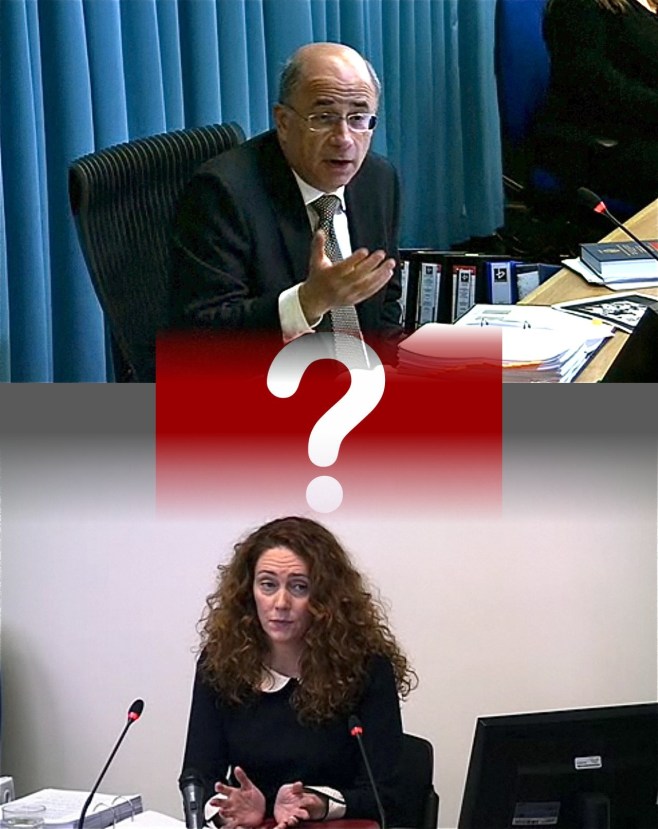
Will Leveson end blessing press partisanship and slamming the brakes on the rise of new media and the 5th Estate?

Lord Justice Leveson interrogating Rebekah Brooks, the former News International chief.

Why is this blog keeping a close eye on the progress of the Leveson Inquiry? Not because of minutiae about Rupert Murdoch and his henchwoman Rebekah Brooks jumping in and out of bed with British prime ministers, metaphorically speaking – as important as those shenanigans are to grasping the extent to which the governing of Britian has been infested by parasitical media magnates.

Under his Inquiry’s terms of reference, Lord Justice Leveson will have to make recommendations about the future of press regulation in Britain. These are bound to influence the debate about policy in other parts of the world. The expectation about the effect of his prescriptions that we at post-Gutenberg find most exciting is in this advice the judge has received:

…[I]f you do get the regulatory framework right for print journalism, I think that will have a profound effect on the way the Internet develops. […] What I think is happening is that we’re going to end up in a position where there has to be a redefinition essentially of what a journalist is.  … [I]t would be absurd to expect you to have regulation for every single person who is on Facebook and Twitter because then you’re not far off from saying we have to regulate the content of text messaging and so forth. […] So I think there has to be a definition of what a journalist is, what a media organisation is, and [though] this is where I have some sympathy for the print industry, it’s not just about the print industry.

That was part of yesterday’s testimony by Alastair Campbell, the much-reviled political strategist and press adviser to Tony Blair. Further justifying this blog’s praise for his contribution at an earlier hearing a few months ago,  Campbell has proved to be incontestably the clearest and best-informed thinker among those assisting the Inquiry.

Lord Justice Leveson’s obvious grasp of the most subtle aspects of what Campbell told him was particularly welcome after undercurrents at last week’s hearings suggested that perhaps David Cameron’s government – even though it commissioned this Inquiry – had been warning the judiciary, off-stage, about excessive zealousness.

The presiding judge’s unfailing good humour had up to then been as striking as his scrupulously fair treatment of all witnesses. But a newspaper quoted him as having said, last Thursday, with unprecedented irritability, that he was impatient to reach the end of the hearings and get back to ‘productive judicial work’. As this followed his rejection, the week before, of the government’s request for privileged ‘core participant’ status in the proceedings, it seems most likely that friction between the executive and judicial overseers of our democracy played some part in darkening his mood.

There were other apparent reactions to unpleasant, behind-the-scenes manoeuvring – as in the somewhat tortured and meandering summing-up by the chief interrogator, Counsel Robert Jay, of the chief issues raised by the hearings. Formally addressing the Lord Chief Justice, he delivered a sort of pre-mastication of findings from witness testimony to date. In this, he partly echoed quixotic attempts by the media to justify a partisan press – of which the most bizarre has been an argument offered by The Economist, dissected in an earlier post on this blog.

‘The fearlessness and vibrancy of our press is something of which we should be enormously proud,’ Counsel Jay, usually a model of calm rationality, said in a rare rhetorical passage. He also said:

Newspapers are entitled to be partisan in a democracy, to campaign in favour of causes, policies and political parties; and were the State to legislate otherwise that would be undemocratic, as well as, under our current settlement, an abrogation of human rights.

This paean clashed with his clear understanding – obvious from his thinly veiled outrage, in one interrogation after another – of the damage done by partisanship.  On Friday, grilling Rebekah Brooks, the former chief executive of News International, he sought to underline that the payoff for newspapers, for pushing the agenda of their chosen political parties, is the ability to influence policy — and that this seriously undermines democracy. A New York Times report spotlighted his repeated insistence to Brooks that

…. media executives and editors were ‘unelected forces’ influencing policy by exercising power over governments …

Post-Gutenberg wondered, watching a video feed from Leveson:  since when has the concept of press partisanship been warped by being treated as an essential component of press freedom?  Not everyone is taken in by this Orwellian obfuscation. Gus O’Donnell – a Whitehall mandarin who has served three governments as cabinet secretary —  testified just before Alastair Campbell yesterday. In his written statement submitted to the Inquiry in advance, he said unequivocally,

Newspapers can and do actively support political parties, meaning it can be difficult to obtain objective information from them …

… then, in his live testimony, added:

 … [I]t’s in their strong interests for politicians to talk to newspaper editors and proprietors to try and explain their policies, try and explain why that newspaper should support them.  That’s been going on and continues to go on and that’s the structure we have.  And as long as you have newspapers which are allowed to strongly support and come out very overtly in favour of political parties, that relationship is going to continue.

Where I would like to see a change, perhaps, is […] if you contrast the newspapers, say, in the United States with the United Kingdom, you’ll find in the United States newspapers in general tend to separate out opinion and news much more.  So you’ll get a page of opinion, which basically says, “We strongly     support this politician or this set of policies”, in a very kind of almost propaganda-ish way, and then you’ll get the news columns, which tend to be pretty straight.

I think if you looked at our newspapers, where they differ is that you’ll find that you get all the opinion in the same way but in the news stories. [my ital.]

… Why is the press so desperate to convince us that media partisanship is a good thing? Because, if the public approves of the press siding with particular political leaders and parties — instead of preferring press impartiality,  as it actually does, at present — the 4th Estate can continue to assume king-making powers.

Politicians will continue to put themselves at the beck and call of newspaper proprietors and editors in the hope of winning their nominations in elections. As Campbell pointed out yesterday, Murdoch’s is not the only press fiefdom involved in what O’Donnell characterised earlier in the day as ‘a co-dependent relationship between politicians and the media’.

Alastair Campbell noted:

Because Murdoch’s the biggest figure and because the phone hacking has led to this Inquiry, there’s been a huge amount of focus on him, but this goes right across the media panoply.  I mean, I was in charge of Tony Blair’s  media operation and we had strategies for all of these papers and we had approaches out to all of these papers.

Let us hope that Lord Justice Leveson, when he sits down to write his report, proposes a regulatory framework that puts an end to the toxic mutual manipulation that goes with press partisanship. Let us hope that he can resist the huge pressure being brought to bear on him to stop citizen journalists and other outsiders from breaking up the exclusionary symbiosis of old media and government.

One thoughtful witness after another has recommended greater transparency and accountability in press dealings with the government and politicians. Excellent and essential ideas, yes. But the Lord Justice should, in addition, do all he can to let the new technologies at our disposal open the way to many more disseminators of facts, and to challengers of media warping or omitting inconvenient facts.

New voices must be heard from – in whatever framework he advocates — on equal terms with today’s media powerhouses, even as the lights dim in these institutions, and they bow before the force of the onrushing 5th Estate.

Murdoch’s end shows why the 4th Estate needs competition, power-sharing, and watchdogs as astute as Lord Justice Leveson — on permanent duty

Rupert the piteously wronged: it should not have taken 30 years to see him flushed down the sewer of history

Questions that came to mind, watching segments of Rupert Murdoch’s testimony last week at the Leveson Inquiry into the culture, practice and ethics of the British press:

Why did it take over three decades — the lifespan of some loyal readers here — for the outing of Rupert Murdoch as the most pernicious influence on British journalism for at least a century?

Max Hastings, who was for some years the editor of The Daily Telegraph — but has voted for both Labour and the Tories, in different elections — is almost the last man standing at the profession’s summit who deserves deepest respect. His account of competing with Murdoch and his newspapers in a memoir published ten years ago, Editor: An Inside Story of Newspapers, reveals why the man went unchallenged for so long, and offered a deft portrait of him:

… Murdoch, as always when I encountered him, cut a curiously joyless figure. He appeared to have no life beyond his business, no cultural or aesthetic interests. [… He] will leave this planet having added precious little to the store of decency, culture, humanity …

[…]

One of the most sensitive issues for many British newspapers is that of how they treat their rivals in print. There is a shameless, self-serving compact between companies, that the personal embarrassments of newspaper owners are not reported by competitors. Anyone who attempts to write about Rupert Murdoch’s or his family’s domestic arrangements for another publication is likely to receive  a call (or, more likely, his editor or managing director will do so) from one of the great tycoon’s senior stooges at News International, drawing attention to the proprietors’ pact, and warning without much subtlety about the inevitability of retaliation if the convention is breached. The preposterous Barclay brothers ruthlessly assert their right to be spared personal publicity of any kind, even about the fortress they have constructed in the Channel Islands, and even though they have chosen to become newspaper owners.

It always seems pretty rich, that titles which derive most of their income from laying bare the private lives of others should show no embarrassment about protecting their own proprietors from scrutiny, through what amounts to a system of social nuclear deterrence.

All that being known on Fleet Street, why are none of the newspaper chieftains conceding, as they analyse the implications of Murdoch’s toppling, that he and they were all in the same club? … Why are none of them explaining the wider consequences of that to their readers? … For instance, that staffers on their papers were as entangled with politicians as Murdoch and his lieutenants were – so much so, that the two most important scoops of the last decade about power in Britain came not from staffers but freelance journalists?

As far as I can tell, there has been just one noble exception to this selective blindness. An Observer columnist, Henry Porter, wrote at the weekend:

The point of regulations and institutions is to defend the relatively fragile democratic process from people like Murdoch. The fact that none of the safeguards worked and we came within a whisker of allowing his near total dominance of the marketplace further erodes our faith in the political class to act in the interests of the public. Let’s not forget that it was largely accident, and the dedication of a very few journalists, that exposed the cover-up, of which Murdoch now claims, with eye-watering hypocrisy, that he was a victim.

Actually, it was one dogged and intuitive reporter – Nick Davies, working as an outside contributor to a broadsheet newspaper, who was able to capitalise on the ‘accident’ that exposed the extent of phone hacking by Murdoch’s minions.

Why did staff journalists anywhere fail to publish that ugliness hidden in plain sight, or break the political horror story of 2009, the MPs’ expenses scandal – the revelations about members of parliament misusing allowances and expense accounts to pay for pornography and cleaning their castle moats, among other fraudulent acts?

This scoop was also the triumph of a freelance journalist, Heather Brooke – operating outside the cosy club in which the country’s leading parliamentary correspondents wined and cuddled politicians.

The inescapable conclusion?

The club walls need tearing down. It is time for the long reign of 4th Estate journalism to give way to the 5th Estate, in which new rules and conventions will allow for the full participation of outsiders, including citizen-journalists.

Like everyone else who cares about making democracy work, David Puttnam, a genuinely idealistic politician and activist who is also a hugely successful film producer – of Chariots of Fire, for one – perceives a clear need for media reform:

In the House of Lords and elsewhere, I have repeatedly called for a comprehensive cross-media impact study – so far to no avail. At the end of his session with Lord Justice Leveson, Rupert Murdoch described the digital landscape, which we have now entered, as one in which tablets and GPS-enabled smartphones are displacing newsprint. The potential of this technology to engender even greater competitive diversity in an intelligently regulated democracy ought to be very welcome. It should result in a broadening of the lens through which we see the world, not a narrowing of it.

But that requires a clear regulatory framework that encourages, in fact enables, media plurality to flourish. We cannot, for example, legislate for good journalism, but we can legislate for the conditions under which the very best journalism is nurtured and sustained.

There were some hostile early reactions to the Leveson Inquiry from the 4th Estate — when it was not ignoring it altogether — like this bit of ludicrous exaggeration by the Guardian columnist and former editor of two newspapers, Simon Jenkins: ‘As with a military occupation, the longer Leveson’s tanks stay on Fleet Street’s lawn, the less benign they seem.’  But lately, some leaders there have apparently begun to hope that the judiciary’s interest in their doings might be used to protect them from being overrun by the 5th Estate.

A Guardian editorial last week adopted a surprising new tone:

The other revealing moment in Murdoch’s testimony last week was when he launched into an incoherent rant about – and against – the internet. […] As Murdoch rambled, waving his arms despairingly and pounding the table, it was difficult to determine what point he was trying to make, other than the unfairness of governments regulating newspapers while the wild west web remains untamed. Was it just that he senses his powers ebbing away, flowing towards the new masters of the digital universe – the Sergey Brins, Larry Pages and Mark Zuckerbergs of this world?

Will they turn out to be any better than the media moguls who preceded them? And who will play Lord Justice Leveson’s role if they don’t?

As this blog pointed out, when newspapers on both sides of the Atlantic were doing their best to ignore the judicial probe, the two-man team of Lord Justice Leveson and Robert Jay has been giving us an astonishing demonstration of judicial skill and insight. This is British justice at its dazzling best.

David Cameron would do well to put these same men at the head of the organisation that replaces the disgraced Press Complaints Commission – at least, for the first few years of its existence.

Above all, let us hope that in his recommendations at the Inquiry’s end, this Lord Justice spotlights the need for the media to adapt for the future, in a reinvention guided by maximising inclusiveness and transparency – through, for instance, co-ownership. See:

(for an explanation of why the old order has to give way to the new: )

Good Guardian, bad Guardian, and two more censored comments

https://post-gutenberg.com/2011/11/15/good-guardian-bad-guardian-and-two-more-censored-comments/

Also:

Why a keiretsu-cooperative is a gentle transition for old media

https://post-gutenberg.com/2012/02/21/why-a-keiretsu-cooperative-is-a-gentle-transition-for-old-media-and-how-about-saying-an-exaltation-of-bloggers/

Co-owning media is on the horizon — and press coverage of the Leveson Inquiry shows why we need this

https://post-gutenberg.com/2011/12/06/co-owning-media-with-audiences-is-on-the-horizon-and-press-coverage-of-the-leveson-inquiry-shows-why-we-need-this/

Why is The Guardian censoring debate about press reform and ignoring the Lord Chief Justice’s endorsement of citizen journalism?

https://post-gutenberg.com/2011/11/07/why-is-the-guardian-censoring-discussion-of-press-restructuring-and-ignoring-the-top-judges-support-for-citizen-journalism/

Is Amazon a bully, beating publishers into submission? Dear writers: some publishers were aiming for totalitarian rule of the book business

Not many writers visit the book fair. ‘It’d be like bringing a cow for a stroll around a meat market,’ said one editor.

report on the London Book Fair by Patrick Barkham, 18 April 2012

[ the date is what matters most, here: ]… Publishing is moving towards a crisis. One should expect to see a number of respected publishing houses quietly exit the scene.  […]  Authors’ incomes are low for an embarrassingly simple reason: publishers do not sell enough copies of their books. […] For every copy of a hardcover book sold at its normal retail price, one book is sold as a remainder – a book that goes from the publisher to the remainder dealer for less than the cost of producing it and with zero income to the author. No other industry can make this claim.

— Leonard Shatzkin, In Cold Type: Overcoming the Book Crisis, 1982

Someone once said that his favourite times in history were when things were collapsing, because that meant that something new was being born.

— Julian Barnes, The Sense of an Ending, 2011

Writers are deeply confused by e-publishing and its implications. They are mistaking friends for enemies, and embracing their most shameless exploiters – for centuries – like Little Red Riding Hood hugging the beast tricked out as her granny.

I read with eyes popping in disbelief a veteran publisher, Dan Cafaro, advising young writers to ‘mentally prepare to endure as a starving artist.’ He said that last October. Then, referring to the digital revolution, he suggested that they ‘carve out a patchwork career in the creative arts by complying with the behaviours of this new paradigm of publishing’.

How could he have come by the wisdom in his second pronouncement without understanding that the ‘paradigm’ taking shape represents the best chance that has come along – ever – to change the meek acceptance of hunger and suffering as inevitably the lot of scribes? … Yes, thank you, I have read my history. I know that this has been thoroughly conventional wisdom for a long time. But why not consider that for aeons, everywhere, the wisest heads once saw the fates of kulaks, their poorer fellow-peasants, and Hindu caste untouchables, as equally immutable – until these social doormats seized their chance for rebellion?

I would like writers who care about being able to make a reasonable living some day to get just two things right: (i) Amazon is their true friend, as this blog has explained before, and not members of the old print club, like the five publishers fined by the U.S. justice department on the 11th — with Apple — for collusive price-fixing.  (ii) Far from gobbling up book publishing on every continent and turning everyone else in the business into a forelock-tugging serf, the giant retailer could just let us rewrite the sad story of writers and their wages into a far happier narrative.

Scott Turow, the president of the American Authors’ Guild, is simply wrong to say that the antitrust suit risks ‘killing real competition in order to save the appearance of competition.’

Consider these arguments by one of the few voices of sanity in the hullabaloo over Amazon’s well-deserved victory over the price-fixers. What Eduardo Porter said in his ‘Economic Scene’ column in the New York Times last week is not merely true. It correctly puts the welfare of writers — the workers without whom there would be neither books nor e-texts — at the centre of the picture.

To believe publishers and authors, the government just handed Amazon a monopoly over the book market: The price-fixing suit against Apple and the nation’s top publishers […] will free Amazon to offer ruinous discounts in the booming new market of electronic books, drive brick-and-mortar bookstores out of existence and kill off publishers’ lucrative business of ink on paper.

[…]

Yet there is a different reading to this story. Publishing companies — like bookstores — fear they are on the losing end of a technological whirlwind of digital distribution that will make much of what they do obsolete. They would like to stop it. But though publishers may be happy to subvert competition to protect their business, this can entail a heavy cost for the rest of society.

Why have none of the hysterical media commentators Porter contradicted in his analysis – for instance, David Carr, writing for the same newspaper – met a journalist’s obligation to state the whole truth, which is that Amazon’s share of e-book sales has fallen dramatically over the last two years? As Porter says,

While Amazon remains dominant, its share of the e-book market has fallen to about 60 percent from 90 percent.

Carr dug out a law professor in New York to say, for his column: ‘It is not clear that lower prices are necessarily in the long-term interests of the public at large.’ He found a New York lawyer for a gloomy summing-up: ‘The book business is both hermetic and dwindling. There is not a drop of new capital coming into this business … The margins are low and there is almost no growth …’.

The only trouble with orchestrating this condemnation of Amazon is that the same mournful dirge was being played for book publishers thirty years ago. Then, there were no e-books or gigantic e-booksellers. E-publishing existed exclusively in the misty visions of futurists.

In In Cold Type: Overcoming the Book Crisis, Leonard Shatzkin, a respected senior executive in the New York book business, wrote three decades ago:

There is no longer very much doubt that trade book publishing is suffering from more than its share of our present economic malaise … The immediate future for … book publishing in general is bleak …’. [his ital.]

A number-cruncher at heart, Shatzkin diagnosed poor sales forecasting and inefficient stocking and inventory management as the chief cause of book business woes. He dreamt up complex mathematical formulae for calculating the ideal size of a publisher’s sales force, and techniques of regression analysis for projecting book sales.

Though it is clear throughout his book that he was a civilised man who cared about readers, sound editorial policies, and publishing’s ‘contribution to the health of our democratic culture’, only one of his sixteen chapters was devoted to writers: ‘Don’t Forget the Author’. Who does his book treat as the lead characters in the business? Publishers, book distributors, and booksellers.

Encapsulating his recommendations for curing publishing of its ills, he advocated precisely the reverse of what actually happened after Amazon entered the scene about ten years later – that publishers aim at complete control of the book business by wresting power from book distributors:

It does not seem too far-fetched to suggest that some of the larger publishers will some day make publisher control of inventory a condition for doing business with a book retailer. […] The introduction of rational, publisher-controlled and publisher-responsible distribution implies other desirable consequences. […] Distribution controlled by the publisher will reduce the shameful waste resulting from the present need to guess how many copies will be needed on publication day …

And what was the happiest result he foresaw? It is hair-raisingly ironic for anyone listening to the raving by Amazon’s critics about the steady decline in book prices that it has brought about:

The reduction in production waste and in the waste of handling and processing of returns […] and all the activities concerned with distribution, should lead to a reduction in the retail price of books. Even at half their present levels, book prices will give publishers much greater margins than they now enjoy.

Ahem.

So, was Leonard Shatzkin – who died ten years ago — a lone, batty eccentric, mostly ignored by his cohorts when he wrote his book? Very much to the contrary, In Cold Type’s publisher, Boston-based Houghton-Mifflin – one of the most blue-blooded imprints in the U.S. – inserted an extraordinary note into the copyright page, which read in part:

It is not often that Houghton Mifflin adds a statement to a book it has published …[W]hen a publisher presents a book containing strong opinions about … American trade publishing, it may be thought that such a book represents, in some measure the philosophy of the publisher as well as that of the author.

Instead of publishers devouring the book chain, as Shatzkin and Houghton hoped, the panic in 2012 is about the chain – or rather, one member of it – making a meal of all publishing.

From the perspective of writers who care most about their craft and the particular manuscript they happen to be working on today, the fight is about as interesting as competition between football teams for someone whose game is boules. Yes,  certainly, who wins – and how – will have crucial consequences for their ability to make ends meet. But to survive financially, writers are better off ignoring the memory-loss endemic among Amazon’s critics and thinking flexibly, like Eduardo Porter, about a universe of possibilities lying before us:

For sure, if brick-and-mortar bookstores disappear, browsing will die with them. But writers and publishers will have plenty of other ways — think Amazon, Facebook or Google — of letting readers know about their books. E-books, moreover, can be profitable. […]  And even if every existing publisher were driven out of business, reading would probably survive. Without the middlemen, publishers might even pay higher royalties to creators.

Let us toast that prospect — make mine a two-shot latte, please.