Will Charlie Hebdo lead the way to media’s still misty, co-owned future?


DSC00476

– postgutenberg[at]gmail.com

[ Late addition: support for an impression of growing disenchantment with hierarchy as a form of organisation came from a surprising source, yesterday. Never mind if it only amounts to a single ‘data point’ — in a short essay by a pilot-turned-architect reflecting on the Germanwings plane intentionally crashed in the Alps earlier this week. See footnote. ]

If ever arguing about a proposal seemed superfluous – because a kindergartener could convince the child on the next play stool of its merits – that would be true of the insistence, by staff members who survived the massacre at Charlie Hebdo, that they deserve ownership stakes in the agent provocateur newspaper, as they risk their lives by carrying on after the bloodbath. An item in The Wall Street Journal last week said:

Some staff members live under round-the-clock police protection, with armored policemen wielding automatic weapons stationed in front of their homes.

Making a paper’s workers co-owners is going only halfway towards what post-Gutenberg sees as a necessary bow to the egalitarian spirit of net-centred life – rejecting hierarchies in favour of structures that value every contribution to the welfare of the enterprise.

Including readers and commenters as co-owners would be even better — certainly do more for economic stability and growth — if enough thought and care were put into adapting the rules and culture of organisations to make sure that efficiency was preserved.

But at Charlie Hebdo, even politically radical major shareholders have, so far, declined to let staffers share the tidal wave of cash flowing into the paper’s coffers – nearly £22 million, since the jihadist attacks on 7 January.

That is, … as far as we can tell. Updates on the dispute are hard to come by because the most famous names in journalism tilting left have been ignoring it altogether. Nothing in The New York Times or Guardian whatsoever, so far, unless we have been typing the wrong terms into search boxes. All the big brand-name papers on the political right have run reports, including three of Rupert Murdoch’s stars — The Times in the U.K., The Wall Street Journal in the U.S., and in his homeland, The Australian — as well as the Daily Mail and The Telegraph.

We are guessing that behind their straightforward news stories on the subject, right-wing editors are sniggering discreetly about idealistic leftie journalists at the French satirical weekly quarrelling about filthy lucre — while co-ownership is an awkward subject for their counterparts on the left, who know that it makes perfect sense, but cannot bring themselves to make any significant move towards it.

The Telegraph report last week said, in part:

Eleven staff members have called for all employees to become equal shareholders in the magazine, setting them up for a battle with the current management.

Charlie Hebdo is currently 40 percent owned by the parents of Charb, the former director of the magazine who was killed in the January 7 attacks, 40 percent by cartoonist Riss, who is recovering in hospital from shoulder wounds and 20 percent by joint manager Eric Portheault.

But one of the Charlie Hebdo journalists, Laurent Leger, stunned the editorial conference on Wednesday by announcing the creation of a group to open talks on an equal division of the magazine’s capital.

[…]

…[H]e said in [a] letter that a more equal division of the funds would allow more “transparency”.

“The wider the control, the more decisions will be taken collectively and that’s better for everyone,” … **

There was an echo of Leger’s words in a post on the website of Harvard’s Nieman Journalism Lab — ‘In media companies, the editorial staff shouldn’t be kept in the dark about finances’ — by Celeste Lecompte, a senior manager at Gigaom, an online American publisher specialising in blogging about technology, which abruptly went out of business earlier this month:

Our industry is undergoing incredible changes, and finding a way to thrive amid the new economic and technology context is critical …. Managers with direct budget responsibility tend to focus on meeting goals and targets in the short term. But when other employees have access to this information, they can contribute to the conversation in different ways, supporting and critiquing strategic efforts.**

If a co-owned Charlie Hebdo emerges from horror of eleven staff members murdered in plain sight, that will be at the top of the class of unlikely geneses – just right for now, with T. S. Eliot’s cruellest month getting ready to breed, from land seemingly beyond resurrection, its improbable lilacs …

Something else in that category, and in the realm of publishing — only a long time ago, in 16th-century Venice, is the life of a co-inventor of italic type. At post-Gutenberg, we find the typeface useful, but would list, at the top of reasons why we have never much liked it, that it is irritatingly spidery and insubstantial and dainty-bordering-on-effete. So. Who collaborated, dear reader, with Aldus Manutius – an early printer, in the Gutenberg hall of fame — in the creation of italics? The answer, a small feast of the bizarre — in a review of an exhibition devoted to Aldus in the NY Times last month — is that he was …

… the type cutter Francesco Griffo, a shadowy fellow who broke with Aldus acrimoniously and then slugged a man to death with an iron bar before reputedly meeting his own demise at the end of a hangman’s rope. Italics, which were intended to mimic the humanist handwriting of the day, first appeared in a modest five words in a 1500 edition of the letters of St. Catherine …

Yes, … italics.

** After we posted this entry, we read an essay by Andrew McGee in The New York Times that — incidentally — made the same point as Laurent Leger and Celeste Lecompte in another sphere – airline safety:

In the 1960s and ’70s, several crashes were judged primarily a result of pilot error, some stemming from the hierarchical relationship between the captain and the co-pilot. Co-pilots were often afraid to challenge the captain’s decisions, and the results could be disastrous. In training, they played us a cockpit voice recording of a co-pilot timidly telling the captain they were running out of fuel; he didn’t mention it again before the engines flamed out.
Daffy spring doggerel break: from a treasured comments archive on the net, and a beloved doggerelist

Daffodils: postgutenberg[at]gmail.com

daffy cornucopia 2


An experience of helpless laughter … one of the most memorable in that category, ever?

Blame a doggerelist’s contributions to a discussion of William Wordsworth’s best-known poem in a 2007 thread on The Guardian’s books blog, one with no shortage of literary scholars weighing in. It comes to mind every spring — with heartache. We miss the doggerelist, @cynicalsteve — a scientist with a fine Cambridge pedigree and excellent taste in literature; a dearly cherished, cherishing, invisible, net friend snatched before his time by the Reaper.

The tone for the most impish reactions in that comments section was set by an irreverent post by Sam Jordison:

Terrible poet – great museum

Wordsworth’s appalling ‘Daffodils’ seems to me a terrible advertisement for the Lakes. But the Grasmere museum is just terrific.

Before we reproduce a few choice extracts – not necessarily in the right chronological order: please quote this thread whenever you have to suffer yet another blinkered enemy of commenters claiming that virtually all web comments are the work of evil trolls.

Finally, research is supporting those of us insisting for about a decade that comment sections are often friendly and enlightening places. The New York Times reported last month that

Corinne A. Moss-Racusin, a psychology professor at Skidmore College […] and her co-authors Aneta K. Molenda and Charlotte R. Cramer analyzed comments from three sources (The New York Times, the Discover magazine science blog and a Facebook group for science buffs) … They found some encouraging signs: Positive comments were more common than negative ones.

And here’s proof … although anyone appalled by English schoolboy wit gone off-leash will please stop reading after the second comment by @freepoland:

cynicalsteve 25 Apr 2007 1:35

I thought it was only me that thought the daffodil poem was a piece of third rate doggerel. It’s main drawback is the schoolboy-like monotonous rhythm of the piece – “I WANdered LONEly AS a CLOUD…”

Anyhow, it’s much improved in the real schoolboy version:

I wandered lonely as a cloud That floats on high oer hill and dale When all at once I saw a pub And went in for a pint of ale.

liberaldogooder 25 Apr 2007 2:22

Seems just a little unfair to slag off a great writer by more or less sole reference to perceptions of their most popular work, which by its nature isn’t normally going to be their most challenging. (with Wordsworth ‘The Preludes’ already been mentioned, but then you have ‘Immortality’, ‘Tintern Abbey’, ‘The Leech Gatherer’, etc, where tons of stuff are going on under the hood). By these standards Dickens is a writer of sentimental childrens’ tales, Chaucer a teller of dirty stories and TS Eliot a dyed-in-the-wool registered cat fetishist.

But having said that it’s a great way to cause controversy – I think you should put up a thread entitled ‘Shakespeare was shit’, and then we can play ‘The Ride of the Valkryes’, as the ranters come down on you like a wolf on the fold.

Henuttawy 25 Apr 2007 4:08

Well I blame anthologies for endlessly re-printing “Daffodils”. It appears so often, we are led to think that it’s great verse. But I personally think it comes so perilously near to doggerel that I wonder if Wordsworth was actually being a bit tongue-in-cheek when he wrote it.

Still, I wouldn’t say that he’s the best of the Romantics anyway – not by a long, long way. Keats was much better. And Byron, of course.

freepoland 25 Apr 2007 4:16

Nobody has improved on J.K.Stephen’s commentary on Wordsworth:

Two voices are there: one is of the deep; It learns the storm-cloud’s thunderous melody, Now roars, now murmurs with the changing sea, Now bird-like pipes, now closes soft in sleep: And one is of an old half-witted sheep Which bleats articulate monotony, And indicates that two and one are three, That grass is green, lakes damp, and mountains steep And, Wordsworth, both are thine. […]

israelvisitor 25 Apr 2007 4:20

I like “Daffodils”; I even knew it by heart once. Not maybe one to be put to a class of ten-year-old boys, though, who would instinctively vie to be the most openly unimpressed by it.

The rhyme of “gay” with “company” could quite easily be seen as bold and innovative, for what it’s worth.

The wild daffodils beside Ullswater – were they the ones that inspired Wordsworth? – certainly impressed me, when I saw them in 1980: they are not your garden King Alfreds, but delicate little wild ones that do flutter in the breeze, and are present in seemingly illimitable numbers along the shore. (In this way they contrast with WW’s solitude – and I am sure that even in the pluvial Lake District, solitary clouds are to be seen.)

[…]

No, I don’t think “Daffodils” is a crap poem. I think it’s nice. But I’m aware that many would say that means the same thing…

freepoland 25 Apr 2007 5:39

… Wordsworth and money were a curious combination. Raisley Calvert’s legacy enabled him to live out an idyll at Dove Cottage, where it is usually said he did his best work. Later, he took Lord Lonsdale’s shilling and the post of controller of Stamps for Westmorland. Poets shouldnt be wealthy. His career trajectory was rather modern, and his ideals probably suffered, but it is difficult to locate a socialist poet in the period 1800-1850. Ideals were a good deal more cerebral than fifty years later. Above, I suggested he was not perhaps worthy of the title of 3rd best poet, but at least he had a crack at the epic, and The Prelude has some good things in it. A useful comparison is with Tennyson, whose command of the technicalities of language were as good as WW’s, but who reads Idylls of the King now? Undergraduates are still subjected to the Prelude, and usually come out with something worthwhile. My favourite is Michael, and if you stroll up Helvellyn out of Grasmere and sit down there to read it, you get a real feel for what Wordsworth thought of as the rustic life and its disappointments.

cynicalsteve 26 Apr 2007 4:51

I wandered, desperate for a piss Whilst walking by the Canyon Grand Dare I let fly o’er the abyss? Or should I use a rubber band….

bouquet black backdrop


daffy long Screen Shot 2014-03-23 at 00.47.37

Inventory-taking time for post-Gutenberg.com

Note on 27.12.2020: This stale and outdated inventory of pG posts will, with luck, be replaced — in some week in which there are fewer excitements than the Great Conjunction of Jupiter and Saturn on the Winter Solstice last Monday. See fuzzy white specks on lower-right margin


 …

Indoors or out, no one relaxes
In March, that month of wind and taxes,
The wind will presently disappear,
The taxes last us all the year.

Ogden Nash, ‘Thar She Blows,’ Versus (1949)

How spring came to be blighted by reckoning is a mystery we must remind ourselves to investigate, some day. At post-Gutenberg — in the spirit of the season — we have been taking stock of what we have been doing in this space. Here is a capsule history:

In 2011, an unexpected development guaranteed an audience for proposals for new economic structures or ‘business models’ for media organisations – such as the scheme with which this blog began. The British prime minister ordered a judicially supervised public investigation of the practices and culture of the British press, in the wake of a scandal about the widespread, routine hacking by reporters at — chiefly tabloid — newspapers of private communications of targets who included celebrities and prominent public figures, extending all the way up to government ministers and heirs to the throne.

In the prelude to this Leveson Inquiry, supervised by Lord Justice (Sir Brian) Leveson — charged with making recommendations for press reform, if necessary — the Lord Chief Justice at the time, Lord (Igor) Judge, made a historic speech reminding his fellow-citizens that:

‘the liberty of the press is the birthright of every citizen, that is, the community as a whole. It is birthright of the citizen that the press should be independent. It is therefore not a right of one section of the community, not just a sectional right.’

Because traditional media in Britain are unhappy about the competition from citizen journalists and feared that the Leveson Inquiry would lead to government regulation of the press — ending the historic independence of the Fourth Estate — this speech went virtually unreported.

But the LCJ’s theme perfectly fit the reasoning behind a proposal for an inclusive ‘keiretsu-cooperative’ scheme as a gentle transition towards, and possible replacement for, the traditional economic structure for media.

The Leveson hearings, commencing on 15 November 2011, were closely monitored by media round the world. In spite of this interest, for several weeks, the traditional British press virtually boycotted or (very) selectively reported on the Inquiry – as if blind to the unique parade of witnesses that included newspaper proprietors, chief editors, famous columnists, leading politicians and ex-prime ministers and their advisers. Post-Gutenberg.com and INFORRM (The International Forum for Responsible Media Blog) — a site administered from London by a prominent barrister, Hugh Tomlinson — and a scattering of other bloggers, ran analyses and long excerpts from the extraordinary testimony broadcast live and in full by the BBC.

The Inquiry helped to establish post-Gutenberg.com’s focus on:

+ what might be gained from harnessing the greater, international inclusiveness of the internet in various spheres – not just citizen journalism, but regular attention to the cultural traditions, achievements and conversations of large and increasingly important countries, such as China and India; challenging mutual biases against literary taste and conventions in English-speaking cultures on both sides of the Atlantic; contributing to the conversation about literature that can and cannot be translated from other languages successfully with detailed, specific examples.

supplying and proposing corrections for biased reporting and analysis by the traditional press – about, for instance, the Snowden leaks, and the subsequent debate about ‘mass surveillance’; and of distortions of the historical record, such as the mistaken assignment to Steve Jobs of credit for the user-friendly technological core of Apple’s well-loved products.

drawing attention to the weakening of democracy and cost to society of a proudly partisan press, parts of which feel under no obligation to present opposing views or information that undermines their positions.

highlighting examples of successful power-sharing in collaborative and consultative organisations, such as cooperatives – and, in more than one post-Gutenberg.com entry, the inspiration that Switzerland and Swiss institutions provide; as well as suggesting how digital technologies might be used to overcome traditional handicaps of democratic decision-making (slowness; difficulty sharing complex information; quarrelling between members of organisations and groups).

non-traditional media organisations and specialists leading and accelerating the pace of the post-Gutenberg revolution – responsible not just the explosive growth of indie e-book and self-publishing, but novel journalistic enterprises operating on schemes closely parallel to the sketch of a keiretsu-cooperative (De Correspondent in the Netherlands, for example.)

chatty, informal, often lighthearted commentary on effects and implications of the transition to a post-Gutenberg world – and nods to the spontaneity, intimacy and friendliness of social media, including entries to mark personal experiences of the seasons and religious holidays.

Pope Francis: a pontiff putting post-Gutenberg media slugabeds to shame

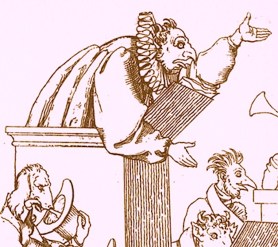
- caricature of a pompous, power-mad cleric, the kind Pope Francis is doing his best to eliminate -- by the supremely anti-clerical Martin Disteli (1802-1844)

Caricature of a pompous, power-mad cleric, the kind Pope Francis is doing his best to eliminate — by the supremely anti-clerical Martin Disteli (1802-1844)

The astonishing Argentinian Pope Francis, who is 78 and breathing with only one lung, does not expect to live long – hence is racing to do all he can, as fast as possible, to rid the Vatican of bureaucratic arteriosclerosis, closed minds, meaningless pomp and display, factionalism and infighting.

All this we have learnt from the outstanding profile that emerges from assessments of three new biographies by Eamon Duffy, writing in The New York Review of Books.

We tend to think of the young as the most obvious campaigners for radical change; as its natural leaders. But if you stop to think about it, old radicals are far more impressive. They have a lifetime’s experience of discouragement of challengers of the status quo — often, by the extremely nasty and powerful. They have heard all the very best reasons for leaving things as they are — ad nauseam.

For those of us frustrated by the pace of media’s post-Gutenberg revolution, the Duffy essay – certainly no hagiography, with its extended passages about the pontiff’s flaws and failures – was a bracing and encouraging read. Not least, about life’s capacity to surprise us. Think of the size of the institution the Vatican manages. In 2011, the Catholic Church had 1.2 billion members, tended to by 413,418 priests. Think of its age. It is two thousand years old. Age and size are typically justifications for intertia – or no change at all.

Extracts from ‘Who Is the Pope?’ The New York Review of Books, 19 February 2015 (with highlights for unrepentant skimmers):

…[A]bove all, Francis is the first pope to embrace wholeheartedly the Second Vatican Council’s aspiration for a church in which authority is shared among the whole episcopate, rather than monolithically focused in the papacy. At the end of the council in 1965, Pope Paul VI had established a permanent Synod of Bishops as a forum for continued collaboration between pope and bishops. Many saw the synod as the major expression of “collegiality” that would devolve much of the decision-making of the Roman Curia to the bishops in synod and through them to the local churches.

Such hopes proved illusory: the Roman authorities saw to it that the synod remained a powerless talking shop with no independence or initiating power. Bergoglio shared the general episcopal dissatisfaction with this situation, and as pope, in one of the most striking passages of Evangelii Gaudium, he has called for “a conversion of the papacy” on such matters. John Paul II, he reminded his readers, had invited suggestions for a renewal of the papal office to make it more visibly an office of service, but “we have made little progress in this regard.” The papacy and the central structures of the Church must heed the call to “pastoral conversion,” because “excessive centralization, rather than proving helpful, complicates the Church’s life and her missionary outreach.” In particular, Francis insisted, there had been a failure to realize a truly collegial spirit within the church, and episcopal conferences needed to be given “genuine doctrinal authority.”

He has proved as good as his word. Opening the Synod on the Family in October 2014 that, among much else, dealt with the fraught issues of sexuality, contraception, divorce, and remarriage, Francis encouraged the bishops to express their views frankly. No one should be silent or conceal his true opinions, “perhaps believing that the Pope might think something else.” To do so would be a failure in “synodality, because it is necessary to say all that, in the Lord, one feels the need to say: without polite deference, without hesitation.” These were not empty platitudes: under John Paul II and Benedict XVI open questioning of official positions was routinely branded as “dissent,” and bishops who deviated even mildly from the official line were subject to reprimand or removal. For a pope to encourage fearless public outspokenness among the bishops was a startling novelty.

… On the one hand there was the temptation to “hostile inflexibility,” of “wanting to close oneself,…not allowing oneself to be surprised by God, by the God of surprises,” clinging to “the certitude of what we know.” This was the special temptation of the zealous, and the so-called “traditionalists.” On the other hand he warned against “a destructive tendency to do-goodism” (buonismo in Italian) that “in the name of a deceptive mercy binds the wounds without first curing them and treating them; that treats the symptoms and not the causes and the roots.” This, [he said], was the special temptation of the “do-gooders,” and of the so-called “progressives and liberals.” …

Though always meticulously respectful of his immediate predecessors, the differences between Francis and them are wide, deep, and, as his handling of the synod makes clear, momentous for the church. His distrust of religious leaders who “play Tarzan,” secure in their own certitudes, does not sit well with admirers of John Paul II or his style of leadership. Though he has commended the “prudence” of Benedict XVI’s rehabilitation of the old Latin liturgy, he is suspicious of the reactionary ideological freight that the Latin liturgy often carries with it, and he despises ceremonial pomp.

… he has abolished honorific titles and dress for the younger clergy working in the Curia, since for him priesthood is essentially about service to the poor and vulnerable, rather than a symbolic status or the exercise of sacramental power.

Perhaps most momentously, Francis has pointed the church away from culture wars with secular society that were such a feature of Benedict’s papacy, toward a less confrontational approach to the social circumstances in which the faithful have to live, and a more fruitful reengagement with the church’s mission to the poor and underprivileged, in whom he sees both the natural and the most receptive hearers of the Gospel. Where Benedict was inclined to blame the increasing marginalization of Christianity in Western society on a collective apostasy rooted in the shallow materialism of secular modern society, Francis is inclined to attribute the corresponding decline in Latin America to the church’s own shortcomings:

Perhaps the Church appeared too weak, perhaps too distant from their needs…perhaps too cold, perhaps too caught up with itself, perhaps a prisoner of its own rigid formulas, perhaps the world seems to have made the Church a relic of the past, unfit for new questions; perhaps the Church could speak to people in their infancy but not to those come of age.

… Francis himself is unlikely to have a long pontificate: he is an old man, with only one functioning lung. Both in Rome and in the dioceses of the world he has been quietly putting in place men who share his vision. But the announcement in January 2015 of his second consistory for the creation of new cardinals was anything but quiet, because the pope’s startling list of the twenty cardinals-designate, fifteen of them under eighty and therefore eligible to vote in the next papal conclave, represented a positive fanfare for Francis’s alternative vision of the Catholic Church.