The unbearable unreliability of online being, and a warning deducible from the lovely speculations of Bernard Mayes about the foolishness of all such complaints

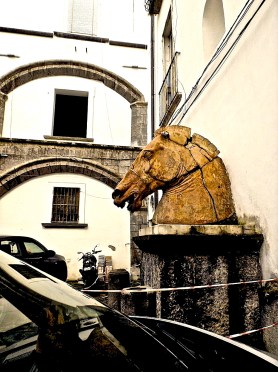
All things material must pass or be set aside – not unlike this head of a grand old equestrian statue mouldering in a seedy car park. The construction of our online lives in software — ‘pure thought stuff’ — is even more ephemeral  - photograph by MIL22

All things material must pass or be set aside – not unlike this head of a grand old equestrian statue mouldering in a seedy car park. The construction of our online lives in software — ‘pure thought stuff’ — is even more ephemeral

– photograph by MIL22

Screen Shot 2014-11-06 at 02.40.29

The original version of our masthead, using fonts offered by Wordpress.com through an arrangement with Typekit.com – then arbitrarily ‘retired’ by the blogging platform

Post-Gutenberg has been looking for a new home on the internet after an unwelcome lesson about the flimsiness of all commitments between suppliers of internet services – such as blog-hosting platforms like WordPress.com – and their too-trusting users. Any faithful reader of this blog since its first entry three years ago knows that the one element that stayed constant through experiments with layout and colours was the lettering in its masthead, a style referred to over the centuries as Fraktur, Blackletter, Gothic and – most recently — Brokenscript.

Choosing it for this site was a very small visual joke, a reminder that one of the oldest versions of the typeface was actually carved by Johannes Gutenberg himself in the 1450s, to print his mechanically lettered version of the Bible which – in the Wikipedia’s salute to it,

… was the first major book printed in the West using movable type. It marked the start of the ‘Gutenberg revolution’ and the age of the printed book in the West.

A blog becomes a sort of home on the net for its minders and contributors, over time. Watching the pixels of its masthead swim into view can be as consoling as knowing that there will soon be a mug of fragrant hot cocoa on the other side of your front door on a soggy night on which you approach it with freezing rain snaking down the back of your neck. But suddenly, last summer, that comfort was lost. Post-Gutenberg appeared at the top of each page in the timid, undersized, spidery default font for this layout (or ‘theme’). After a temporary switch to another layout to compensate for the mysterious reversion to what we never chose, it proved impossible to restore the original look of this site – not just the masthead, but the sizes of other fonts we selected with care.

As the use of these custom typefaces is not free, but requires a subscription, the usual excuse for having some part of one’s cyber life turned upside-down — ‘You get what you pay for’ – is hollow. We say this sadly, as WordPress.com – literally wonderful, in innumerable ways — has been a cross between kindergarten and training wheels in our education in unmediated publishing.

One group of WordPress users in England, at thelondonwakecompany, reacted as disgustedly as we did to the blog host’s refusal to offer any explanation for the change:

Hi, our website seems to have lost the original font we used and we can’t seem to get it back, its not in the list of fonts we can use either and it’s changed the whole look, […]There is no other font that even comes close and I’m supremely annoyed. All our marketing material matches our website especially the font and looks completely out of sync now, as there isn’t even a similar font that we can get away with. Why were we not warned of the changes that were being planned? Such a small change for you guys is a headache for us. I would like something to be done, as when I bought our site/signed up with WordPress I was not aware that they can change what they want when they want without any notification or consideration.

It was while fuming over this saga that we came across a record of a surpassing life, the obituary in The New York Times of one of England’s finest exports to the U.S.. Here was a man who somehow helped to found and run America’s only reliably intelligent and advertisement-free TV and radio channel — the Public Broadcasting Service – and personally ran its first suicide-prevention hotline, while living at a vast remove from the public eye and any popular acclaim. He was also an ex-Anglican clergyman and gay rights activist. Not until Bernard Mayes died on 23 October at eighty-five were his achievements ever celebrated in the media – an impression that the Wikipedia’s lack of any media citations before then seems to confirm.

This was the most captivating section of the NYT’s account of his passage for someone maddened by insubstantial software’s ephemerality – a reminder that even what we perceive as reliable matter is, in its essence, far from solid:

As he grew older, Mr. Mayes abandoned his Christian faith and promoted a philosophy that he said was rooted in “scientific materialism.” He called it Soupism.

“There are no gods, no magic, no final judgment and no grand plan,” he wrote on his website devoted to Soupism. “Everything from planets to humans is composed of tiny particles, energy, and nothing else. All the particles are always moving and endlessly interacting with each other as in a soup.”

He discussed the philosophy in his autobiography as well, finding a kind of transcendence in the material world.

“We are,” he wrote, “already close to, surrounded by, enveloped, as it were, in immortality: sheets formed from the cotton of the fields or the wool of the sheep; plastics boiled from minerals dug from the earth or the oil of ancient vegetation; concrete and metal poured from the rocks of the planet; all moving within the endless interchange from which our bodies are derived and from which others are already being born. Never does the process cease; never does it fail us.”
- photograph by MIL22

– photograph by MIL22

With all our e-devices, why don’t we hear from more voices like Yan Lianke’s in China and Russia? + can The Guardian’s ‘membership’ scheme set an example?

Commenters on Yan Lianke’s poetic essay from China in Thursday’s New York Times — about the task of writers — spoke for many and maybe most of his readers in expressing fears for his safety. Why, in this age of magically flexible and ubiquitous post-Gutenberg communication tools — of which China is the leading manufacturer — do we hear so seldom from voices like his in China and Russia, supporting writers like him, and giving us essential information?

A small child who has only paddled in a bathtub can have no idea of what swimming in an ocean is like. Still, the experience of being immersed in water does supply an atom or two of useful comprehension. In this way, anyone in the liberal West whose thoughts typed into comment boxes on media sites have been stifled — persistently — by ‘community moderators,’ solely because they do not suit the politics and editorial policies of a powerful newspaper, has had a taste of actual censorship, and of refusing to let the fear of humiliation, punishment and banishment (deleting a commenter’s account) shut down the flow of words.

No one expects to have to be a heroic Yan Lianke in any proud Western democracy. Yet even in these, the suppression of inconvenient views in the most scrupulously polite debate gets hardly any attention. This week, The Guardian has again been promoting the paid, tiered ‘membership’ scheme it is offering readers. No one yet knows exactly what this club is going to do for free expression, and for reining in this paper’s notoriously trigger-happy moderators (of whom we at post-Gutenberg must admit that we have no recent first-hand experience, having decided to stop going there and say what we want to about The Guardian on this site, instead.) In a post here a few weeks ago — ‘Alan Rusbridger must please not let ‘Guardian membership’ mean bread-and-circuses, and prove that he is sincere about ‘mutualised’ journalism’ — we expressed our hope that there is substance behind the alluring advertisement.

No ‘membership’ scheme will be worth the attention of thinking people unless ‘members’ are allowed to help The Guardian’s policy-makers ensure that its ‘Comment is Free’ section lives up to its name. Yan Lianke’s New York Times contribution shows just how much thinkers like him count on the West for inspiration and support. Never mind China’s grand, ancient philosophical tradition. Confucianism was never about individual freedom.

With marvellous economy and a soulfulness rarely found in Western editorialising, he has reminded us of what we forget at our peril – the importance of unencumbered truth-telling. Please pass on the link to his piece after you have read the extracts below, and a sample of readers’ comments on them – including one from someone not fluent in English, who is owed our thanks for pointing out why some of his criticisms of China could be mistaken. We wish it was within our power to invite Yan Lianke to respond in this space.

BEIJING — China’s efforts to promote socialism in the late 1950s and early 1960s resulted in what is euphemistically known as the three years of natural disasters, during which more than 30 million people starved to death. One evening when I was a young boy, not long after the catastrophe, I followed my mother as she went to dump garbage outside the wall that surrounded our village, a poor and isolated town in central China.

Holding my hand, my mother pointed to the white clay and yellow earth of the wall, and said, “Son, you must always remember, when people are starving to death they may eat this white clay and elm tree bark, but if they try to eat that yellow earth or the bark of any other kind of tree they will die even faster.”

Mother went back inside our house to cook and left behind a long shadow. I stood in front of the edible clay gazing out at the sunset, the village and the fields, and an enormous sheet of darkness gradually approached.

[…]

China may boast of having several thousand years of civilization, but when an old man collapses in the street, everyone refrains from helping him out for fear of being implicated, even as the old man bleeds warm, red blood. What kind of society do we live in when a pregnant woman dies on the delivery table and all of the medical technicians flee in order to avoid responsibility, leaving behind a tiny soul uttering a feeble cry?

It is a writer’s job to find life within this darkness.

I am reminded of Job, in the Old Testament, who after experiencing countless misfortunes said to his wife as she was urging him to curse God, “Shall we indeed accept good from God, and shall we not accept adversity?” This simple response demonstrates that Job understood that his suffering was merely God’s way of testing him, and was evidence that darkness and light must exist together.

I don’t pretend that I have been uniquely selected by God, as Job was, to endure suffering, but I do know that I am somehow fated to perceive darkness. From these shadows I lift my pen to write. I search for love, goodness and a perpetually beating heart.

At a symposium last week, President Xi Jinping met with a group of artists, including the Nobel Laureate Mo Yan, and talked about the value of art in China. According to the official China Youth Online, he said, “For art workers to be successful, they must breathe together with the people, share their fate and feel their feelings, rejoice at their joy, grieve at their grief, and serve the people like a willing ox.”

But only the pursuit of true art, unencumbered by anyone, can help us find the delicate light, beauty, warmth and love that are hidden in the darkness.

Some comments by his readers (not in their original order):

William Hathaway

… Despite the unfashionable earnestness in this essay, I applaud its plea for cosmopolitan artistic freedom in the tradition of Romain Rolland. I’m sure that Yan Lianke will pay a real price for it.

ronnyc

I was hoping to read that his name was a pseudonym, but I didn’t. It is a beautiful and incredibly brave piece of writing. I just hope it doesn’t cost him his freedom, or worse.

Andre

Absolutely correct…. Confuciusm can’t mesh with the mordern global system… Neither can traditional Judaism/Christianity/Islam. Te only thing that meshes is money. It’s the new world order…

Tim McCoy

“…now that money and power have replaced socialism and capitalism…

Though Yan Lianke seems like writer of some brilliance, I think the above statement is fundamentally flawed. Capitalism is nothing if it is not about money and power.

Stranger [ someone apparently posting from California ]

The author only pointed out one side of the problem.

Why the old man fell on the street and nobody dared to help him? Because there was a famous lawsuit in Nanjing in which an old lady framed a young guy who actually helped her get up and the judge condemned him to pay about 12,000USD to that old lady.

And why the medical technicians flee when the pregnant woman died? She died from amniotic embolism which is difficult to diagnose and extremely dangerous. A hysterectomy surgery might have saved her life but unfortunately her husband refused this option because he was worrying about if his wife was going to be able to have the second baby. After the pregnant woman died, the family sent dozens of relatives trashed the hospital, that was why the doctors and nurses had to flee. IN china, every year several doctors died of medical disputes, most of them are stabbed by angry/crazy patients or their family members.

well, the other side of story only makes China even a worse country. That’s the reality of China. Democracy is not the medicine for its illness right now, seriously. With such a low level civil consciousness, democracy will just be abused. china has a long way to go. let’s take it slowly.

A Sincere but Puzzled Han Chinese Girl [ Guangzhou, China ]

Stranger, you speak out what i’d like to clarify here. Many thanks

Richard Luettge 

The author may be fated to perceive darkness, but if so, he would perceive darkness wherever men walk in numbers, and not merely in China. The challenges he writes of aren’t uniquely Chinese challenges but human ones and timeless ones. We study these challenges in every society, in part through art, in part through philosophy, and the purpose of such study is to find the “delicate light, beauty, warmth and love that are hidden in the darkness”. More, it’s to find purpose in the darkness.

Others labor elsewhere, but his challenge is to find these qualities in China.


Post-Gutenberg media could give have-nots an essential hand in shaping history — in the Studs Terkel tradition

rose seeds closeup

Last week’s entry on David Lankes’s ideas for redesigning libraries to be centres of brimming invention and maximally engaged enlightenment for communities led to two discoveries. The first was a new post on his personal blog about his recovery from a terrifying illness — a turnaround owed to a harrowing but successful stem cell transplant — which, we hope, will be swift, strong and complete. In this report, he tells – in passing – of having been the target of exceptionally nasty attacks by some fellow-librarians.

All genuine reformers have stories like this – and the hostility is often in direct proportion to the importance of the changes being seeded and sown. Anyone who doubts this need only read Tuesday’s report in The New York Times about the resentment at the World Bank of a reorganisation instigated by its president, Dr. Jing Yong Kim, who has also – as an expert in fighting epidemics — made it his personal mission to put the Bank’s resources at the disposal of Ebola-stricken African countries at a speed insiders thought impossible, before the fact.

Next, we learnt about a contest organised by the Knight Foundation in which competitors are invited to submit schemes for turning libraries into more or less the places Lankes envisages – although it does not actually say so in its brief for contestants. This organisation’s charter entails financing ‘transformational ideas that promote quality journalism, advance media innovation, engage communities and foster the arts.’

The proposal of Phil Shapiro, the other future focused librarian mentioned here last week, captured our attention because it describes – down to its precise technological components – a way for ordinary citizens to create biographical and historical multi-media records by interviewing each other. Any fan of Studs Terkel’s brilliant and moving Working: People Talk About What They Do All Day and How They Feel About What They Do (1974) hardly needs an explanation for why that is such a good idea in itself. The contestants clarify their ideas in a crisp interrogation.

In one sentence, describe your idea as simply as possible.

Video booths at public libraries that allow community members to interview other community members over the web with the video and audio captured locally in high quality — and merged after the fact using free, open source software or a web video editing service such as Wevideo.com

Briefly describe the need that you’re trying to address.

Libraries are about the sharing of ideas. Some of the best ideas are in the minds of people who are not famous and who also do not have the video or computer skills to create their own YouTube videos. By giving community members a chance to interview each other, many interesting new ideas will be uncovered that will spark new conversations and new thinking about communities.

Reading that Q and A revived a memory of how social inequality can unbalance the historical record – and of an unsuccessful attempt, a few years ago, to lobby for a remedy at famously left-wing Berkeley. It inspired the following contribution to the feedback that Knight wants members of the public to leave on the competing plans — which fits this blog because it could help some suffering traditional publishers, writers, artists and media workers to understand why it isn’t just that the post-Gutenberg revolution cannot be stopped. Painful as it is for us, it should and must continue, with our encouragement and support.

… Years ago, in researching a book about the culture and characters in the most cosmopolitan segment of American farm country – the Napa Valley — I drew on a superb collection of transcripts from the Bancroft Library’s Regional Oral History Project at Berkeley. Comparing what the same subjects told me with what they were willing to tell the Bancroft interviewers was fascinating.

A decade or so after that, I rang the BROHP director with a proposal to interview someone in California ranch country, a woman of about my mother’s age who was the librarian in a small town to which she and her husband had migrated when he got a job as a ranch hand nearby. She had a sharp and original mind, a biting wit, and a fabulous hoard of stories about her past — for instance, surviving the Depression with her family, as a girl, helping sheep to give birth, and working at two jobs to help keep the family afloat.

I told the Bancroft director: most of the records of the local historical society focus on the top strata of the ranching communities in the region. What if an interview with this particular subject was the first in a series about families at the other end of the economic scale?

He said that that wouldn’t be possible. His organisation relied on donations from the outside to supply the money for the video recording equipment, video editing, travel, and so on. The reason why the Napa Valley was so well represented in the Bancroft collection was that the ‘wine industry’ had been outstandingly generous with funding. But wouldn’t that unbalance the history of rural California, I asked. His answer amounted to a shrug. He agreed with me, but didn’t know how to solve the problem.

I don’t know that the Bancroft’s oral archive still has this flaw. I hope that the bias has been corrected …

roses setting seeds

Roses setting seeds in a drought (part 2 of a story in pictures)

Roses setting seeds in a drought (part 2 of a story in pictures) — postgutenberg [at] gmail.com