‘Mass surveillance’: a top spook is allowed an intelligent and revealing say, at last

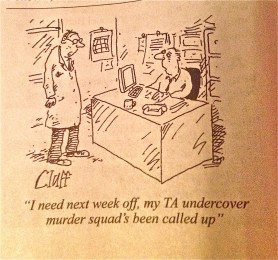
With the apparent arrival of see-through spying, can transparent black ops be far behind? - 'Cluff' for Private Eye

With the apparent arrival of see-through spying, can transparent black ops be far behind?
– ‘Cluff’ for Private Eye

As this is not really a personal blog, let us say simply that, for the second December in a row, we find ourselves grieving. Two losses. Two who could not be closer to us: she, just after Christmas, last year; he, last week.

He could be morose and rage like thunder, yes. But laughter was what came to him most naturally. He would have loved this enlargement of a drawing at the bottom of an inside page of a recent Private Eye that there was no time to send him. For weeks, we’d been discussing — in wondering tones — exactly how the spies of Britain’s GCHQ and America’s NSA were going to do their jobs ‘transparently’ with members of the judiciary and politicians breathing hotly down their backs.

He, with an insider’s knowledge of these things – in another part of the world – would have warmly endorsed points made by a former top spy in the aftermath of the Snowden leaks. David Omand is the one truly thoughtful debater who, as far as we have noticed, has been given a chance to make the case for the other side of government data-gathering about ordinary citizens to a politically liberal audience. We have not seen his reflections given any space in the newspapers**, but paid close attention to what he said at a forum organised by the Labour Campaign for Human Rights – ‘GCHQ and the fight against terrorism: did UK surveillance go too far?’ — where the speakers included the Wikipedia founder Jimmy Wales. Here was an event that made us think — at long last, balance.

Not as an endorsement, just good food for thought, an extract from live reporting of the event by a Guardian reporter — part of David Omand’s contribution to the conversation at the Houses of Parliament on 17 December:

7.14pm GMT Sir David Omand, the former head of GCHQ, speaks next.

He is speaking on his own behalf, he says.

He says these revelations would not have come as a shock if the Guardian had done more homework – “there are books written about all this stuff”. There is a lot of “synthetic shock horror”, he says.

7.17pm GMT There is increasing demand for more data about criminals from law enforcement, Omand says.

Supplying those demands is driven by the ever-improving electronic communications devices.

The ethical constraints are the third key force here, he says. It is our legitimate concern for privacy that constrains how such data is used.

We should be looking for a point of stable equilibrium between these three forces, he says.

Much of what has been reported about what Snowden stole has been misleading, he says.

A “major category error” runs through the Guardian’s reporting, he says. It is journalistic sleight of hand to confuse access to fibre-optic cables with mass surveillance. “We are not actually subject to mass surveillance in this country”, but we are “blessed” with an intelligence community that has “bulk access” – but that is different, he says.

7.23pm GMT

He has seven points to make.

He believes in human rights and the privacy of family life.

But also of protecting the weak from those who would harm them.

For a long time we have sanctioned intrusion by law, he says. The European convention on human rights states that states have the right to protect their citizens, but there has to be oversight and investigation of abuse, and redress if abuse is found.

The scale of change needed to deal with the internet by law enforcement today needs to be recognised, he says. It is the medium of choice for enemies of society because it offers multiple means of hiding your identity, Omand says. Complete anonymity is not desirable and should not be a policy goal, he says.

The security services should be able to find and access the communications of those who mean to do us harm, he says. You need powerful tools for that, and that’s where bulk access comes in, and if you don’t allow the services those tools, you won’t be able to stop the terrorists.

You should be proud that in this country we have people of the skills and dedication to be able to do this, he says.

Oversight and regulation and judicial determination that the actions are lawful are also necessary.

In this security space it would be absurdly self-defeating to inform suspects they were under surveillance or tell them how they were. So the authorities cannot be transparent – “they can however be much more open about the purposes of this activity and the nature of the work that is being done”, he says.

You don’t need to read the Guardian to find out about this – it was already out there. For some reasons government was reticent about giving a full account, he says.

So the ISC [ the Intelligence and Security Committee of Parliament ] will have to continue to have private sessions, he says.

7.26pm GMT

[…]

If you follow those seven steps you end up with a sensible agenda for change, Omand says.

[…]

Speaking personally, he says he didn’t devote most of his working life to fighting the cold war in order to introduce new totalitarianism, all-knowing mass surveillance.

** A quick post-posting check shows that he was permitted to contribute an opinion piece about the Snowden leaks on the Guardian site in September — but with low reader interest guaranteed by its placing in the Comment-is-Free section with commenting turned off. Erm — well, yes.

The Supreme who reads Proust to live by, and to understand his fellow human-beings

Marcel was surely here: a Parisian backstreet not far from Sacré Couer - postgutenberg [@] gmail.com

Marcel Proust was surely here: a Parisian backstreet not far from Sacré Couer
– postgutenberg [ at ] gmail.com

‘Artistic people aren’t respected.’ We quoted someone to that effect a year ago – a close relation of someone else of strikingly conventional views, but unusually plain-spoken, who says frankly, ‘I want power,’ and would like to have been a lawyer or politician.

We thought of her as we read a recent interview with an American Supreme Court judge, Justice Stephen Breyer, translated by The New York Review of Books from a French literary journal, La Revue des Deux Mondes. Justice Breyer was talking with marvellous fluency about his near life-long love of Proust’s In Remembrance of Things Past. The edited transcript of the conversation reads like an early Christmas card – except that the most winning images of doves, poinsettias, Boticelli angels and white-bearded old men clad in scarlet, humping sacks of gifts, cannot compete, as channels to transcendent happiness, with what he says about the supreme importance of literature:

Q: This year marks the centennial of the publication of Swann’s Way. In your opinion, what is the novel’s greatest contribution?

A: What I especially remember is the meditation on the passing of time at the very end of that volume, when the narrator strolls through the Bois de Boulogne just as Odette used to do so many years before. But the forest he walks through is no longer Odette’s forest. Time has passed. Women are no longer dressed the same way, the fashion has changed, automobiles have made their appearance. And as he watches the women promenade down the chestnut-lined allées, the narrator wonders: “Where has Odette’s world gone? Has it vanished forever?” The answer of course will come much later, in Time Regained. This world still exists, but it does so in our memory, in our recollections, and what gives it new life, what rescues it from oblivion, is literary creation. It is the work of art that allows us to rediscover lost time.

Q: During a lecture you delivered at New York Law School, a student asked you what major you would recommend he select in order to become a lawyer. Your answer was quite surprising: you suggested that he choose “whatever major you want, as long as it has nothing to do with the law.” You, in fact, studied philosophy at Stanford and Oxford before studying the law at Harvard. How can the humanities or foreign languages be an asset for a jurist?

A: It’s true, I’ve always thought that it was not particularly useful to study law as an undergrad. We are only allowed to live one life: it’s the human condition, there’s no escaping it. In my view, only by studying the humanities can we hope to escape this fundamental limitation and understand how other people live. Because literature, history, or philosophy all provide extraordinary windows on the world. Foreign languages, too, are fundamental.

The French language gave me an entrée into another culture. It allowed me to discover different means of expression, a different way of life, different values, a different system of thought. Because when you’re a judge and you spend your whole day in front of a computer screen, it’s important to be able to imagine what other people’s lives might be like, lives that your decisions will affect. People who are not only different from you, but also very different from each other. So, yes, reading is a very good thing for a judge to do. Reading makes a judge capable of projecting himself into the lives of others, lives that have nothing in common with his own, even lives in completely different eras or cultures. And this empathy, this ability to envision the practical consequences on one’s contemporaries of a law or a legal decision, seems to me to a crucial quality in a judge.

… Literature is crucial to any democracy. Take the field of women’s rights, for instance. You have to read Mme de Lafayette’s La Princesse de Clèves to realize how narrow a range of opportunities were available even to a highborn young woman in the seventeenth century. They had a choice of either marriage or the convent. It only got worse in the nineteenth century, because along with the pressure of the church, there was the male stranglehold on all property rights. It’s evident in Balzac’s novels, for example. In Balzac, there are mainly two types of women: prostitutes and brebis, or ewes, who are all victims. Eugénie Grandet is a victim. Madame de Mortsauf, in Le Lys dans la vallée (The Lily of the Valley), is one too.

… Personally, I get a great deal of pleasure from writing. I take great satisfaction in drawing out the substance of matters that are separate and unrelated and giving them form on paper, through writing: that too is a creative process.

Q: In France, there is a very special prestige that attaches to being a president who is a “man of letters” or a “friend of the arts.” In the United States, the label of “man of letters” seems to be much less valued in the realm of politics. A presidential candidate or a sitting president is unlikely to express his or her literary tastes publicly, much less claim to be “cultivated.” How would you explain this difference between the two cultures?

SB: I think that Tocqueville can help us to understand that difference. He very rightly pointed out that there is a mistrust of elites in the United States. […] Now, in France, art and power have always been bound up together, whether under the monarchy or in a republic. You will not find the same proximity between the spheres of power and culture in the United States.

… [T]heater tickets—could they be considered basic necessities, and could they be regulated as such? The majority thought the theater was not a necessity. The great Justice Oliver Wendell Holmes Jr. replied in his dissent: “We have not that respect for art that is one of the glories of France. But to many people, the superfluous is the necessary.”

Q: You often emphasize the beneficial role of artistic creation for all of us.

A: To me, the distinguishing characteristic of human beings is the desire to create order out of chaos, to give form to the universe. We are surrounded by colors, shapes, and sounds. We can arrange all these things in an attractive and constructive manner, as in a painting or a symphony. And that is what Proust did with his writing. Of course, he was supremely talented—but I firmly believe that every one of us can, to some extent, try to establish order amid chaos.

If Silicon Valley knew any history, would it be encouraging the destruction of artistic copyright — as energetically as it fights infringements of technology patents?

‘Venus and Cupid,’ Cranach the Elder, 1509

German artists of the Renaissance, inspired by Italy, took off in other directions: ‘Venus and Cupid,’ Cranach the Elder, 1509

There is something wonderfully right about a son of Italy, Federico Faggin, being the designer of the ur-ancestor of the miniature electronic brains at the core of our computers, tablets, and every other intelligent device in our nearly all-digital, all-wired existence.

Italy was the first place in Europe to experience the damburst of transformative creativity we call the Renaissance. The worship of invention and innovation that defines Silicon Valley is easily traced across six centuries to Veneto, the region in which Federico, the architect of the first commercial microprocessor, was born in 1941– with today’s date on his birth certificate. Vicenza, the town on that document, is famous as the home and chief showplace of the work of Andrea Palladio, the most influential architect of the Renaissance and, experts say, Western architectural tradition. We have been amused to discover, in looking up his lifespan, that yesterday was Palladio’s birthday – in 1508.

None of these are connections we have ever heard anyone in Silicon Valley make – even if Federico is mentioned in the Wikipedia entry for Vicenza. Why, you might ask, do they need making? Why should geniuses frantically multitasking to design our collective future stop to trace the antecedents of their grand enterprise?

Well, we were dismayed by the green light a U.S. federal judge gave Google last month, which lets the search engine leader continue to scan and upload millions of books online. It can do this without paying living authors of any of those print originals a cent for the free access it gives any web surfer to sections of the texts. This, as Google insists and the judge accepted, is an important act of cultural generosity. All very well, we agree, until you consider that it allows Google itself, already one of the world’s richest companies, to grow even richer from selling advertising space in its vast library of scanned texts, Google Books – while making no contribution to easing the notorious financial uncertainty of book-writing, or reversing the comprehensive destruction by the digital revolution of too many struggling writers’ livelihoods.

Google’s defence for this seeming callousness is all tied up with the scholar Lawrence Lessig’s insistence – enshrined in the ‘free culture’ movement – that loosening copyright laws will permit more ‘sharing’ of artistic and original works and a flowering of collective creativity; conversely, that the enforcement of traditional copyright blocks such creativity.

Too many of his ardent disciples are also apt to parrot the notion that all creativity is ultimately derivative and builds on the work of others. Fair enough, until that truism is wielded as a club, justifying the smashing of an artist’s right to earn income from the labour of shaping derivative inspiration. This argument is particularly unwelcome from anyone working in, say, Google – famous for its ferocious secrecy about its equivalent of Coca-Cola’s secret recipe, the algorithms on which its search engine runs. These are thickly enmeshed in protective patents. There is incontrovertible proof of the company’s recognition of intellectual property rights – but only in its own sphere, technology, where it follows the conventions for acknowledging in cash its indebtedness for creative opportunities. Google has for years been paying royalties to Stanford, the university where its founders Sergey Brin and Larry Page developed the algorithm they used to set up shop – a total of $337 million so far.

If Silicon Valley-ites knew their history, would Lessig’s wish to dilute if not dismantle copyright have proved so popular? Technologists know enough about the importance of the Renaissance for Bill Gates to have snapped up Leonardo da Vinci’s Codex for $30 million in 1994. But do they realise that the expression of personal, individual creativity was the key to that revolution? That in the Renaissance, artists were liberated from the constraining group-think and rigid rules of minds enslaved to medieval church doctrine?

Giorgio Vasari, a painter of that era and also the first historian of Italian art is said by the historian John Hale to have looked for maniera – the manner in which an artist expressed himself, a novelty after the Middle Ages’ convention of anonymous stonemasons toiling on great Gothic cathedrals, humbly suppressing their individuality in the service of God.

That individuality was of the essence of the Renaissance was also discernible in the way each country – and individual artists in it – reinterpreted the marvellous innovations in Italy in its own way. As Hale put it, ‘Whatever was made in Italy in the fifteenth and sixteenth centuries … met two major obstacles: personal genius and shared temperament – the stereotypes of national character …’. This accounts, for instance, for the strikingly different treatment of the female subjects of the German painter Lucas Cranach (1442-1573), whose ‘Venus Restraining Cupid’ Hale calls ‘the first frontally nude goddess in German art.’

Technologists need to help artists to prosper from the expression of their individual visions. In the eight years Google spent fighting the legal battle over its book-scanning, couldn’t it have found a way to use its clout and brilliant inventiveness to establish micropayments as a way to compensate artists, writers and musicians – the way Amazon has taken online retailing from a futurist’s pipe dream to everyday reality?

… We must note in closing that in years of delightful conversations with Federico and his lovely wife Elvia – also born in Vicenza, and whom he considers indispensable to his achievements in Silicon Valley – he has never sought any reflected glory from the Renaissance, nor drawn any attention to Palladio’s stamp on the appearance of his birthplace. His modesty is exemplary. Still, we doubt that he would disagree with this entry in post-Gutenberg, his eldest child being not a technologist but a painter … of whom we will reveal just a little more, anon.

Buon compleanno, Federico!

BLUE BACKDROP faggin