Spooky yarn-spinning: just how did the Guardian and New York Times get the surveillance story back-to-front?

Snowden surveillance saga: leaving the tech giants out will be remembered as clickbait-shaped storytelling with a touch of the surreal  -drawing by Martin Disteli (1802-44)

Snowden surveillance saga: leaving the tech giants out will be remembered as clickbait-shaped storytelling with a touch of the fantastic
– drawing by Martin Disteli (1802-44)

… or why most editors and writers specialising in technology see no actual scoop in the Snowden leaks …

Sometimes the person dancing backwards and in high heels – famously, Ginger Rogers, compared with her dance partner Fred Astaire – is a man. In this instance, he is the writer and new media entrepreneur Michael Wolff. With a set of super-sensitive manoeuvres that Ginger would have envied, he wickedly added his voice last week to the revelation that the ‘surveillance business model’, not exactly news, has been mistaken by some newspapers for a creepy invention of government spooks bent on invading our private acts and communications.

His ostensible topic was a book published earlier this month about a 1971 break-in by activists that revealed the spine-crawling extent of FBI surveillance under that agency’s notorious founder, J. Edgar Hoover, who ran it from 1935 to 1972. The inside story of the break-in had already been told in another book, Wolff said, eleven years ago. He was briefly puzzled by the huge attention paid to its forty-year old subject in recent weeks in headlines of the two old print stars of the Snowden saga. ‘Earlier this month, The New York Times, Guardian and other media outlets “revealed” the identities of several people who burgled the FBI in 1971,’ was how Wolff’s s Guardian sub-editor encapsulated his gently sardonic amazement. Wolff himself described how the answer came to him, as follows:

[W]hy, 11 years later, was I reading about this as though, mirabile dictu, the lost secrets of the past were suddenly being revealed and now making headlines everywhere? … In the age of Snowden, revelations about government spying are not just hot stories, but suddenly part of a vast new narrative canvas and moral tale. … [I]t is apparently possible to ignore what is known – even in the age of Google – and, when convenient, reposition it to be new and useful again. … There is not just a new age of political activism, à la Edward Snowden, but also of story telling activism.

Quite, and successful storytelling activism makes irresistible clickbait that works even better when it becomes outrage that goes viral when the audience confuses the story with other – justified – targets for anger. At post-Gutenberg, we have had irritable email from dear readers, including two Americans, in which a complaint about our refusal to be impressed by the Snowden narrative has billowed into a polite rant about U.S. military actions and policy – the use of drones at all, or against poor countries, nuclear testing, Guantanamo, and so on – as if the correspondent had never met the idea of a non sequitur.

Let us be clear: post-Gutenberg is chilled to the viscera by the thought of all military weapons, used by anyone, for any reason – and has the identical reaction to any mention of torturing prisoners.

The real surveillance story’s only connection with all that is the use by the UK and US governments of the same tools invented and deployed by large US companies. As Andrew Leonard wrote in Salon last summer in ‘Netflix, Facebook — and the NSA: They’re all in it together,’ expanding on a genuine Wall Street Journal revelation about free surveillance software available to anyone to use:

By making it economically feasible to extract meaning from the massive streams of data that increasingly define our online existence, Hadoop effectively enabled the surveillance state.

And not just in the narrowest, Big Brother, government-is-watching-everyone-all-the-time sense of that term. Hadoop is equally critical to private sector corporate surveillance. Facebook, Twitter, Yahoo, Amazon, Netflix — just about every big player that gathers the trillions of data “events” generated by our everyday online actions employs Hadoop as a part of their arsenal of Big Data-crunching tools. Hadoop is everywhere — as one programmer told me, “it’s taken over the world.”

… In the past half-decade Hadoop has emerged as one of the triumphs of the non-proprietary, open-source software programming methodology that previously gave us the Apache Web server, the Linux operating system and the Firefox browser. Hadoop belongs to nobody. Anyone can copy it, modify, extend it as they please.

They’re all in it together. The spooks and the social media titans and the online commerce goliaths are collaborating to improve data-crunching software tools that enable the tracking of our behavior in fantastically intimate ways that simply weren’t possible as recently as four or five years ago. It’s a new military industrial open source Big Data complex. The gift economy has delivered us the surveillance state.

… Hadoop quickly secured the critical mass of cross-industry support necessary for an open-source software program to become an essential part of Internet infrastructure. Even engineers at Google chipped in, although Hadoop, at its core, was basically an attempt to reverse-engineer proprietary Google technology.

People reading those extracts might wonder why Hadoop and not Snowden was the surveillance sensation of 2013. Two answers — aside from the plain truth, verifiable by five seconds spent typing the appropriate search terms into a Google box, that Hadoop has been snapped up enthusiastically by both The New York Times and The Guardian for spying on their readers:

In the way traditional media work, writers who understand technology do not get much of a hearing from the editors at the top, who specialise in politics. The technology writers usually work for sections that cover business and, or, science. In other words, they are treated as incomprehensible boffins or wonks.

Why, demanded one irate friend, an American poet, didn’t they and post-Gutenberg – who has also served as one of those gnomes — tell everyone else about government surveillance if we knew all about it long before the Snowden hooha? Erm, well, we did … We distinctly remember confessing to him, years ago, our anxiety about email being read by eyes for which it was not intended, including those of spooks. And, quickly noting his sceptical reaction, we realised what he was only thinking but others, equally oblivious but less tactful, had stated bluntly: ‘You’re being paranoid.’

Being able to pin information about technology to a face, a personality, an identity, and ideally – drama — humanises it. That can suddenly magnetise people who usually ignore it for good reasons: it is complex, and learning about it and the culture and ambitions of Silicon Valley consumes attention they would rather focus elsewhere. But because they do not really understand it – even though some political editors, like Alan Rusbridger at The Guardian, have a hobbyist’s deep fascination with the ‘mechanics’ of their devices and the net – they are easily misled. Think of the millions who really believe that Steve Jobs invented the computer revolution, or that Al Gore had something to do with the birth of the internet.

To reach Joe and Jane Everyone and work them into a tizzy, news of our subjugation to the ‘surveillance business model’ had to be delivered to them as visions of nightmares about a totalitarian state — fronted by the ghostly and bespectacled clever-boy-next-door visage of Edward Snowden, the high drama of his secret-stealing and travails as a fugitive.

Not so much activism as storytelling activism, just as Wolff says.

But the extent of yarn-spinning always gets out, eventually, and diminishes trust in the media. As we keep repeating on this blog – tiresomely – because that trust should not be sacrificed to clickbait, another way of financing and structuring media has to be found – and soon.

Zounds! At last print, led by The New York Review of Books, picks up the real surveillance story: the NSA and GCHQ spooks are followers, not leaders

24/7 surveillance: eyes, cameras, mirrors … cameras in and behind mirrors? - postgutenberg[at]gmail.com

24/7 surveillance: eyes, cameras, mirrors, clear and fuzzy views … cameras in and behind mirrors?
– postgutenberg[at]gmail.com

Not for ages has there been a pudding quite as over-egged as the one presented as the news story of 2013 – the Orwellian mass surveillance exposé which, as it unravels, shows the UK and US governments hardly initiating nonstop monitoring but, rather, striving to keep up with companies like Facebook, Apple, Microsoft and Google in gathering intimate information about us and watching what we do.

Why are you learning about this on a blog, not on the front page of any well-known newspaper? Because any dissenting voices in the new ‘participatory media’ – the blogosphere, online-only journals, social networking sites and other evolving sources of facts – are still drowned out by the megaphones of the brand names at the top of the old media pyramid, names we were brought up to revere. Until those amplifiers are shared through a formal restructuring of media ownership and operation – which could be a long wait — correcting misguided and misleading information will tend to be maddeningly slow, no matter how big the story.

Two of the finest of the old guard, The Guardian and The New York Times, have yet to give any sign of noticing the shifting narrative about surveillance. This is unsurprising. They love the attention they have won from pinning Big-Brother-run-amok behaviour exclusively on the UK and US governments, and the hailstorms of congratulations from commenters and colleagues in other parts of the media that they unwittingly led astray. Both newspapers chose – apparently without much critical thinking – to gratify Edward Snowden’s wish to be fêted as a hero for torrential leaking of extremely sensitive information related to national security. 

The clearest de-bunking of the myth constructed from the Snowden leaks has come from The New York Review of Books – it so happens, after someone at post-Gutenberg wrote late last November to two editors on that publication, the editor-in-chief, Robert Silvers, and the one in charge of covering technology. The email was not about mass surveillance. But it did include a link to this blog when our home page displayed more than one post deconstructing the souped-up hullabaloo with our usual careful citations, and pointing to corporate technology giants as the round-the-clock watchers we should really be worrying about – even if the NSA appears to have outdone them in spying techniques (see yesterday’s ‘N.S.A. Devises Radio Pathway Into Computers’ in the NY Times).

In the week in which we communicated with that rightly esteemed publication, the NYRB’s contribution to the discussion was ‘The NSA’s Threat to Global Free Speech,’  to be followed shortly by ‘The Snowden Leaks and the Public,’ and ‘The NSA on Trial’. In fact, searching on ‘NSA and NYRB’ brings up a first page of Google links to articles in that publication last year all singing the same tune as The Guardian and The New York Times.

Then came an abrupt switch in direction. … Was it a mere coincidence that last week, about six weeks after the NYRB received a web address for post-Gutenberg — and roughly as long as it takes a publication as methodical as that Review to put together a report — its site featured a piece titled, ‘How Your Data Are Being Deeply Mined’, beginning,

The recent revelations regarding the NSA’s collection of the personal information and the digital activities of millions of people across the world have attracted immense attention and public concern. But there are equally troubling and equally opaque systems run by advertising, marketing, and data-mining firms that are far less known. Using techniques ranging from supermarket loyalty cards to targeted advertising on Facebook, private companies systematically collect very personal information, from who you are, to what you do, to what you buy. Data about your online and offline behavior are combined, analyzed, and sold to marketers, corporations, governments, and even criminals. The scope of this collection, aggregation, and brokering of information is similar to, if not larger than, that of the NSA, yet it is almost entirely unregulated and many of the activities of data-mining and digital marketing firms are not publicly known at all.

Compare that with part of our own offering on the subject, in the week we wrote to the NYRB,  titled, ‘In the shift “from God to Google” do we want our spooks stuck in the age of typewriters …?’:

The Guardian – railing ad nauseam about spooks — is oddly tongue-tied about corporate surveillance. The explanation for this is surely the potential embarrassment of having to admit the true extent of the newspaper’s own monitoring of its readers’ behaviour.

[…]

Onora O’Neill, a down-to-earth philosopher — specialising in justice, public trust and accountability – who is also a member of the House of Lords (Baroness O’Neill of Bengarve) commendably unaffiliated to any political party, is one of the few sounding this particular alarm. ‘Insofar as [government spies at the NSA and GCHQ] collect content, I might be … worried,’ she said recently, ‘but by the same token I would worry equally about Facebook, who collect content, and in particular a lot of personal content.’

The NYRB added, in the same report on data mining:

[W]e may be more concerned with government surveillance than with marketers or data brokers collecting personal information, but this ignores the fact that the government regularly purchases data from these companies. ChoicePoint, now owned by Elsevier, was an enormous data aggregator that combined personal data extracted from public and private databases, including Social Security numbers, credit reports, and criminal records. It maintained 17 billion records on businesses and individuals, which it sold to approximately 100,000 clients, including thirty-five government agencies and seven thousand federal, state, and local law enforcement agencies.

Again, compare that with a point made here earlier. Last September, this blog warned that the blinkers needed to come off too many commentators on the NSA and Britain’s GCHQ – to let them appreciate that we should be protesting not just about spooks but anyone amassing personal data about us. In an entry about reader-commenters on newspaper sites correcting the unbalanced coverage of mass surveillance, we said:

Stores of information, once they are gathered, can acquire new owners. 

By the end of 2013, when the Guardian and New York Times were running editorials campaigning for the virtual canonisation of Snowden, the Guardian’s commendably independent-minded sister publication, The Observer, was changing tack in the same direction as the NYRB. The standfirst for an editorial there read: ‘Digital behemoths have perfected surveillance as a business model.’

Did the ‘digital behemoths’ scream in protest about that attack on nonstop surveillance as their ‘business model’? On 30 December, The Guardian, perhaps in sympathy with their plea – and conceivably worried about losing its own right to spy on readers, justified as market research — actually ran a blog post by an American academic, titled ‘The primary NSA issue isn’t privacy, it’s authority’:

[O]nce we say some amount of data is too much to have, then we will end up debating the line around too much knowledge and that is a line I never want to see drawn. If we start to say that bad things can happen merely if knowledge exists, then too soon we fall into the trap of controlling the extent of knowledge – who may know what and how much they may know and thus who may say what to whom.

Imagine how the spooks at the NSA and GCHQ must have smiled about reading that.

N.B.: As we post, The Guardian site has a lamentation by Senator John McCain about ‘overreach’ by the NSA. In a menu of other offerings in the right-hand column on the same page, there is this bit of clickbait: ‘US will not enter bilateral no-spy agreement with Germany … Despite assurance from Barack Obama, United States has not ruled out bugging political leaders’ calls, claims German paper.’

We somehow doubt that much of what the NSA or GCHQ do will change, after a crowd-calming interlude of more or less cosmetic modifications of their practices. Spies can no more stop spying with every available advance on James Bond’s arsenal of gadgetry than journalists can stop wheedling secrets out of sources with charm, or casinos discourage impulsive and compulsive gambling, or prostitutes start dressing like nuns …

Britain’s government ‘moderates’ The Guardian as a commenter on its surveillance policies, and The New York Times hides ex-General James Cartwright

door

After the horror of thought police, the most terrifying aspect of the society George Orwell anticipates so brilliantly in 1984 is that almost nothing about its regulations or the behaviour of the people running it makes any sense.

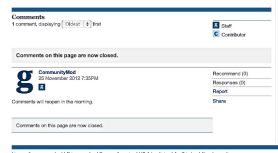
Why was The Guardian so unembarrassed by the inconsistency of making such a fuss about being forbidden by Government Communications Headquarters (GCHQ) to publish any more revelations about the extent of UK and US government spying on the public – when this newspaper also shuts down disclosures about and discussion of matters it considers sensitive?

For instance – what? For instance, reader commentary on the Leveson Inquiry into press ethics and conduct. As more than one commenter pointed out, on the same web page as the newspaper’s unconvincing attempt to justify its censorship, Lord Justice Leveson himself had been permitting far more revealing accusations and evidence to be aired at his hearings. guardian notice Complaint by Guardian editor Alan Rusbridger:

The mood toughened just over a month ago, when I received a phone call from the centre of government telling me: “You’ve had your fun. Now we want the stuff back.” There followed further meetings with shadowy Whitehall figures. The demand was the same: hand the Snowden material back or destroy it. I explained that we could not research and report on this subject if we complied with this request. The man from Whitehall looked mystified. “You’ve had your debate. There’s no need to write any more.”

As a reader identified as ‘Dr. Gabriel Mayer’ on the site of The New York Times pointed out, about the tunnel vision in condemnations of surveillance focused exclusively on the National Security Agency:

What really surprises me is this universal alarm regarding the NSA and a possible sinister utilization of data should something unpredictable and Orwellian take place.

If …… and when …

But right now this comment is being monitored by Google and Apple (I am on one of their products) for sure, and probably a few other bloodthirsty corporate entities.

Where are the op-eds about this reality?

Well, Dr. Mayer, how can the newspapers be expected to attack round-the-clock commercial surveillance when they themselves plant spy cookies on our devices every time we read articles on their sites? Looking for a ray of light in this chilling scene, we were pleased, at first, to read a paragraph in David Carr’s Media Equation column in The New York Times last week. He deftly summarised recent leaks by whistle-blowers and other disseminators of vital information outside mainstream journalism:

Because of the leaks and the stories they generated, we have learned that in the name of tracking terrorists, the N.S.A. has been logging phone calls and e-mails for years, recorded the metadata of correspondence between Americans, and in some instances, dived right into the content of e-mails. The WikiLeaks documents revealed that the United States turned a blind eye on the use of torture by our Iraqi allies, and that an airstrike was ordered to cover up the execution of civilians. WikiLeaks also published a video showing a United States Army helicopter opening fire on a group of civilians, including two Reuters journalists.

But then his characterisation of the leakers being punished conveyed an impression of raffish, marginal and faintly unreliable figures:

Perhaps they got what’s coming to them. They knew, or should have known, the risks of revealing information entrusted to them, and decided to proceed. Like almost all whistle-blowers, they are difficult people with complicated motives.

So, too, are the journalists who aid them. It’s not surprising that Julian Assange, the founder of WikiLeaks, who brokered the publishing of Private Manning’s documents, and Glenn Greenwald, the columnist for The Guardian who has led the Snowden revelations, have also come under intense criticism.

But why was there no mention at all, in his column, of possibly the most distinguished leaker of all – a retired four-star general who was vice-chairman of the U.S. Joint Chiefs of Staff? He is generally believed to have been the chief source for the story last year about an American cyber-attack on Iranian nuclear facilities, a report that appeared in … well, The New York Times. A blogger explained:

In the flood of news surrounding Edward Snowden’s revelations about the surveillance operations of the National Security Agency, another equally consequential development in the crisis of the security state has gone largely unnoticed. This is the news that retired general James Cartwright, former vice chair of the Joint Chiefs of Staff, is under investigation by the Justice Department in relation to the leaking of secret information about the 2010 Stuxnet virus attack on Iranian nuclear facilities.

To understand the significance of this, it’s important to observe that, as with the revelations of Edward Snowden and Bradley Manning, this alleged “leak” did not reveal anything that was not known to the enemies of the United States. In all these cases, the leaks only confirmed what any member of the general public who had bothered to follow the story could reasonably infer.

A New York Times article from June 2012, which allegedly relied on leaks from Cartwright, revealed that Stuxnet was part of a U.S. program initiated by the Bush administration and carried on under Obama.

How did Orwell know? How did he see so far ahead, with 20/20 vision?

Will 2012 be the year of a great leap forward into media’s future — even at The New York Times?

Back to the future 1: barn-raising

Back to the future 2: the work of quilting bees -- Steven Heller

My new year will begin not with a resolution but a hope.

It has been a bit lonely, trying to persuade other people intimately acquainted with mainstream media to discuss specific proposals for media reform. But three short essays published in the last month – to which I am about to post links – show that I am in good company in suspecting that co-owning media with readers and viewers could be the most realistic route into the future. It is no longer quixotic to hope that the most rigid opponents of reform will give alternatives to the status quo a friendlier reception.

With any luck, I will soon be able to drop the subject of media restructuring from this blog because powerful media people persistently refusing to discuss it have, at last, picked up the torch.

My personal high-water mark for the media establishment’s resistance to the new dates from the spring of 2010, when I emailed a question to an editor near the top of The New York Times.

The press has been critical to the success of democracy as a form of government; how is it responding to its own democratisation, and how far would it be prepared to go on that road — voluntarily? If you could recommend the right person at the paper for these questions, I’d be immensely grateful.

Zzzzzzzzzing! … the editor’s reply came fast enough to set heads spinning:

I don’t know that anyone would have a specific opinion on this, at least not one that represented the Times in general. You might look to see if an editorial has ever been written about it. If not, I suspect your question doesn’t have an answer.  [my ital.]

No search engine brings up any such NYT editorial. What that response was surely supposed to impress on me was that ‘our’ never having addressed the question meant that it was inherently unanswerable.

Which is patently untrue – but that was then, and I cannot believe that anyone with a senior role in running the newspaper would respond so loftily today. The subject of co-owned institutions is not apparently off-limits for the editors there, as it is for large numbers of their fellow-citizens. Nor do they automatically dismiss it as ‘socialism’, very nearly a term of abuse in much of the U. S. — a fact that has always struck me as a bit odd about a country that is not only the home of capitalism and Ayn Rand’s woolgathering about the ‘virtues of selfishness,’ but of cherished memories of communal barn-raising and quilting bees.

On 14 December, the NYT  gave Gar Alperovitz, the author of America Beyond Capitalism, the chance to tell us, in ‘Worker-Owners of America, Unite!’:

[M]ore and more Americans are involved in co-ops, worker-owned companies and other alternatives to the traditional capitalist model. We may, in fact, be moving toward a hybrid system, something different from both traditional capitalism and socialism, without anyone even noticing.

Some 130 million Americans, for example, now participate in the ownership of co-op businesses and credit unions. More than 13 million Americans have become worker-owners of more than 11,000 employee-owned companies, six million more than belong to private-sector unions.

Out in the blogosphere, these posts were waiting to be discovered:

In a 9 December entry on the site of Harvard’s Nieman Journalism Lab, Tom Stites, the president and founder of the Banyan Project — which is building a model for web journalism as a reader-owned cooperative focusing on local news — asked: ‘Might the new web journalism model be neither for-profit nor nonprofit?’ He said, in part:

In this era of rampant deceptive business practices,[…] a significant source of co-ops’ strength is the trustworthiness inherent in their democratic and accountable structure.

This is also an era of rampant mistrust of journalism, so co-op news sites’ trustworthiness has the potential to add value to what they publish. Further, the co-op form allows, or rather demands, that news coverage decisions arise from the what a community’s people need rather than from today’s dominant approaches […] The web is inherently collaborative — just as co-ops are — and at the local level this creates the potential for civic synergy that could add still more value to co-op community journalism.

On 19 December, Jeff Jarvis, a new media expert, suggested that The New York Times should consider using a ‘reverse pay meter’.

As I ponder the future of The New York Times, it occurred to me that its pay meter could be exactly reversed. I’ll also tell you why this wouldn’t work in a minute. But in any case, this is a way to illustrate how how media are valuing our readers/users/customers opposite how we should, rewarding the freeriders and taxing—and perhaps turning away—the valuable users.

[…]

Imagine that you pay to get access to The Times. […] But whenever you add value to The Times, you earn a credit that delays the next bill.

»  You see ads, you get credit.

»  You click: more credit.

»  You come back often and read many pages: credit.

»  You promote The Times on Twitter, Facebook, Google+, or your blog: credit. The more folks share what you’ve shared, the more credit you get.

[ … and several other suggestions along these lines …]

He said in closing:

Readers bring value to sites if the sites are smart enough to have the mechanisms to recognize, exploit, and reward that value, which comes in many forms…

Regular visitors to post-Gutenberg.com will have noticed a striking overlap between the essence of the Stites and Jarvis schemes and the proposal for a ‘keiretsu-cooperative’ as the ideal structure for media of the future. (New readers will want to see: The Keiretsu-Cooperative: A Model for Post-Gutenberg Publishing.)

May this most welcome parallelism lead to actual change — soon.

In the meanwhile,  Happy New Year!