Inventory-taking time for post-Gutenberg.com

Note on 27.12.2020: This stale and outdated inventory of pG posts will, with luck, be replaced — in some week in which there are fewer excitements than the Great Conjunction of Jupiter and Saturn on the Winter Solstice last Monday. See fuzzy white specks on lower-right margin


 …

Indoors or out, no one relaxes
In March, that month of wind and taxes,
The wind will presently disappear,
The taxes last us all the year.

Ogden Nash, ‘Thar She Blows,’ Versus (1949)

How spring came to be blighted by reckoning is a mystery we must remind ourselves to investigate, some day. At post-Gutenberg — in the spirit of the season — we have been taking stock of what we have been doing in this space. Here is a capsule history:

In 2011, an unexpected development guaranteed an audience for proposals for new economic structures or ‘business models’ for media organisations – such as the scheme with which this blog began. The British prime minister ordered a judicially supervised public investigation of the practices and culture of the British press, in the wake of a scandal about the widespread, routine hacking by reporters at — chiefly tabloid — newspapers of private communications of targets who included celebrities and prominent public figures, extending all the way up to government ministers and heirs to the throne.

In the prelude to this Leveson Inquiry, supervised by Lord Justice (Sir Brian) Leveson — charged with making recommendations for press reform, if necessary — the Lord Chief Justice at the time, Lord (Igor) Judge, made a historic speech reminding his fellow-citizens that:

‘the liberty of the press is the birthright of every citizen, that is, the community as a whole. It is birthright of the citizen that the press should be independent. It is therefore not a right of one section of the community, not just a sectional right.’

Because traditional media in Britain are unhappy about the competition from citizen journalists and feared that the Leveson Inquiry would lead to government regulation of the press — ending the historic independence of the Fourth Estate — this speech went virtually unreported.

But the LCJ’s theme perfectly fit the reasoning behind a proposal for an inclusive ‘keiretsu-cooperative’ scheme as a gentle transition towards, and possible replacement for, the traditional economic structure for media.

The Leveson hearings, commencing on 15 November 2011, were closely monitored by media round the world. In spite of this interest, for several weeks, the traditional British press virtually boycotted or (very) selectively reported on the Inquiry – as if blind to the unique parade of witnesses that included newspaper proprietors, chief editors, famous columnists, leading politicians and ex-prime ministers and their advisers. Post-Gutenberg.com and INFORRM (The International Forum for Responsible Media Blog) — a site administered from London by a prominent barrister, Hugh Tomlinson — and a scattering of other bloggers, ran analyses and long excerpts from the extraordinary testimony broadcast live and in full by the BBC.

The Inquiry helped to establish post-Gutenberg.com’s focus on:

+ what might be gained from harnessing the greater, international inclusiveness of the internet in various spheres – not just citizen journalism, but regular attention to the cultural traditions, achievements and conversations of large and increasingly important countries, such as China and India; challenging mutual biases against literary taste and conventions in English-speaking cultures on both sides of the Atlantic; contributing to the conversation about literature that can and cannot be translated from other languages successfully with detailed, specific examples.

supplying and proposing corrections for biased reporting and analysis by the traditional press – about, for instance, the Snowden leaks, and the subsequent debate about ‘mass surveillance’; and of distortions of the historical record, such as the mistaken assignment to Steve Jobs of credit for the user-friendly technological core of Apple’s well-loved products.

drawing attention to the weakening of democracy and cost to society of a proudly partisan press, parts of which feel under no obligation to present opposing views or information that undermines their positions.

highlighting examples of successful power-sharing in collaborative and consultative organisations, such as cooperatives – and, in more than one post-Gutenberg.com entry, the inspiration that Switzerland and Swiss institutions provide; as well as suggesting how digital technologies might be used to overcome traditional handicaps of democratic decision-making (slowness; difficulty sharing complex information; quarrelling between members of organisations and groups).

non-traditional media organisations and specialists leading and accelerating the pace of the post-Gutenberg revolution – responsible not just the explosive growth of indie e-book and self-publishing, but novel journalistic enterprises operating on schemes closely parallel to the sketch of a keiretsu-cooperative (De Correspondent in the Netherlands, for example.)

chatty, informal, often lighthearted commentary on effects and implications of the transition to a post-Gutenberg world – and nods to the spontaneity, intimacy and friendliness of social media, including entries to mark personal experiences of the seasons and religious holidays.

Pope Francis: a pontiff putting post-Gutenberg media slugabeds to shame

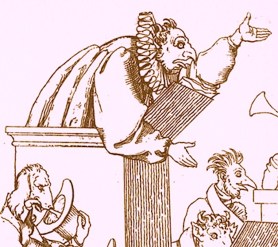
- caricature of a pompous, power-mad cleric, the kind Pope Francis is doing his best to eliminate -- by the supremely anti-clerical Martin Disteli (1802-1844)

Caricature of a pompous, power-mad cleric, the kind Pope Francis is doing his best to eliminate — by the supremely anti-clerical Martin Disteli (1802-1844)

The astonishing Argentinian Pope Francis, who is 78 and breathing with only one lung, does not expect to live long – hence is racing to do all he can, as fast as possible, to rid the Vatican of bureaucratic arteriosclerosis, closed minds, meaningless pomp and display, factionalism and infighting.

All this we have learnt from the outstanding profile that emerges from assessments of three new biographies by Eamon Duffy, writing in The New York Review of Books.

We tend to think of the young as the most obvious campaigners for radical change; as its natural leaders. But if you stop to think about it, old radicals are far more impressive. They have a lifetime’s experience of discouragement of challengers of the status quo — often, by the extremely nasty and powerful. They have heard all the very best reasons for leaving things as they are — ad nauseam.

For those of us frustrated by the pace of media’s post-Gutenberg revolution, the Duffy essay – certainly no hagiography, with its extended passages about the pontiff’s flaws and failures – was a bracing and encouraging read. Not least, about life’s capacity to surprise us. Think of the size of the institution the Vatican manages. In 2011, the Catholic Church had 1.2 billion members, tended to by 413,418 priests. Think of its age. It is two thousand years old. Age and size are typically justifications for intertia – or no change at all.

Extracts from ‘Who Is the Pope?’ The New York Review of Books, 19 February 2015 (with highlights for unrepentant skimmers):

…[A]bove all, Francis is the first pope to embrace wholeheartedly the Second Vatican Council’s aspiration for a church in which authority is shared among the whole episcopate, rather than monolithically focused in the papacy. At the end of the council in 1965, Pope Paul VI had established a permanent Synod of Bishops as a forum for continued collaboration between pope and bishops. Many saw the synod as the major expression of “collegiality” that would devolve much of the decision-making of the Roman Curia to the bishops in synod and through them to the local churches.

Such hopes proved illusory: the Roman authorities saw to it that the synod remained a powerless talking shop with no independence or initiating power. Bergoglio shared the general episcopal dissatisfaction with this situation, and as pope, in one of the most striking passages of Evangelii Gaudium, he has called for “a conversion of the papacy” on such matters. John Paul II, he reminded his readers, had invited suggestions for a renewal of the papal office to make it more visibly an office of service, but “we have made little progress in this regard.” The papacy and the central structures of the Church must heed the call to “pastoral conversion,” because “excessive centralization, rather than proving helpful, complicates the Church’s life and her missionary outreach.” In particular, Francis insisted, there had been a failure to realize a truly collegial spirit within the church, and episcopal conferences needed to be given “genuine doctrinal authority.”

He has proved as good as his word. Opening the Synod on the Family in October 2014 that, among much else, dealt with the fraught issues of sexuality, contraception, divorce, and remarriage, Francis encouraged the bishops to express their views frankly. No one should be silent or conceal his true opinions, “perhaps believing that the Pope might think something else.” To do so would be a failure in “synodality, because it is necessary to say all that, in the Lord, one feels the need to say: without polite deference, without hesitation.” These were not empty platitudes: under John Paul II and Benedict XVI open questioning of official positions was routinely branded as “dissent,” and bishops who deviated even mildly from the official line were subject to reprimand or removal. For a pope to encourage fearless public outspokenness among the bishops was a startling novelty.

… On the one hand there was the temptation to “hostile inflexibility,” of “wanting to close oneself,…not allowing oneself to be surprised by God, by the God of surprises,” clinging to “the certitude of what we know.” This was the special temptation of the zealous, and the so-called “traditionalists.” On the other hand he warned against “a destructive tendency to do-goodism” (buonismo in Italian) that “in the name of a deceptive mercy binds the wounds without first curing them and treating them; that treats the symptoms and not the causes and the roots.” This, [he said], was the special temptation of the “do-gooders,” and of the so-called “progressives and liberals.” …

Though always meticulously respectful of his immediate predecessors, the differences between Francis and them are wide, deep, and, as his handling of the synod makes clear, momentous for the church. His distrust of religious leaders who “play Tarzan,” secure in their own certitudes, does not sit well with admirers of John Paul II or his style of leadership. Though he has commended the “prudence” of Benedict XVI’s rehabilitation of the old Latin liturgy, he is suspicious of the reactionary ideological freight that the Latin liturgy often carries with it, and he despises ceremonial pomp.

… he has abolished honorific titles and dress for the younger clergy working in the Curia, since for him priesthood is essentially about service to the poor and vulnerable, rather than a symbolic status or the exercise of sacramental power.

Perhaps most momentously, Francis has pointed the church away from culture wars with secular society that were such a feature of Benedict’s papacy, toward a less confrontational approach to the social circumstances in which the faithful have to live, and a more fruitful reengagement with the church’s mission to the poor and underprivileged, in whom he sees both the natural and the most receptive hearers of the Gospel. Where Benedict was inclined to blame the increasing marginalization of Christianity in Western society on a collective apostasy rooted in the shallow materialism of secular modern society, Francis is inclined to attribute the corresponding decline in Latin America to the church’s own shortcomings:

Perhaps the Church appeared too weak, perhaps too distant from their needs…perhaps too cold, perhaps too caught up with itself, perhaps a prisoner of its own rigid formulas, perhaps the world seems to have made the Church a relic of the past, unfit for new questions; perhaps the Church could speak to people in their infancy but not to those come of age.

… Francis himself is unlikely to have a long pontificate: he is an old man, with only one functioning lung. Both in Rome and in the dioceses of the world he has been quietly putting in place men who share his vision. But the announcement in January 2015 of his second consistory for the creation of new cardinals was anything but quiet, because the pope’s startling list of the twenty cardinals-designate, fifteen of them under eighty and therefore eligible to vote in the next papal conclave, represented a positive fanfare for Francis’s alternative vision of the Catholic Church.

The Guardian wants to look like a Facebook extension, but the right model for a socially sensitive, reader-supported newspaper is either Private Eye or Tsū.co

-- postgutenberg[at]gmail.com, from a detail by MIL22

— postgutenberg[at]gmail.com, from a detail of a photograph by MIL22

Next week, editorial staff at the newspaper with one of the three most-visited English-language sites on the net will be offered the unusual chance to vote for their next editor-in-chief – even though that will be someone chosen from a different (overlapping) list by the paper’s board of overseers.

The voters will select from among just four candidates for the job — of a total of two dozen-odd applicants — who are brave enough not to rely simply on their qualifications, but submit in public to testing and demonstrating what support they can count on from rank-and-file staffers. The staff favourite is not guaranteed the job: the board of directors could pick an applicant from the longer list not running for election. More curiously yet, the voting is being organised from outside the newspaper, by Britain’s sterling, 108 year-old National Union of Journalists.

This hybrid, fuzzy, faintly Mad Hatter-ish path to the job — or not — has a precedent at The Guardian. Alan Rusbridger, the editor being replaced, who has served as the paper’s chief for two decades, was apparently appointed through an arcane weighing of skills vs. popularity with Guardianistas.

So, history is one reason why no one should read into this succession drama any implication that the paper is democratising its modus operandi. Some onlookers have also made the mistake of assuming that The Guardian is bowing to egalitarian net culture by urging readers to pay subscriptions to become ‘members’ of its organisation. Last year, two of these observers interpreted the scheme’s announcement, in exuberant messages to post-Gutenberg, as proof of the paper’s adoption of the proposal with which this blog began — that Guardian readers were going to be invited to become part-owners through subscriptions that would also be small financial stakes.

So far, that conclusion has been wrong – a realisation that, for some of us, borders on tragic. (See ‘Alan Rusbridger must please not let ‘Guardian membership’ mean bread-and-circuses, and prove that he is sincere about “mutualised” journalism,’ post-Gutenberg.com, 18 September 2014.)

Why? Because we see small-scale reader-owners becoming passionately involved in the paper’s future economic survival — and creating a new economic model for running media — if their contributions of ideas, reactions, news and campaigning for favourite causes are given greater prominence in expanded comments sections. This will be especially true if what they supply is freed from censorship by Guardian moderators. Many of us can remember dozens of stimulating, irreverent, frequently dazzling ‘below-the-line’ contributors to readers’ discussions in the first year or two after this newspaper launched its online ‘Comment-is-Free’ section in 2006. We watched, nearly heartbroken, as most of them stopped reacting to above-the-line articles – or, as we often put it in those days, blogging in comments sections – from disgust with repressive moderators and moderation policies, which too often led to the banning of commenters we loved most. (See: ‘Why is The Guardian censoring debate about press reform and ignoring the Lord Chief Justice’s endorsement of citizen journalism?‘, post-Gutenberg.com, 7 November 2011.)

Most traditional journalists, especially senior and long-fêted members of the profession – all around the world – still despise reader-blogger-commenters. They hate the competition. Having got too comfortable on pedestals on which they were seldom criticised or corrected, they were infuriated by the arrival of citizen-debaters. But a few of these, the most honest critics in so-called legacy journalism, are now reluctantly conceding that they could be mistaken in their classification of reader-commenters as either stupid, uneducated, or vicious trolls. We ourselves could be mistaken in perceiving any such concession – in an oblique form – in a couple of entries in the latest ‘From The Message Boards’ column of Private Eye, the paradoxical magazine written — and run — in the spirit of the net at its most impish and egalitarian, that has no online edition at all. (Issue No. 1385, 6 February – 19 February 2015)  For years, typical FTMB inventions have read like this:

wat about the yesterday’s chanel? theres no way them old nazi’s was filmed the day before :) lol! – Hatfield Gooner

What the Eye presented as representative of comments on newspaper web sites was so predictably buffoonish that it was one of its few sections not worth reading at all (unless you live for Benny Hill toilet jokes). But in the latest issue delivered to our letter box, we were astonished to find this toothsome morsel – which we hope is a sign of FTMB raising its game:

It was on ITV actually, but the BBC is equally culpable when it comes to distortion and inaccuracies. I will never forget the astonishment I felt when watching their film about Stephen Hawking, which (unlike Broadchurch [new crime mini-series being discussed in this FMTB column]) purported to be based on fact. In the opening scene, at Hawking’s 21st birthday party on 8 January 1963, the gramophone in the background is playing ‘Some Other Guy’ by The Big Three, a record not released until March that year. Had Hawking received an advance promotional copy? No, because the track hadn’t yet been recorded. One can only conclude that he had travelled back in time from the future, bringing a copy of the disc to prove his own later theories correct. – PCS 3042

Now, there’s a sendup of genius – a perfect specimen of a post by a high-precision-pedant-on-steroids, one class of reader-commenter post-Gutenberg treasured particularly, in the short-lived good old early days of the Guardian’s Comment-is-Free site. Once you had wept with delight over your introduction to PCS 3042, you found yourself stopping in at CiF all day long, hoping that she or he had returned to post again, in your absence.

So did other readers – and fans and sparring-partners of below-the-line marvels like PCS. That boosted site traffic for the best reasons. Instead, the Guardian’s over-zealous moderators have lashed its BTL contributors into such a pathetic, tame, conformist bunch that it does make perfect sense for the redesigned online version of the paper to look like an extension of bland, boring Facebook. Unbelievably, it has picked a blue-and-white colour scheme just like the social media giant’s for a site frame.

Facebook blueandwhite

With artists in London ready to throw themselves at its feet, why did The Guardian chosen to look like an extension of Facebook.com in its latest redesign?

With artists in London ready to throw themselves at its feet, why has The Guardian chosen to look like an extension of Facebook.com in its latest redesign?

Once, we would have scoured the Guardian’s comments sections to see which other readers had noticed this bizarre act of imitation — unless we mean, slavish homage to the $ power of almighty social media. But in this round of site design, the paper’s managers invited readers to submit their reactions to it not openly, on CiF, but in private messages to them. A shrewd move, indeed.

For three years, post-Gutenberg has been pointing out that Facebook, grown fat and sleek on selling minute details of its users’ lives, should rightly be co-owned by those users – who are entitled to shares in its profits. (See: ‘A better Facebook — or why cooperatives run on the web should work better than the old hippie kind,’ post-Gutenberg.com, 14 February 2012.)

If the Guardian wanted to pull off a brilliant coup, it would use its new look as a Facebook acolyte to make its membership scheme more than the meaningless rich reader-patrons’ club that several other newspapers have also introduced.  The similarity in appearance could help to wean diehard Facebook users, subconsciously, from their devotion to being exploited by Mark Zuckerberg’s company.

As we have said wearily before, we fear that the Guardian’s leaders, even those still only in their forties – over-represented, as far as we can tell, in the candidates for the editor’s job – are too old to see what they need to do. Here is proof in a new social media site, Tsū.co – based in New York, despite its Japanese name, especially delicious in combination with its founder’s novelistic Eastern European identity. Conceived of — as we have concluded from sheer guesswork — in much younger minds, Tsū has its heart exactly where the Guardian’s should be. This is the email we received after we signed up:

Welcome to tsu.co [ post-Gutenberg! ] !

It’s an honor to have you as a new member of this unique user-owned community. We have been working hard to build tsu.co (pronounced ‘sue’) with the purpose of breaking the old rules of social publishing by creating a fair economic model where content creators’ ownership is respected, where they are fairly incentivized and where their content is protected.

[…]

Best,

Sebastian Sobczak

Founder, CEO at tsu.co

PS: We’re also on mobile. Download the app now:

Somehow, Tsū’s arrival has been ignored completely in Guardian coverage of online news and media. Googling yielded a single story about it posted on a blog on the New York Times site last autumn — in ‘The Social Network That Pays You to Friend’ — but no NYT mention since. Decidedly odd, for a startup claiming to have 2 million users last month.

While Facebook and Twitter have been criticized for failing to share their profits with those who post on their platforms, Tsu pledges to do just that: It will give 90 percent of its ad revenue back to users.

Tsu’s philosophy is that “all content creators, which is basically every social user, should receive royalties for the commercial use of their image, likeness and work,” Mr. Sobczak told Op-Talk. “They essentially do all the work, they should get rewarded with the lion’s share.”

“What people don’t realize is how much value is created by these platforms on the backs of basically everybody’s networking,” he said.

Anna North on the Op-Talk blog of The New York Times, 27 October 2014 

How precisely will Tsū be sharing its profits? Through a complex but workable scheme, explained in detail here, in an excellent — by no means wholly laudatory — TechCrunch profile on 19 January by Sarah Perez:

Today, 10% of the total ad revenue goes to Tsu itself. Half of the remainder goes to Tsu’s content creators (users), and the other half goes to the network that brought in those content creators to the platform. That is, when User A invites User B, and then User B shares popular content, User A is compensated for that. The better a users’ network, or “family tree” in Tsu lingo, the more money you make.

How did we hear about it? From a chance mention by LCM, an immeasurably dear artist friend living somewhere deeply rural. She has a clone in a brainy relation, a high-ranking Silicon Valley entrepreneur swimming in the social media shark pond …

Readers, we don’t know exactly how we’ll get there. We are still studying the fine print about Tsū. But something Tsū-like is indisputably our future.

Alan Rusbridger must please not let ‘Guardian membership’ mean bread-and-circuses, and prove that he is sincere about ‘mutualised’ journalism

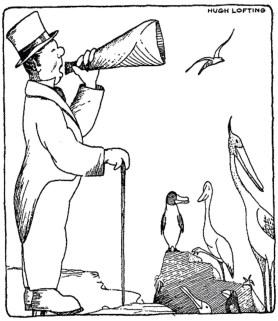
Guardian members will expect to share its media megaphone – on virtually equal terms - Hugh Lofting drawing for a book in his Doctor Dolittle series (1920-52)

Guardian members will expect to share its media megaphone – on nearly equal terms
– Hugh Lofting drawing for a book in his Doctor Dolittle series (1920-52)

It is the next stage in the rolling out of The Guardian’s new ‘paid membership’ scheme for readers and commenters that we want to see. This was the summary of the plan by The Financial Times last week — unaccompanied, as far as we know, by any comment or analysis, so far:

The Guardian has launched a paid membership scheme, as it seeks to narrow operating losses that reached £33.8m last year.

The newspaper, which has resisted charging for access to its online content, will offer readers access to events and a new purpose-built venue near London’s King’s Cross.

Top-level members, known as patrons, will be charged £60 per month and will also have access to tours of the Guardian’s newsroom and print site. Mid-tier “partners” will pay £15 per month, while non-paying “friends” will also be able to book tickets to events.

The Guardian has no pressing need for profitability, with £842.7m in cash as of March, after selling its stake in car magazine Auto Trader.

We hope that there is more to this idea than supplying forms of theatre – either professional entertainment, or the thrilling chance to watch genuine Guardian journalists and editors tapping at their computers. We resist cynicism, at post-Gutenberg. Yet the reminder that came instantly to mind was of the ancient ruses in Europe for diverting the populace from noticing social inequality – known as ‘bread and circuses’. This was an accusation also levelled at the splendid Medici family, at the pinnacle of its wealth and power in Florence during Italy’s Renaissance:

… The days of adventitious sharing in the noise and warmth within an open palace door and a hand-out of the leavings were over; the populace was firmly excluded from the pleasures of the rich.

A similar withdrawal took place with publicly organized occasions of holiday mood. Bread and circuses: Lorenzo de’ Medici was accused of soliciting in the 1470s and 1480s the support of those excluded from a voice in government by lavish public entertainments: tournaments, street pageants. … In a republic that had been subtly manipulated into a narrow oligarchy it was natural … for opponents of this tendency to remember with alarm how the emperors who subverted the republican constitution of ancient Rome had employed gladiatorial and wild beast combats to occupy simple minds. A century after Lorenzo, however, with the rising price of bread and popular insurgency that rose with it, the issue of diversion was seen in terms of practical contemporary politics. ‘Because the common people are unstable and long for novelty, wrote Giovanni Botero in 1589 in his Reason of State, ‘they will seek it out for themselves, changing even their government, and their rulers if their prince does not provide some kind of diversion for them.’

The Civilization of Europe at the Renaissance, John Hale, 1994

Bread-and-circuses is surely not what Alan Rusbridger, The Guardian’s editor, has had in mind, in his speeches and interviews about the ‘mutualisation’ of journalism. This is what he said on the site of Harvard’s Nieman Journalism Lab, in replying to a British commenter on a blog post about turning readers into paying members as an economic survival model for media organisations (part of their exchange):

Han Gough

It’s certainly interesting. And I’d be happy to support the Guardian. But I can’t for the life of me work out what benefits I would gain from membership. I live in a university town in the south west of England and there are no events scheduled in a 300 mile vicinity! And that building looks nice but I’m never going to get to use it. To be a Guardian “member” must one live in Islington???

I feel that the Guardian’s values, and it’s history as the Manchester Guardian, have been somewhat lost in translation. […]

alan rusbridger •

Han, this is a beta launch of something that will become more interesting in a few months and still more interesting once the Midlands Goods Shed is up and running. We haven’t forgotten the rest of the country (or the rest of the world) and will announce further and better plans. This is just the initial announcement…. a *very* soft launch. And thanks for kind words about the Guardian.

Han Gough •

Wow. Thanks for your reply. I wasn’t expecting that. I only posted here because there didn’t seem to be anywhere else to comment.

It sounds like a wonderful idea. And I can see how it would be really exciting if I lived in central London. But £15/month is quite a lot of money. […]. And even if you did put on an event at some point in Exeter (which is where I am), will you ever manage to put on £15-worth of events every month?

Also one of the reasons I like and read the Guardian is for its socially progressive values but this feels regressive at first sight. It’s providing opportunities for an already privileged segment of people: those who are cash-rich and live in London. That’s what I meant when I said it seemed out of step with the spirit of the Manchester Guardian. I can really understand why the Scots have had enough. It is this mentality that London and the south east of England gets the lion’s share and the rest of us roll over and pay for it. […] Thanks again for your reply.

The reason why Han Gough living in Exeter, in England, had to go to a site owned by an American university to react to the Guardian scheme is because that newspaper did not allow public comment on it. A box beneath the notice about it on The Guardian’s site invited readers to submit feedback on a form whisked invisibly into the paper’s mysterious innards. Ah so!

What would be better – much better – than what we have seen, so far, of The Guardian’s plan? Strangely enough, it was from the comments section of that Nieman site at Harvard that someone outstandingly practical contacted post-Gutenberg with the answer, three years ago. This is how our report about this most helpful encounter began:

A stranger, someone astute and entrepreneurial, emailed me about a comment posted in a discussion about the future of journalism on the site of Harvard’s Nieman Lab. ‘I think you’re on the right track with your focus on the business-model issue,’ he said.

He was referring to an outline of a means for old media organisations to move into post-print publishing in a Networking Age in which readers want to be more than passive audiences – to do more than influence stage management and be free to perform themselves. I set out a scheme for turning readers into financial stakeholders or co-owners – experimentally, at first, on parts of newspaper sites – suggesting that this might be an ownership structure for the future.

The essence of the idea was that every subscription would also be a share or financial stake in prospective profits. It would be an inducement for each reader or viewer to help bring many more visitors to a site. It would both help the site owner to attract more advertising and – implicitly – reduce dependence on advertising, if the concept of subscription-stakes caught on and went viral. …

[ continues here: ‘Co-owning media is on the horizon …‘ … ]

Also see:

Can Alan Rusbridger do what he must to make a true mark on media’s future history?