Notes from the post-print transition, 1: the advertising moonshot of Google’s Larry Page and Private Eye’s meerkat phobia

Meerkat to the Eye: ‘You surely don't mean, me?’ - postgutenberg [at] gmail.com

Meerkat to the Eye: ‘You surely don’t mean, me?’
– postgutenberg [at] gmail.com

Anyone sensible who, for decades, has bought nothing expensive without consulting Britain’s Which? (owned by the Consumers’ Association) or Consumer Reports in the U.S. (owned by Consumers Union) can understand Larry Page’s apparent belief, over a decade ago, that conventional advertising would soon be obsolete.

Advertising equals lifeblood in the traditional economic model for newspapers and magazines – the scheme that will soon look pre-historic. In a splendid Business Insider profile, in a section about the early years of the company Page co-founded with Sergey Brin, a far-out idea – known as a moonshot, at the search engine colossus — is described:

… [A]fter Google had become the Internet’s most successful advertising business, Page decided the company should destroy the advertising agency industry. To his thinking, it was obviously a highly inefficient system that could be erased with the help of technology. Not only did the company opt not to take on this battle, but [other top Google executives] did their best to make sure none of Google’s many important ad-agency clients caught wind of Page’s ideas on the topic.

His seems like a straightforward, logical conclusion to anyone who believes – as we do at post-Gutenberg – that

… the perfect search engine would understand whatever your need is. It would understand everything in the world deeply [and] give you back kind of exactly what you need.

That is also a quotation of Page, in the same article.

Private Eye — writing more frankly than any other print publication about the hopelessness of trying to carry the advertising-dependent print model for economic survival into the digital future – has had riveting news in recent ‘Ad Nauseam’ columns, information we have seen nowhere else. … Essential reading, even if the last snippet seems proof of a bizarre phobia at the indispensable satirical magazine – or, possibly, a regrettable instance of inter-species prejudice:

– from Private Eye, No. 1367, 30 May – 12 June, 2014:

The latest digital advertising medium to have its efficacy questioned is video ads.

Recent research suggests that nearly 60 percent of them are never seen by a human being, which does rather post the question as to what media buyers are actually paid for.

– from Private Eye, No. 1369, 27 June -10 July 2014:

Facebook recently admitted what everyone in advertising had already twigged – that no one is reading anything brands put on Facebook any more.

The company posted a long explanation for this, protesting loudly against the idea that it could possibly have anything to do with selling more ads, suggesting instead that it was a problem of there simply being too much ‘branded content’ on the platform. This is all well and good, except a) that problem is entirely of Facebook’s making, given that it has spent seven years telling all brands they have to be on there (without adequately explaining why); and b) all its solutions for brands to get over this issue involve, er, buying more adverts.

– from Private Eye, No. 1367, 30 May – 12 June, 2014:

The latest terrifying vision of the future comes via Personal Neuro, a company which is working with Google Glass to produce wearable technology, which can monitor a wearer’s brainwaves, gauge their mood or state of mind – and feed adverts directly into their eyeballs based on that data!

Welcome to a future in which you will never be able to escape that bloody meerkat, however hard you try

If Personal Neuro is real, not just a vision that came swimming into editorial brains at the Eye after a lavish liquid lunch, why does a Google search turn up no information about this Canadian startup in any other well-known print organ?

A surprising — but long overdue — condemnation of censorship by the press from The Guardian … and summer sign-watching

- postgutenberg [at] gmail.com

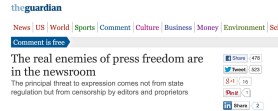
CENSORS in THE PRESS

‘Comment is free’, 30 June 2014

Let us hope that the admirably honest George Monbiot, with his huge following, can get this subject the attention it deserves. Regular readers have seen almost everything in his Guardian blog post on Monday here on post-Gutenberg.com — and his concluding sentence, two years ago, in ‘Censorship by the Press‘. We wrote that after some frustrating months of drawing attention to this problem:

Why is The Guardian censoring debate about press reform and ignoring the Lord Chief Justice’s endorsement of citizen journalism?

The solution proposed by the commenter ‘Natacha’ in her reaction beneath the Monbiot piece defines this blog’s very raison d’être: censors IN the press - NATACHA See:

Loomio: open-source tools from young New Zealand techies to make the dream of practical, efficient, sexy cooperatives come true

Just a short post, for today. We have been on the road, watching for signs – and here is one of our rewards: SIGN w freeway postgutenberg@gmail.com get happy 3

- photographs: postgutenberg [at] gmail.com

– photographs: postgutenberg [at] gmail.com

On media’s stage, a scenery shift: De Correspondent shows off thrilling new props verging on a ‘keiretsu-cooperative’; a NY Times columnist tugs the curtain on the old set

android dec 2011 to nov 2012 035

Betwixt and between: stage hands at work - postgutenberg [at] gmail.com

Betwixt and between: stage hands at work
– postgutenberg [at] gmail.com

A group of Dutch media innovators – inevitably, young, as noted here last week – has created an actual, working prototype of what we expect to be a popular style of organisation for publishing in the near future. It has no advertising. It is financed by reasonably-priced subscriptions. Most important of all, it puts commenters on articles – the people it prefers to refer to as ‘contributors’ – at the centre of its enterprise, treating them as honoured extensions of its founding family. Wondermooi. That is exactly what we recommended in 2010 when, in keeping with the fuzzier usage of the time we referred to this same constituency as ‘bloggers’ — or ‘blogger-commenters,’ after a critic rightly demanded a clarification.

We did not foresee a big, ambitious media venture being able to do without advertising so soon. Nor did we anticipate that one would launch itself with crowdfunding, which Kickstarter was just beginning to turn into a household word four years ago. De Correspondent raised a breathtaking $1.7 million between March and September last year. In a post in April on the site of Harvard’s Nieman Journalism Lab, Loes Witschge reported a remarkable feat in a country with a population of just 16 million:

On March 18, [Rob] Wijnberg, former editor-in-chief of the young-adult-targeted newspaper nrc.next, proposed his idea for a new online journalism platform on Dutch national television. Within 24 hours, his team had raised half its goal, and after eight days, Wijnberg got an earlier than expected go-ahead: 15,000 had subscribed, and many had added donations on top of their subscription fee. In just over a week, in a small country, the Dutch crowdfunding project De Correspondent had raised over €1 million (about $1.3 million).

By this spring, the group had 24,000 subscribers – the proportional equivalent of 450,000 in the US, Wijnberg says — each paying roughly $80 (€60) for the privilege.

Now this, you might agree, is seriously important news. Print media are desperate for a viable new economic model. So, has The New York Times written about De Correspondent? Er, … no, unless we’ve been using the wrong search terms, hunting for evidence. The Guardian, another of the most-visited sites on the net? The Telegraph? The Independent? The Economist? Apparently not – and anyone who has proof to the contrary must please leave a comment with appropriate links beneath this post. … Oh, and there is no point in trying to look up its history on the Wikipedia for anyone irritated by having to make do with a machine translation from Dutch.

We only learnt of De Correspondent’s existence in checking that search engines were keeping up with our last entry on post-Gutenberg, using, for search tags, ‘new media’ and ‘business model’. Its own site is naturally the best guide to its modus operandi, but the applause it richly deserves is to be found exclusively on new media sites of the likes of Journalism.co.uk, Gigaom and MediaGazer. On the Medium blogging platform, Ernst-Jan Pfauth , another founder, explains under the headline ‘Why we see journalists as conversation leaders and readers as expert contributors’:

Every reader is an expert at something

Lately, there has been a lot of talk about news sites shutting down their comments sections, since readers’ contributions are often too obtrusive (read Mathew Ingrams excellent post about this).

Here in Amsterdam, we sincerely regret these developments, since we believe that modern journalists shouldn’t see their readers as a passive group of annoying followers. Instead, they should regard readers as a potential gold mine of expert information. That’s why, at De Correspondent, we encourage our journalists to function as conversation leaders and our members as expert contributors.

At De Correspondent, we owe our very existence to our members, since we launched our Dutch ad-free journalism platform after raising a total of 1.7 million dollars with a world record breaking crowd-funding campaign. We encourage our correspondents — who all have their own niche — to tell the stories that they feel are important, instead of just following the hype cycle of the news.

He also said:

We end every article with a question to our members

In our custom-built editor Respondens, we have a special field called ‘Oproep’ (which translates to ‘Call-up’). Correspondents can use that field to make explicit what they would like to know from their readers. The call shows up underneath the article and steers the contributions in the direction the correspondent finds journalistically most relevant.

We invite members to write guest articles

We continuously invite our members to write guest posts. […]

There is no mention of turning those subscribers into shareholders and running De Correspondent as a cooperative – yet. That might be an idea for another group to try, one we hope will give us the sort of laugh these Dutchmen did in setting out their names — well-established in Netherlands media before they banded together — as follows: Rob Wijnberg (1982), Harald Dunnink (1981), Sebastian Kersten (1976), and Ernst-Jan Pfauth (1986).

Advertising their birth years, you might suppose, amounts to a sign reading, Oldies Keep Out. But, not quite. The first part of ‘the keiretsu-cooperative’ in the paper that started this blog in 2010 referred to the Japanese name for a network of firms collaborating as trading partners, in a proposal for a news site (long-established or new) sharing the initial expense of starting and running a subscriber-owned cooperative with a partner in, say, book publishing. De Correspondent says it is working with:

De Groene Amsterdammer (founded in 1877) … a weekly magazine of ideas and opinion; it is perhaps best comparable to the New Yorker and the New York Review of Books[…] De Groene Amsterdammer will share some of its content as well as its editorial and investigative resources with De Correspondent.

… and …

Momkai (founded in 2002) … an independent, digital creative agency in the Netherlands that is renowned for its ability to combine conceptual thinking, design and technology in the creation of online formats and campaigns. Momkai is founding partner and responsible for the brand, the website, the identity and the campaigns. Momkai also created a new publishing framework and editor for De Correspondent called Respondens.

… Well, well, well – we thought, spotting Monday’s column in The New York Times by its media correspondent, David Carr: this De Correspondent has not been born a moment too soon. Snippets that stood out in the column, a review of a new book — a roman à clef about New York newshounds by Michael Hastings, a journalist killed tragically young in the 2003 Iraq war:

… [P]oliticians and journalists are now neck and neck in a race to the bottom of public trust. According to a poll released by Gallup last week, fewer than a quarter of news consumers trust what they read, watch or click on, a historic low.

… Much has changed since the period Mr. Hastings chronicles, most notably that the audience has fled established print outlets …

… The public is less prone to the allure of Great Men pontificating from inside a magazine, the television or behind a lectern at a news conference. The jig is up.

The public is ready to share the stage, onto which De Correspondent has invited it to step up and join fully in the action. Bravo for the courage to try out a new idea — never mind if the degree to which it has succeeded so far is hard to judge for those of us who cannot read in Dutch. And a hat tip to David Carr for facing the facts, refusing to bury his head in the sand, and telling us what he sees — truthfully.

The components of the next media ‘business model’ are ready: dewy-eyed newcomers, not media’s Old Guard, will do the essential assembly and testing

august 2013 lolling nymphs circular balcony DSCF1026

The old classic forms for media are broken: their replacements are coming from young explorers open to the magic of possibility and experimentation - photographs of the Villa Borromeo: MIL22

The old classic forms for media are broken: their replacements are coming from young explorers open to the magic of possibility and experimentation
– photographs of the Villa Borromeo: MIL22

Though Larry Page, the Google co-founder, has a thatch of grey hair, we know he is still only forty-one. His baby face reminds us that he was twenty-five in 1998, when he hatched a search engine with Sergey Brin. We also know that Jimmy Wales was thirty-five when he launched the Wikipedia in 2001, and Jeff Bezos a mere thirty at the founding of Amazon.com in 1994.

So, why are we looking to today’s old media leaders to reshape the way we get news and commentary through them? Google, Wikipedia and Amazon — three inventions that have made done more than any others to re-shape the habits of those of us who used to be called bookworms — should have made it pointless for anyone to expect the big names in print media, whose chiefs are nearly all middle-aged or old, to build the bridge to future economic survival for their enterprises.

Three identifiers of the most promising scheme for publishing – called a ‘business model’ – look more practical and likely than ever:

Some form of collective ownership and management – which, for some new publishing groups, would mean replacing the old idea of ‘reader subscriptions’ with small ownership stakes for audience members who want a say in drafting rules and setting policy.

Consultative decision-making on strategic and policy matters helped by free, ‘sharable’ software tools designed to streamline collaboration — the kind being developed by New Zealand’s Loomio cooperative (the most sophisticated of which might include software tailored to deal with particular kinds of conflict).

Vast aggregations of micropayments making up the financial lifeblood of media collectives – from selling access to certain kinds of information or entertainment (though most of this would be free); or in-payments for the privilege of stakeholding, and outpayments when there are profits to be distributed.

Most of the worker-bees driving the creativity at Loomio and the micropayments innovator Flattr are decades younger than the old media leaders in continental Europe interviewed last week by The Guardian about their struggle to adapt for digitisation. The limit of bold and adventurous thinking by these appears to be a subscription club – similar to the plan described by Mario Calabresi, editor-in-chief of Italy’s La Stampa , in which most of its offerings would continue to be free …

… while holding back some premium content in order to be able to offer more in-depth information to those who want it. Around this premium content we are building a club-like structure, which brings together our keenest readers and offers them exclusive tools with which to understand the world.

Club, yes; but stake, no – and that is surely a mistake. Giving readers the chance to own a financial stake, even a small one, in drawing more traffic to a media site would encourage more of them to linger to chat with other readers – regularly log on to comments sections, treating them like virtual pubs or coffee-shops for relaxing sessions of teasing, information-sharing, debating and flirting anonymously and pseudonymously as well as in the prosaic guise of being, as on Facebook, simply themselves. One commenter on the Guardian survey of European papers had the media enterprise of the future exactly right:

ringodingo

13 June 2014 11:03am

… Newspapers, tv etc have to accept that media is now two-way.

So Guardian etc should become more like a social media site?

To an extent they already involve the readers with the comment threads.

Or, as the 2010 paper that this post-Gutenberg blog extends said, if we may be forgiven for the unpardonable sin of quoting ourselves:

New communication technologies have created a karaoke world. … Practically no one is content any more to be just a spectator, reader, passive listener or viewer. Audience participation as well as the right to talk back – which includes non-expert reviewing of works or performances by trained and seasoned professionals — have become absolutely essential.

That La Stampa understands this is clear. Calabresi said:

We are drawing on user-generated content, seeking to unite and integrate it with our quality journalism. On social networks we are working to increase reader engagement in order to make them key players in the debate on our content.

He sounds remarkably like The Guardian’s own editor, Alan Rusbridger, telling an American interviewer that

We are putting our commentators in the same space as all our readers and letting them fight it out. … [R]eally, in this community of Guardian readers, there are a lot of intelligent, well-versed people actually traveling. So let’s open it up to them.

But those are just words, mere sentiments, at present. Until they are offered a financial stake and the possibility, some day, of sharing in any profits, those readers contributing comments and reporting to ‘opened up’ papers are simply supplying unpaid labour. Not, in our view, an operating scheme with much of a future.

When will some newspaper like La Stampa or The Guardian test the idea of sharing ownership and decision-making on a strictly experimental section of its site – as this blog has suggested before, more than once? They might take a cue from the adventurous ‘skunk works’ at the Harvard Business School testing online education.

One European interviewed by the London newspaper about the digital future, Stefan Niggemeier – an ex-Spiegel staffer who has worked both as an editor and publishing innovator — is part of a group of twenty-five German investigative journalists playing with financial schemes that do not rely on advertising: ‘We want to see if there’s a way of establishing a non-advertising-based model. Whether it will work, I don’t know, but I know it’s right to try it, even if it fails.’

Rusbridger is sixty. Niggemeier and Calabresi are both in their mid-forties. Even they might not be young enough to translate proposals and hypotheses into media’s clicking and whirring fully operational future.