Britain’s government ‘moderates’ The Guardian as a commenter on its surveillance policies, and The New York Times hides ex-General James Cartwright

door

After the horror of thought police, the most terrifying aspect of the society George Orwell anticipates so brilliantly in 1984 is that almost nothing about its regulations or the behaviour of the people running it makes any sense.

Why was The Guardian so unembarrassed by the inconsistency of making such a fuss about being forbidden by Government Communications Headquarters (GCHQ) to publish any more revelations about the extent of UK and US government spying on the public – when this newspaper also shuts down disclosures about and discussion of matters it considers sensitive?

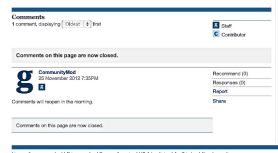
For instance – what? For instance, reader commentary on the Leveson Inquiry into press ethics and conduct. As more than one commenter pointed out, on the same web page as the newspaper’s unconvincing attempt to justify its censorship, Lord Justice Leveson himself had been permitting far more revealing accusations and evidence to be aired at his hearings. guardian notice Complaint by Guardian editor Alan Rusbridger:
The mood toughened just over a month ago, when I received a phone call from the centre of government telling me: “You’ve had your fun. Now we want the stuff back.” There followed further meetings with shadowy Whitehall figures. The demand was the same: hand the Snowden material back or destroy it. I explained that we could not research and report on this subject if we complied with this request. The man from Whitehall looked mystified. “You’ve had your debate. There’s no need to write any more.”

As a reader identified as ‘Dr. Gabriel Mayer’ on the site of The New York Times pointed out, about the tunnel vision in condemnations of surveillance focused exclusively on the National Security Agency:

What really surprises me is this universal alarm regarding the NSA and a possible sinister utilization of data should something unpredictable and Orwellian take place.

If …… and when …

But right now this comment is being monitored by Google and Apple (I am on one of their products) for sure, and probably a few other bloodthirsty corporate entities.

Where are the op-eds about this reality?

Well, Dr. Mayer, how can the newspapers be expected to attack round-the-clock commercial surveillance when they themselves plant spy cookies on our devices every time we read articles on their sites? Looking for a ray of light in this chilling scene, we were pleased, at first, to read a paragraph in David Carr’s Media Equation column in The New York Times last week. He deftly summarised recent leaks by whistle-blowers and other disseminators of vital information outside mainstream journalism:

Because of the leaks and the stories they generated, we have learned that in the name of tracking terrorists, the N.S.A. has been logging phone calls and e-mails for years, recorded the metadata of correspondence between Americans, and in some instances, dived right into the content of e-mails. The WikiLeaks documents revealed that the United States turned a blind eye on the use of torture by our Iraqi allies, and that an airstrike was ordered to cover up the execution of civilians. WikiLeaks also published a video showing a United States Army helicopter opening fire on a group of civilians, including two Reuters journalists.

But then his characterisation of the leakers being punished conveyed an impression of raffish, marginal and faintly unreliable figures:

Perhaps they got what’s coming to them. They knew, or should have known, the risks of revealing information entrusted to them, and decided to proceed. Like almost all whistle-blowers, they are difficult people with complicated motives.

So, too, are the journalists who aid them. It’s not surprising that Julian Assange, the founder of WikiLeaks, who brokered the publishing of Private Manning’s documents, and Glenn Greenwald, the columnist for The Guardian who has led the Snowden revelations, have also come under intense criticism.

But why was there no mention at all, in his column, of possibly the most distinguished leaker of all – a retired four-star general who was vice-chairman of the U.S. Joint Chiefs of Staff? He is generally believed to have been the chief source for the story last year about an American cyber-attack on Iranian nuclear facilities, a report that appeared in … well, The New York Times. A blogger explained:

In the flood of news surrounding Edward Snowden’s revelations about the surveillance operations of the National Security Agency, another equally consequential development in the crisis of the security state has gone largely unnoticed. This is the news that retired general James Cartwright, former vice chair of the Joint Chiefs of Staff, is under investigation by the Justice Department in relation to the leaking of secret information about the 2010 Stuxnet virus attack on Iranian nuclear facilities.

To understand the significance of this, it’s important to observe that, as with the revelations of Edward Snowden and Bradley Manning, this alleged “leak” did not reveal anything that was not known to the enemies of the United States. In all these cases, the leaks only confirmed what any member of the general public who had bothered to follow the story could reasonably infer.

A New York Times article from June 2012, which allegedly relied on leaks from Cartwright, revealed that Stuxnet was part of a U.S. program initiated by the Bush administration and carried on under Obama.

How did Orwell know? How did he see so far ahead, with 20/20 vision?

How Lord Justice #Leveson let down everyone who cares about the practice of journalism ‘without fear or favour’

Partisan press = blinkered view + distorted facts photograph: postgutenberg@gmail.com

Partisan press = blinkered vision + distorted facts
Reichenau Island, 2011, by postgutenberg@gmail.com

A few days ago, The New York Times columnist David Brooks, arguing from first principles, made the case against a partisan press incontrovertibly. Like all the best essayists, he did this by also constructing the best possible case for the opposing side, listing all the disadvantages of detachment.

That was not long after a Leeds scholar, Paul Wragg – speaking at a workshop of Oxford’s Foundation for Law, Justice and Society on the 12th of April –  expressed his dismay at Lord Justice Leveson’s failure, in his report, to explain or justify adequately his support of press partisanship. This, said Wragg, was inconsistent with the judge’s own repeated reminders of his mission — to find ways to stop the  ‘real harm caused to real people’ resulting from the ‘cultural indifference to individual privacy and dignity’ on the part of the British press.

This blog’s worst fears for the Leveson Inquiry into press ethics and behaviour were expressed in a headline last May:

Will Leveson end blessing press partisanship and slamming the brakes on the rise of new media and the 5th estate?

We had not quite given up hope before our earlier blog entry on the same subject, in February, when we had begun to sense — but not believe — the drift of the judge’s sentiments on partisanship, from his remarks during the hearings:

Leveson hearings: can a “blind and unreasoning” or partisan press censoring citizen-journalists be good for democracy?

We are dismayed by the proof that our pessimism was so fully justified. At the Inquiry’s inception, a speech by the Lord Chief Justice – who selected Leveson LJ for the job – had given us every reason to hope for a diametrically opposite outcome:

Why is The Guardian censoring debate about press reform and ignoring the Lord Chief Justice’s endorsement of citizen journalism?

Everyone should have a chance to weigh what David Brooks said about the virtues of detachment – of non-partisan journalism:

… The detached writer also starts with a worldview. If you don’t have a philosophic worldview, your essays won’t even rise to the status of being wrong. They won’t be anything.

But the detached writer wants to be a few steps away from the partisans. She is progressive but not Democratic, conservative but not Republican. She fears the team mentality will blinker her views. She wants to remain mentally independent because she sees politics as a competition between partial truths, and she wants the liberty to find the proper balance between them, issue by issue.

The detached writer believes that writing is more like teaching than activism. Her essays are generally not about winning short-term influence. (Realistically, how many times can an outside writer shape the short-term strategies of the insider politicians?) She would rather have an impact upstream, shaping people’s perceptions of underlying reality and hoping that she can provide a context in which other people can think. She sometimes gets passionate about her views, but she distrusts her passions. She takes notes with emotion, but aims to write with a regulated sobriety.

There are trade-offs, no matter what spot on the continuum you ultimately choose. The engaged writer enjoys a tight community and a powerful sense of commitment. The detached writer enjoys more freedom and objectivity. The engaged writer emphasizes loyalty, while the detached writer emphasizes honesty. At his worst, the engaged writer slips into rabid extremism and simple-minded brutalism. At her worst, the detached writer slips into a sanguine, pox-on-all-your-houses complacency and an unearned sense of superiority. The engaged writer might become predictable. The detached writer might become irrelevant, ignored at both ends.

These days most writers land on the engaged side of the continuum. Look at most think tanks. They used to look like detached quasi universities; now some are more like rapid response teams for their partisan masters. If you ever want to get a political appointment, you have to be engaged, working on political campaigns and serving the team.

But I would still urge you to slide over toward the detached side of the scale. First, there is the matter of mental hygiene. You may think you can become a political partisan without becoming rigid and stale, and we all know people who achieve this, but the risk is high.

Engaged writers gravitate toward topics where they can do the most damage to the other side. These are topics where the battle lines are clearly drawn, not topics where there is a great deal of uncertainty. Engaged writers develop a talent for muzzle velocity, not curiosity. Just as in life, our manners end up dictating our morals. So, in writing our prose, styles end up shaping our mentalities. If you write in a way that suggests combative certitude, you may gradually smother the inner chaos that will be the source of lifelong freshness and creativity.

Also, detached writers have more realistic goals. Detached writers generally understand that they are not going to succeed in telling people what to think. It is enough to prod people to think …

[ … Read the whole column here … ]

How Swiss audience inclusion and a certain sort of nudity might be the key to success for post-Gutenberg media

Diccon Bewes, a member of Swissinfo.ch's five-man Public Council

Diccon Bewes, a member of Swissinfo.ch’s five-man Public Council

Swiss Watching NEW ED

Naked hiking is alarmingly popular, even in winter … Public nudity is not a trauma in Switzerland. Many Swiss bathing areas have FKK (Freikörper-kultur or free body culture; that is, nudist) sections … It’s still not on the German scale, where you never know when the next naked person might appear. Have a picnic in the wrong section of Munich’s English Garden and you’ll never eat another Scotch egg.

Swiss Watching: Inside the Land of Milk and MoneyDiccon Bewes, (2010)

The dispenser of advice on hazardous unclothing, Diccon Bewes, has written the wittiest, most elegantly informative and indispensable manual on today’s Switzerland for English-speaking foreigners. His whirling outline of Swiss history at the start of his book is spliced into an account of a winding walk chosen for historical associations, which gives a reader mnemonic imagery for its highlights. Bewes knows better than to frighten the Swiss, restraining what the glowing review in the Zurich paper Tages-Anzeiger called ‘typically black English humour.’

Yet encoded in his skipping prose is the style of such unforgettable thought-capsules, in 1066 and All That — the unsurpassed (1930) parody of history text-books – as, ‘[King] Alfred noticed that the Danes had very long ships, so he built a great many more much longer ones, thus cleverly founding the British Navy.’ This is specially admirable in a practical guide so astute at gauging what outsiders need to know to survive in a place where English is missing even from multilingual train announcements and museum placards, that every new visitor touching down on a Swiss tarmac could use a Bewes-on-CH (Confoederatio Helvetica) mobile app spun off from Swiss Watching.

Our overview of the visible talents of Diccon Bewes is not offered from any interest in boosting Swiss tourism, or encouraging expatriation to the Alps. He has caught our attention for an entirely unrelated reason. What we outside CH most need from him is a detailed, step-by-step education by an insider in how the Swiss make extreme democracy work, or what Beppe Grillo and the Occupy movements must do to realise their dreams. Specifically, it is media of the Gutenberg era baffled by — and resisting the transition to — post-Gutenberg inclusiveness who most need his assistance. As we have said before –

Techno-optimists are sure that our egalitarian internet that brought you to this blog will flatten power structures in organisations, both online and offline, and usher in an age of extreme democracy. Cynics say that they are wrong. Whisper to them tentatively about, for instance, reorganising the media to make readers and viewers part-owners and managers, and they will roar at you, “Ridiculous! Disastrous! It could never work!’

You must then reply in calming tones, ‘True, if you do it like California, but not if you copy Switzerland.’

So, how exactly do you copy CH? Few English-speakers have either Bewes’s hands-on experience of working with Swiss colleagues inside Switzerland – his home for the last eight years – or gift for cross-cultural explanation, backed by a degree in International Relations from the London School of Economics.

What would make his counsel particularly valuable to future-focused media people is his experience as the English-language specialist on the five-man Publikumsrat or Public Council of Swissinfo.ch – the internet adjunct of the Swiss Broadcasting Corporation (SBC) founded in 1999 that specialises in news about, and of special interest to the Swiss, and crisply-written features that illuminate foreigners. All this, every day, is translated into ten languages.

The style of government that makes Switzerland the world’s most democratic democracy is replicated in organisations of every size and kind in CH – including its many businesses run as cooperatives, two of which make the list of the world’s top twenty-five in sales.

The Publikumsrat gives Swissinfo’s editors and journalists detailed feedback on their choice of subjects as well as on the way these are tackled. It makes suggestions for new topics. It also defends Swissinfo from its detractors.  More than once, in the last ten years, it has led  campaigns to protect it from accountants wielding budget-slashing axes – inspiring ‘Save Swissinfo!’ petitions from as far away as New South Wales, in Australia.

Post-Gutenberg has been browsing on the Swissinfo site for three years. The experience of reading there has been hugely surprising – nothing like the teasing love-letter to CH that Swiss Watching’s tone suggests, but equipping Swiss-bashers with ammunition. Its coverage of the most embarrassing, even humiliating, topics for the Swiss is frank enough to suggest that, more than a mere pastime, nude hiking in glacial cold could be a metaphor for … well, the naked honesty in the conversational style of the Schweizerdeutsch, the German-speaking Swiss who dominate the population. In our experience, they express themselves freely and with graphic precision on almost any subject, even chatting to strangers (unless these are identified as journalists, a reviled profession in CH), as long as they respect basic standards for civility and friendliness.

Part of the reason why Swissinfo’s coverage of topics is startlingly direct is that there is no room for subtle and idiomatic expression in any text that has to scan as well, in the language of its composition, as in its Portuguese, Chinese and Russian versions. Of course, this is also true of the work of the BBC World Service – but the unflinching Schweizer style does seem to make for extra-bluntness.

Readers of this blog can wander over to Swissinfo.ch and see for themselves. We have been stunned by some reports there on the Nazi Gold scandal – in part of which Swiss banks were accused of conspiring to deny descendants of Holocaust victims access to their families’ Swiss bank accounts, or about academic studies blaming lax gun control policies for Switzerland ranking, with America, at the top of the statistics for gun-related suicides. Far from any cover-up, there is a relentless succession of articles quoting critics of gun ownership. This is especially brave in a country in which every referendum on the subject shows the Swiss refusing to be weaned off weapons ownership. (We cannot conceive of a cowardly Swissinfo blackout of news about press reform, if this had the attention of Swiss government leaders.)

Forthrightness – and audience involvement, through the Publikumusrat — could make Swissinfo a model for news coverage in the UK and US, where, as one poll after another shows, public trust in the media has never been lower.

Until recently, the point of having Swissinfo was to help Swiss nationals living abroad stay sufficiently well-informed to make the best possible decisions when they vote remotely in referendums and elections. This part of its charter is no longer as important as demystifying Switzerland for foreigners, because free online editions of so many Swiss newspapers give Swiss expatriates the facts they need.

But doing a good job of serving Swiss voters abroad meant that the information the site supplied had to be politically neutral, or carefully balanced across the spectrum of political opinions. That this approach has not changed, even after Swissinfo’s staff and budget were each cut back last year by roughly a third, only adds to the attractions of the site – since, as this blog has underlined in the past, the reading public prefers to be served news undistorted by politics.

The British press ignores this preference. Both during and since the Leveson hearings on press ethics, one editor after another insisted – invoking  time-hallowed tradition as frantically as the Catholic Church fighting for respect, in recent weeks —  that political slanting has always been part of its lifeblood.

Though mockers of the Occupy movements keep insisting that extreme democracy could never be either practical or realistic, Switzerland, the über-democracy, is proof to the contrary. With its tiny population of not quite 8 million, CH can boast of being not just one of the world’s richest countries but the one at the very top of economists’ table for individual wealth – per (adult) capita.

Here is some food for meditation from Swiss Watching’s chapter titled ‘Ask the audience’:

Walking through the centre of Bern means running the gauntlet of clipboard-thrusting pen holders wanting your name. These aren’t charity muggers desperate for your cash … And the papers are not futile petitions that will be delivered to the government without any prospect of anyone taking notice. This is not Britain. This is Switzerland, where the people have power, and they use it. Collecting signatures is the first step towards a referendum, the basic tool of the direct democracy system. Don’t like a government decision? Then collect names to change it. Want to create a new law? Then collect names to initiate it. Hate minarets? Then collect signatures to ban them [ … ]

For outsiders, it’s hard to imagine how a country can function if every law and government action is subject to a government vote. For the Swiss, it’s hard to understand how any country can be run without just that. […] The Swiss people can initiate legislation or destroy it; they can force the government into new policies or reject decisions it’s already made. No one person or party ever has complete control – the people do. Forget China and North Korea; if any country deserves to be called a People’s Republic, it is Switzerland.

Swisscellany 300 dpi for web

The press is telling hair-raising porkies about ♯Leveson: true or false? A media scholar settles the question

Adaptation of photograph by MIL22 -- postgutenberg@gmail.com

In his popemobile, Pope Benedict XVI, whose church once held the reins of ‘mass media’
— adaptation of a photograph by MIL22

@5th, a stimulating visitor to this site with a particular interest in open-access online education, said in a comment on a recent ♯Leveson post here:

[A]s long as the press establishment is tightly connected to politics and politicians it seems rather pointless to regulate it by political means. … I think you are quite right that it’s up to all of us to hold the press accountable, but it’s hard to see how this change will come about. Traditional newspapers (including their online editions) have a tremendous advantage in that they are already popular, and their popularity leads to a kind of positive feedback process where popularity generates popularity. It’s convenient for people to read what everybody else reads (and links to!). … I think it’s hard for citizen-journalists to really reach out to the public in part because […] they are simply scattered all over the web.

The essence of post-Gutenberg’s reply to 5th is: indeed, the famous names in print are still powerful. They could be for a long time, yet. But in diving into any news that matters to us, we now spend only as much time with them as we do on sites that did not exist ten years ago – and we use these new sources to check the truthfulness of what the papers say, and neutralise their biases. We are sure that we are not alone in this attention shift. Already, the key to finding the most reliable and enlightening information – and the right people to discuss it with – is using search engines well. These tools get cleverer by the week (never mind if Google’s picture-indexer often attaches to results for this site a sultry, dark-eyed blonde we regret we do not know).

On some days we, too, feel pessimistic about things changing too slowly – but change they will. On The Atlantic’s blog the other day, the headline for an entertaining – and accurate — post by Rebecca Rosen about the imminent departure of Pope Benedict XVI was, ‘The Last Time a Pope Resigned, Mass Media Was Called … Mass’.

Her point was that for much of Europe in the Middle Ages, the chief – and virtually, only – authoritative source of news about the wider world was the Catholic Church.

Then that was all turned upside-down. It was, of course, the Gutenberg press making it so easy for dissenters to disseminate texts exposing the Church’s lies and disinformation that broke religion’s monopoly on knowledge and learning.

Okay, we will concede that the Catholic Church still has over a billion adherents. To this day, the resignation of a pope is as liable to create a tweet storm as to sprout headlines wherever people read newspapers. But in its original European homeland, it has lost so much of its sway and credibility that less than half of all the world’s Catholics live there. The next leader of the Vatican could be Latin American or African – and arguably, should.

Memories of this church’s corrupt ancient past passed down from generation to generation, in Europe, have something to do with European disenchantment.

What we have been wondering lately is, … will the deliberate warping of the truth about the misuse of power by today’s print media be just as famous, in retellings of its story a hundred years from now?

With the kind permission of INFORRM, we are re-posting below the first part of a meticulous analysis of the scale of that distortion by Brian Cathcart, Professor of Journalism at London’s Kingston University, and the director of Hacked Off. We urge you to follow the link beneath our extract and read on.

Leveson: The Latest Press Disinformation Campaign

Brian Cathcart

Three weeks ago the great former Sunday Times editor Sir Harry Evans accused the national press of gross distortion and staggering misrepresentation in their coverage of Lord Justice Leveson’s report. Well, since then it has got a lot worse.

The papers have turned their megaphone up even louder and, using a range of distortions, misrepresentations and downright lies, they are trying to drown out all reasoned discussion of the Leveson report in the hope that it will vanish for good.

Most of the noise is not about regulation, which is the core of the report. Instead it is about other supposed Leveson outrages relating to whistleblowers, journalistic sources and other matters.

The aim is to muddy the waters around press self-regulation. Editors and proprietors want to conceal the fact that they are engaged in disreputable secret negotiations with ministers for the purpose of sabotaging Leveson.

Before looking at the misinformation campaign, we need to look at what is happening about the Leveson recommendations on regulation.

You may remember that the judge offered papers the chance to set up their own independent self-regulator. But to protect the public and ensure that this self-regulator did not just turn out to be another Press Complaints Commission, he also proposed the establishment of a ‘recognition body’ which every three years would check that the self-regulator met various basic standards.

Although Leveson said this recognition body must be totally independent of both the press and politicians, and must be backed by statute, David Cameron promptly threw a spanner in the works by coming out against any legislation. So now instead Conservative ministers want to create the recognition body by royal charter.

They published their draft of this charter last week and it was a scandalous document, because ministers had secretly allowed editors and proprietors to rewrite it to suit their own interests. If that royal charter were adopted, the press would escape accountability.

If you were an editor you would want your readers looking elsewhere while you engaged in such a disgraceful political fix, and this is what is happening. The megaphone has been turned up, and we are having distractions shouted at us.

Now let’s deal with the distractions in turn.

1. Whistleblowers.

We are told that Leveson’s proposals mean it will be harder, or even impossible, for whistleblowers to bring stories of wrongdoing to the press. This is completely false, and you can read a full explanation here. In brief, Leveson in his report declared that whistleblowing was ‘justified and legitimate’, although he pointed out that in the case of the police service it might be a good idea if staff also had the alternative of reporting misconduct internally, rather than their only option being to go to the press. That’s it.

[ … continues here …]