The Guardian wants to look like a Facebook extension, but the right model for a socially sensitive, reader-supported newspaper is either Private Eye or Tsū.co

-- postgutenberg[at]gmail.com, from a detail by MIL22

— postgutenberg[at]gmail.com, from a detail of a photograph by MIL22

Next week, editorial staff at the newspaper with one of the three most-visited English-language sites on the net will be offered the unusual chance to vote for their next editor-in-chief – even though that will be someone chosen from a different (overlapping) list by the paper’s board of overseers.

The voters will select from among just four candidates for the job — of a total of two dozen-odd applicants — who are brave enough not to rely simply on their qualifications, but submit in public to testing and demonstrating what support they can count on from rank-and-file staffers. The staff favourite is not guaranteed the job: the board of directors could pick an applicant from the longer list not running for election. More curiously yet, the voting is being organised from outside the newspaper, by Britain’s sterling, 108 year-old National Union of Journalists.

This hybrid, fuzzy, faintly Mad Hatter-ish path to the job — or not — has a precedent at The Guardian. Alan Rusbridger, the editor being replaced, who has served as the paper’s chief for two decades, was apparently appointed through an arcane weighing of skills vs. popularity with Guardianistas.

So, history is one reason why no one should read into this succession drama any implication that the paper is democratising its modus operandi. Some onlookers have also made the mistake of assuming that The Guardian is bowing to egalitarian net culture by urging readers to pay subscriptions to become ‘members’ of its organisation. Last year, two of these observers interpreted the scheme’s announcement, in exuberant messages to post-Gutenberg, as proof of the paper’s adoption of the proposal with which this blog began — that Guardian readers were going to be invited to become part-owners through subscriptions that would also be small financial stakes.

So far, that conclusion has been wrong – a realisation that, for some of us, borders on tragic. (See ‘Alan Rusbridger must please not let ‘Guardian membership’ mean bread-and-circuses, and prove that he is sincere about “mutualised” journalism,’ post-Gutenberg.com, 18 September 2014.)

Why? Because we see small-scale reader-owners becoming passionately involved in the paper’s future economic survival — and creating a new economic model for running media — if their contributions of ideas, reactions, news and campaigning for favourite causes are given greater prominence in expanded comments sections. This will be especially true if what they supply is freed from censorship by Guardian moderators. Many of us can remember dozens of stimulating, irreverent, frequently dazzling ‘below-the-line’ contributors to readers’ discussions in the first year or two after this newspaper launched its online ‘Comment-is-Free’ section in 2006. We watched, nearly heartbroken, as most of them stopped reacting to above-the-line articles – or, as we often put it in those days, blogging in comments sections – from disgust with repressive moderators and moderation policies, which too often led to the banning of commenters we loved most. (See: ‘Why is The Guardian censoring debate about press reform and ignoring the Lord Chief Justice’s endorsement of citizen journalism?‘, post-Gutenberg.com, 7 November 2011.)

Most traditional journalists, especially senior and long-fêted members of the profession – all around the world – still despise reader-blogger-commenters. They hate the competition. Having got too comfortable on pedestals on which they were seldom criticised or corrected, they were infuriated by the arrival of citizen-debaters. But a few of these, the most honest critics in so-called legacy journalism, are now reluctantly conceding that they could be mistaken in their classification of reader-commenters as either stupid, uneducated, or vicious trolls. We ourselves could be mistaken in perceiving any such concession – in an oblique form – in a couple of entries in the latest ‘From The Message Boards’ column of Private Eye, the paradoxical magazine written — and run — in the spirit of the net at its most impish and egalitarian, that has no online edition at all. (Issue No. 1385, 6 February – 19 February 2015)  For years, typical FTMB inventions have read like this:

wat about the yesterday’s chanel? theres no way them old nazi’s was filmed the day before :) lol! – Hatfield Gooner

What the Eye presented as representative of comments on newspaper web sites was so predictably buffoonish that it was one of its few sections not worth reading at all (unless you live for Benny Hill toilet jokes). But in the latest issue delivered to our letter box, we were astonished to find this toothsome morsel – which we hope is a sign of FTMB raising its game:

It was on ITV actually, but the BBC is equally culpable when it comes to distortion and inaccuracies. I will never forget the astonishment I felt when watching their film about Stephen Hawking, which (unlike Broadchurch [new crime mini-series being discussed in this FMTB column]) purported to be based on fact. In the opening scene, at Hawking’s 21st birthday party on 8 January 1963, the gramophone in the background is playing ‘Some Other Guy’ by The Big Three, a record not released until March that year. Had Hawking received an advance promotional copy? No, because the track hadn’t yet been recorded. One can only conclude that he had travelled back in time from the future, bringing a copy of the disc to prove his own later theories correct. – PCS 3042

Now, there’s a sendup of genius – a perfect specimen of a post by a high-precision-pedant-on-steroids, one class of reader-commenter post-Gutenberg treasured particularly, in the short-lived good old early days of the Guardian’s Comment-is-Free site. Once you had wept with delight over your introduction to PCS 3042, you found yourself stopping in at CiF all day long, hoping that she or he had returned to post again, in your absence.

So did other readers – and fans and sparring-partners of below-the-line marvels like PCS. That boosted site traffic for the best reasons. Instead, the Guardian’s over-zealous moderators have lashed its BTL contributors into such a pathetic, tame, conformist bunch that it does make perfect sense for the redesigned online version of the paper to look like an extension of bland, boring Facebook. Unbelievably, it has picked a blue-and-white colour scheme just like the social media giant’s for a site frame.

Facebook blueandwhite

With artists in London ready to throw themselves at its feet, why did The Guardian chosen to look like an extension of Facebook.com in its latest redesign?

With artists in London ready to throw themselves at its feet, why has The Guardian chosen to look like an extension of Facebook.com in its latest redesign?

Once, we would have scoured the Guardian’s comments sections to see which other readers had noticed this bizarre act of imitation — unless we mean, slavish homage to the $ power of almighty social media. But in this round of site design, the paper’s managers invited readers to submit their reactions to it not openly, on CiF, but in private messages to them. A shrewd move, indeed.

For three years, post-Gutenberg has been pointing out that Facebook, grown fat and sleek on selling minute details of its users’ lives, should rightly be co-owned by those users – who are entitled to shares in its profits. (See: ‘A better Facebook — or why cooperatives run on the web should work better than the old hippie kind,’ post-Gutenberg.com, 14 February 2012.)

If the Guardian wanted to pull off a brilliant coup, it would use its new look as a Facebook acolyte to make its membership scheme more than the meaningless rich reader-patrons’ club that several other newspapers have also introduced.  The similarity in appearance could help to wean diehard Facebook users, subconsciously, from their devotion to being exploited by Mark Zuckerberg’s company.

As we have said wearily before, we fear that the Guardian’s leaders, even those still only in their forties – over-represented, as far as we can tell, in the candidates for the editor’s job – are too old to see what they need to do. Here is proof in a new social media site, Tsū.co – based in New York, despite its Japanese name, especially delicious in combination with its founder’s novelistic Eastern European identity. Conceived of — as we have concluded from sheer guesswork — in much younger minds, Tsū has its heart exactly where the Guardian’s should be. This is the email we received after we signed up:

Welcome to tsu.co [ post-Gutenberg! ] !

It’s an honor to have you as a new member of this unique user-owned community. We have been working hard to build tsu.co (pronounced ‘sue’) with the purpose of breaking the old rules of social publishing by creating a fair economic model where content creators’ ownership is respected, where they are fairly incentivized and where their content is protected.

[…]

Best,

Sebastian Sobczak

Founder, CEO at tsu.co

PS: We’re also on mobile. Download the app now:

Somehow, Tsū’s arrival has been ignored completely in Guardian coverage of online news and media. Googling yielded a single story about it posted on a blog on the New York Times site last autumn — in ‘The Social Network That Pays You to Friend’ — but no NYT mention since. Decidedly odd, for a startup claiming to have 2 million users last month.

While Facebook and Twitter have been criticized for failing to share their profits with those who post on their platforms, Tsu pledges to do just that: It will give 90 percent of its ad revenue back to users.

Tsu’s philosophy is that “all content creators, which is basically every social user, should receive royalties for the commercial use of their image, likeness and work,” Mr. Sobczak told Op-Talk. “They essentially do all the work, they should get rewarded with the lion’s share.”

“What people don’t realize is how much value is created by these platforms on the backs of basically everybody’s networking,” he said.

Anna North on the Op-Talk blog of The New York Times, 27 October 2014 

How precisely will Tsū be sharing its profits? Through a complex but workable scheme, explained in detail here, in an excellent — by no means wholly laudatory — TechCrunch profile on 19 January by Sarah Perez:

Today, 10% of the total ad revenue goes to Tsu itself. Half of the remainder goes to Tsu’s content creators (users), and the other half goes to the network that brought in those content creators to the platform. That is, when User A invites User B, and then User B shares popular content, User A is compensated for that. The better a users’ network, or “family tree” in Tsu lingo, the more money you make.

How did we hear about it? From a chance mention by LCM, an immeasurably dear artist friend living somewhere deeply rural. She has a clone in a brainy relation, a high-ranking Silicon Valley entrepreneur swimming in the social media shark pond …

Readers, we don’t know exactly how we’ll get there. We are still studying the fine print about Tsū. But something Tsū-like is indisputably our future.

Be kind to internet trolls who are not vicious in personal ways: one might just leave you a poem, some day

Brunngasse - photograph: postgutenberg[at]gmail.com

Brunngasse
– postgutenberg [at] gmail.com

Even Private Eye – considered an über-troll itself, by literal-minded readers and victims – has awarded trolling a few thoughtful column inches (Issue No. 1378) in the barrage of reports and comment on the subject in recent weeks. It mentioned someone complaining about a troll that ‘carried out a systematic campaign of abuse … calling us fat because we were enjoying eating the grass … and then finally he threatened to gobble us all up and crush us to bits, body and bone.’

Ah, trolls. We find ourselves smiling when we remember being part of a small circle formed spontaneously in the mid-‘00s, on a newspaper web site, to lobby the discussion monitors about reinstating a commenter in our group that they chronically misunderstood and banned – a teasing, free-thinking, occasionally hallucinating Anglo-Irish versifier and blogger they labelled a troll. One day, out of the blue, he posted a gift for us, his supporters: a flawless, beautiful, elliptical poem by another poet — Michael Donaghy, who sadly died at 50, in 2004. In plaiting together technology, music, literature and love, it may very well be unique.

The other day, it came as a welcome surprise to find several copies of ‘Machines’ on the net. Four winters ago, on a walk on which icicles were forming in stone archways, there was a sight that would have made anyone regret not being able to remember enough of that poem’s lines – a bicycle stand that simply had to be photographed without the right camera for snow or twilight, capable of making the photographer come close to taking a tumble, laughing silently about being introduced to ‘Machines,’ and by whom.

Thank you, Des. Thank you, Michael Donaghy, wherever you are: it is not in the least surprising to see the Poetry Foundation fill in this detail about you: ‘In addition to writing and teaching, he played the flute and the bodhrán, specializing in traditional Irish music.’

MACHINES

Dearest, note how these two are alike:

This harpsicord pavane by Purcell

And the racer’s twelve-speed bike.


The machinery of grace is always simple.

This chrome trapezoid, one wheel connected

To another of concentric gears,

Which Ptolemy dreamt of and Schwinn perfected,

Is gone. The cyclist, not the cycle, steers.

And in the playing, Purcell’s chords are played away.


So this talk, or touch if I were there,

Should work its effortless gadgetry of love,

Like Dante’s heaven, and melt into the air.


If it doesn’t, of course, I’ve fallen. So much is chance,

So much agility, desire, and feverish care,

As bicyclists and harpsicordists prove


Who only by moving can balance,

Only by balancing move.


Michael Donaghy, Dances Learned Last Night: Poems 1975-1995
 

The unbearable unreliability of online being, and a warning deducible from the lovely speculations of Bernard Mayes about the foolishness of all such complaints

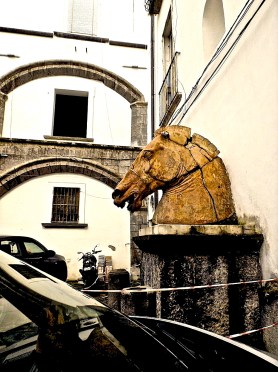
All things material must pass or be set aside – not unlike this head of a grand old equestrian statue mouldering in a seedy car park. The construction of our online lives in software — ‘pure thought stuff’ — is even more ephemeral  - photograph by MIL22

All things material must pass or be set aside – not unlike this head of a grand old equestrian statue mouldering in a seedy car park. The construction of our online lives in software — ‘pure thought stuff’ — is even more ephemeral

– photograph by MIL22

Screen Shot 2014-11-06 at 02.40.29

The original version of our masthead, using fonts offered by Wordpress.com through an arrangement with Typekit.com – then arbitrarily ‘retired’ by the blogging platform

Post-Gutenberg has been looking for a new home on the internet after an unwelcome lesson about the flimsiness of all commitments between suppliers of internet services – such as blog-hosting platforms like WordPress.com – and their too-trusting users. Any faithful reader of this blog since its first entry three years ago knows that the one element that stayed constant through experiments with layout and colours was the lettering in its masthead, a style referred to over the centuries as Fraktur, Blackletter, Gothic and – most recently — Brokenscript.

Choosing it for this site was a very small visual joke, a reminder that one of the oldest versions of the typeface was actually carved by Johannes Gutenberg himself in the 1450s, to print his mechanically lettered version of the Bible which – in the Wikipedia’s salute to it,

… was the first major book printed in the West using movable type. It marked the start of the ‘Gutenberg revolution’ and the age of the printed book in the West.

A blog becomes a sort of home on the net for its minders and contributors, over time. Watching the pixels of its masthead swim into view can be as consoling as knowing that there will soon be a mug of fragrant hot cocoa on the other side of your front door on a soggy night on which you approach it with freezing rain snaking down the back of your neck. But suddenly, last summer, that comfort was lost. Post-Gutenberg appeared at the top of each page in the timid, undersized, spidery default font for this layout (or ‘theme’). After a temporary switch to another layout to compensate for the mysterious reversion to what we never chose, it proved impossible to restore the original look of this site – not just the masthead, but the sizes of other fonts we selected with care.

As the use of these custom typefaces is not free, but requires a subscription, the usual excuse for having some part of one’s cyber life turned upside-down — ‘You get what you pay for’ – is hollow. We say this sadly, as WordPress.com – literally wonderful, in innumerable ways — has been a cross between kindergarten and training wheels in our education in unmediated publishing.

One group of WordPress users in England, at thelondonwakecompany, reacted as disgustedly as we did to the blog host’s refusal to offer any explanation for the change:

Hi, our website seems to have lost the original font we used and we can’t seem to get it back, its not in the list of fonts we can use either and it’s changed the whole look, […]There is no other font that even comes close and I’m supremely annoyed. All our marketing material matches our website especially the font and looks completely out of sync now, as there isn’t even a similar font that we can get away with. Why were we not warned of the changes that were being planned? Such a small change for you guys is a headache for us. I would like something to be done, as when I bought our site/signed up with WordPress I was not aware that they can change what they want when they want without any notification or consideration.

It was while fuming over this saga that we came across a record of a surpassing life, the obituary in The New York Times of one of England’s finest exports to the U.S.. Here was a man who somehow helped to found and run America’s only reliably intelligent and advertisement-free TV and radio channel — the Public Broadcasting Service – and personally ran its first suicide-prevention hotline, while living at a vast remove from the public eye and any popular acclaim. He was also an ex-Anglican clergyman and gay rights activist. Not until Bernard Mayes died on 23 October at eighty-five were his achievements ever celebrated in the media – an impression that the Wikipedia’s lack of any media citations before then seems to confirm.

This was the most captivating section of the NYT’s account of his passage for someone maddened by insubstantial software’s ephemerality – a reminder that even what we perceive as reliable matter is, in its essence, far from solid:

As he grew older, Mr. Mayes abandoned his Christian faith and promoted a philosophy that he said was rooted in “scientific materialism.” He called it Soupism.

“There are no gods, no magic, no final judgment and no grand plan,” he wrote on his website devoted to Soupism. “Everything from planets to humans is composed of tiny particles, energy, and nothing else. All the particles are always moving and endlessly interacting with each other as in a soup.”

He discussed the philosophy in his autobiography as well, finding a kind of transcendence in the material world.

“We are,” he wrote, “already close to, surrounded by, enveloped, as it were, in immortality: sheets formed from the cotton of the fields or the wool of the sheep; plastics boiled from minerals dug from the earth or the oil of ancient vegetation; concrete and metal poured from the rocks of the planet; all moving within the endless interchange from which our bodies are derived and from which others are already being born. Never does the process cease; never does it fail us.”

- photograph by MIL22

– photograph by MIL22

How the Gutenberg press helped Switzerland to become the pioneer of ‘inclusive capitalism’, and why poor Sophia Tolstoy needed a post-Gutenberg blog of her own

Muenster in early evening light -- around 4 pm -- Cheryll Barron

View from Bern Muenster Cheryll Barron postgutenberg[at]gmail.com

– photographs: postgutenberg[at]gmail.com

A clarification. Our use of ‘inclusive capitalism’ is neither fuzzy nor subversive – as in the accusation levelled at the organisers of a conference on the topic in London last May. For us, it describes cooperatives of various sorts, more or less the range set out in a 2009 report by Co-operative Development Scotland. Scroll down this post to see why one subject of that study, Switzerland, is proof that man as a consensus-building, egalitarian animal can be wildly successful.

Nothing drills the facts about Switzerland’s revolt against the corrupt old Catholic Church into you — your very bones — quite like mulling over them as you climb the 254 sub-arctic, twisting stairs to the bell tower of the Bern Muenster in mid-winter. From the viewing balcony up there, eyes unglued with difficulty from the hypnotic, turquoise River Aare below stray to the stone terrace at the cathedral’s base, where, during the Reformation of the 1500s, rebels had a merry old time smashing priceless religious images and objects.

This battleground in the Swiss capital is an unequalled symbol of the fight against inequality: the hulking Gothic structure on which construction began in 1421 loomed above a mere 5,000 inhabitants of Bern, at the time. All the better to intimidate them — only that assumption proved a mistake. In the words of an English-speaking specialist in the culture and history of Switzerland – an underpopulated species we care about for reasons to be explained in future posts – ‘much of Swiss history derives its interest from a revolt … of peasants against abbeys, … of towns against the ecclesiastical foundations from which they sprang.’

Switzerland’s continuing refinement of practical egalitarianism in the centuries-long wake of the Reformation means that there is a great feeling of been-there-done-that for anyone Swiss coming across a Twitter-trending lexical combination: inclusive capitalism — spotlighted in a speech earlier this year by the International Monetary Fund’s leader, Christine Lagarde. The Alpine republic most famous for political neutrality, charming quaintness and its tourist attractions, arguably deserves to be better known for its vast experience of using cooperatives as tools for wearing down social inequality. You might almost say that the whole of Switzerland – a country that has never had kings or queens, and is run not by any single leader but a Federal Council – works like a giant co-op.

Most elements of inclusive capitalism listed in a PBS – public-service broadcasting – programme in the U.S. a year ago, ‘The Alternative American Dream,’ are old hat for, and well-used by, the Swiss: ‘consumer ownership, credit unions and ownership by franchisees pursuing common purchasing efforts …’. Earlier entries on this blog have pointed to stable, cautious and solidly-grounded Swiss banking cooperatives avoiding the disastrous subprime mortgage crisis, and praised Swiss super-democracy.

Can the Swiss economy be said to have been injured in any way by excessive idealism? Quite the contrary. Cooperatives are democratic, not socialist. Socialism – as the Cambridge historian-of-ideas Gareth Stedman Jones has observed, was in part an attempt to replace the Catholic Church with a state religion. Most Swiss, a supremely praktisch people, have more down-to-earth aspirations. Last September, for the fifth year in a row, Switzerland was the world’s most competitive economy — leading the World Economic Forum’s global competitiveness ranking based on its vetting of ‘the set of institutions, policies, and factors that determine the level of productivity of a country’.

And its record for inventiveness? Last month, for the fourth year in a row, it was also the country at the top of the Global Innovation Index – ranking economies by their capacity to marry ideas to knowledge for creativity with social and economic value.

What connects such success with putting idealism into practice to Bern’s Muenster — and the chief preoccupation of this blog — is the media revolution on which the Reformation rode. Printing centres, most notably in Basel, were established early, in Switzerland, and became critical to marshalling and disseminating the anti-clerical, anti-Vatican arguments and facts.

Forcing change on the Catholic Church in the prelude to the Renaissance would seem dustily irrelevant, to members of the chattering classes in our time. Practically none of us have been constrained by the dictates of religious authorities: most of us grew up as the children of agnostics, atheists or doubting semi-believers. But smashing medieval religious authorities’ outrageously unequal information-power with new technology – in the shape of the Gutenberg printing presses – resonates loudly, in the midst of our digital revolution. Print broke the power of sermons, just as the internet and e-publishing are vaporising the power of print’s gatekeepers today. It was from preaching that most people, who could not read, gleaned authoritative information about the world.

A report on a conference of medieval sermon scholars at Harvard two years ago sets out the remarkable parallels – including doomed attempts to discredit the unmediated broadcast of information, as in old media propaganda, now, about blogs and blogging:

… It was the ecclesiastical system behind sermons “that invented the idea [that] there was a universal body of knowledge” and that led the way to modern universities. Sermons were the dominant literary form in the Middle Ages. They bridged the emerging power of the written word and what was, 900 years ago, the predominance of the spoken.

… Before the printing press, knowledge was disseminated through oral traditions. In the public sphere that meant sermons. These discourses from the pulpit were the Internet and the mainstream press and the propaganda machine of the Middle Ages.

… At the same time, sermons of nearly a millennium ago prompted a very modern question: Who has the right to speak? Vying with priests for the right to preach were lay people, lawyers, kings, and public officials. In a bit of recurrent culture shock, even women demanded the right to preach sermons.

Most of all, the prospect of lay preaching “was an anxiety for the Church,” wrote Carolyn Muessig in a study of medieval preaching and society. (The University of Bristol scholar delivered the first paper at the Harvard conference.) The concern, she wrote, was the Vatican’s desire to protect people from heresy and “to preserve a clerical monopoly on learning.”

The debate over who owned the medieval airwaves went on for hundreds of years. As late as the 14th century, one critic still held that the Vatican had the final say. “No lay person can preach without authorization,” wrote Robert de Basevorn, “and no woman ever.”

… In an internet break from reflections on that old battle, news of a book published by Yale University Press surfed onscreen, this week. More than twelve decades after a brutal misuse of power by her husband, Leo Tolstoy, his wife Sophia Andreevna has got her revenge. It seems that the author of War and Peace wrote a spiteful, vicious tale about his own domestic wars in an 1889 novella, The Kreutzer Sonata. Everyone in literary Russia, and lofty beings outside it – including Tsar Alexander III – knew that the old philanderer’s story about a jealous husband who murders his wife was intended as punishment for Sophia’s infatuation with a musician who filled the void left by the romantic hopes and expectations that Tolstoy’s behaviour wrecked.

The aggression in the novelist’s self-pitying tale was not lost on the tsar, who sympathised with Sophia. In one phase of the drama, this writer’s wife demonstrated exceptional nobility of character in pleading with the ruler to order government censors bent on suppressing The Kreutzer Sonata to lay off – even though she was profoundly hurt by it.

She found her own way to fight back – in two novellas telling her side of the story that languished in deepest obscurity in Tolstoy’s archives until they were published in 21st-century Russia. Now, Yale has had them translated into English, in The Kreutzer Sonata Variations, a collection that includes, along with extracts from her letters and diaries – more amazingly yet – a story by the Tolstoys’ son Lev that is also a protest against Kreutzer.

We have had to wait much too long for these remarkable discoveries. Sophia Andreevna had to make a special journey to St. Petersburg to plead her husband’s case with the tsar. Now, if she had only had a blog …