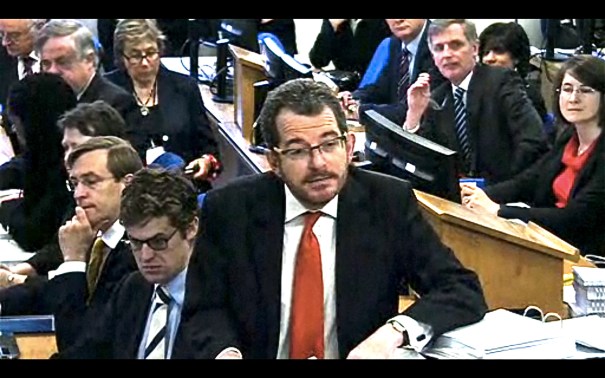
#Leveson, as anticipated by Elie Wiesel, 83 – in his turn, trailing fellow-activist Zhou Youguang, 106, in the blogosphere

‘Giant pawn’ MIL22

Earlier this month, a post-Gutenberg entry on the Leveson Inquiry had the honour of being put in the Twitter ‘favourites’ queue of Hans Peter Lehofer – an administrative law judge and former head of the Austrian Communications Authority, which decides the rules for broadcasting in that country.

No, we did not interpret our inclusion in his list as a gold star of approval. He almost certainly uses the ‘favourites’ button on the glorified e-notice-board the way we do – as an online bookmark. Never mind if, exactly like us — making the same point to #Leveson the other day — he doubts that merely passing laws affecting the way the press works can guarantee our getting what we need, which is ‘broadcasting’ representative of society as a whole.

What did please us is that Herr Lehofer’s interest bears out our forecast in May that Lord Justice Leveson’s recommendations on press regulation would influence the debate about media policy around the world. Austria is lucky to have such a curious and progressive rule-maker. Anyone in Britain worrying about bloggers and citizen-journalists being treated as mere pawns in the chess game the Inquiry is being forced to play with politicians in the final weeks before it delivers its report is bound to be heartened by this judge’s grasp of the size of the leap in thinking about media that we need from the judiciary. He has a blog of his own, and also blogs collaboratively on more than one site.

Gerard Hogan, another intelligently au courant judge — a specialist in constitutional law at Ireland’s High Court — recently accorded the blogosphere a right traditionally reserved for professional journalists. In what the International Forum for Responsible Media (INFORRM) reckons as ‘the first Irish judgment to consider the position of bloggers,’ the court allowed Mike Garde, the blogger-director of an Irish organisation helping people brainwashed by cults, to protect his sources of information.

Hogan J’s judgment read, in part:

Part of the problem here is that the traditional distinction between journalists and laypeople has broken down in recent decades … Mr. Garde’s activities fall squarely within the “education of public opinion” envisaged by Article 40.6.1. A person who blogs on an internet site can just as readily constitute an “organ of public opinion” … [T]here is a high constitutional value in ensuring that his right to voice these views in relation to the actions of religious cults is protected.

How much longer, we wonder, will it take Elie Wiesel – twice quoted on this blog in recent weeks, and cited yet again, below – to join the unmediated conversations in the blogosphere? He has used every other medium in his extraordinary record of ‘bearing witness’ to the murder, torture and terrorisation of European Jews in World War II – after surviving Auschwitz, where he was dispatched as a 15 year-old.

His age today, which is 83, hardly explains his failure to start a blog. Last spring, The New York Times ran an inspiring profile of a Chinese human rights activist, 105 at the time, using a blog to broadcast his thoughts. This astonishing Zhou Youguang – still blogging at 106, if the net is to be believed — is the inventor of the Pinyin or ‘Romanised’ system for converting Chinese sounds into the English alphabet. For his transmissions on the net,

Mr. Zhou … uses a typewriter that converts Pinyin into characters to deliver ever-more pointed critiques of the party in essays and on his as-yet-uncensored blog.

The explanation for the deep hooks sunk into post-Gutenberg’s brain by Elie Wiesel’s short 2010 novel, The Sonderberg Case, is the startling correspondence between this author’s reflections on the role of the press in society, and the actual debate over the Leveson Inquiry. He also uses the trial at the heart of his story to weigh the relative worth of the work of lawyers and journalists – most engagingly.

Our final excerpt from the book is about a fight at a dinner party in New York. It seems uncannily prescient about the precise arguments being used in real life by the media’s old guard – here presented by the main character, Yedidyah, a journalist, and the hostess, Emilie, his only ally – as opposed to those of the public, on whose behalf Yedidyah’s wife Alika, an actress, spars victoriously.

There seems no doubt whatsoever about which side the author is on:

We talk about journalism. Is it useful to a democratic society? Honest or corrupt like everything else? A reliable source of information, a necessary tool for forming an opinion? Emilie and I stand up for the media, primarily because they represent an indispensable element in protecting individual and collective liberties. Alika is our most violent opponent. I’ve rarely seen her as fierce in her opinions. For her, even the best daily papers disgrace their readers. And she goes on to quote and appropriate the remark of a big British press baron concerning a well-known magazine. ‘It isn’t what it used to be … and actually it never was.’ And this applies to all publications, she tries to convince us, with no exceptions. Alex agrees with her. So do their guests. Emilie and I valiantly stand up to them. Alika flares up.

‘How can the two of you stick up for all those miserable newspapers and weeklies? I’m prepared to think you don’t read them! Even the cultural pages are over-politicized. As for the literary supplements, what do they tell us except ‘long live the buddy-buddy network’? What kind of moral rectitude is that? And what about the right to truth?’

[…]

Calm and resolute, Emilie pursues her counterattack and cites the facts: Can we really suspect such and such a writer, at such and such a newspaper, of dishonesty? And can we honestly question the integrity of such and such a professor, who writes in such and such a journal?’

Without the slightest compunction, Alika answers with a shrug of the shoulders. ‘Yes we can. And we should.’

‘In other words,’ Emilie says, ‘they’re all guilty until proven innocent, is that it?’

‘No,’ Alika concedes. ‘I wouldn’t go that far. But I maintain that as a reader, I have the right to wonder about their conception of ethics.’

… Happy birthday, tomorrow, Elie Wiesel.

Why attack ♯Leveson, our best chance to save real journalism?

The coercion which the police state exercises on thought and art is indeed appalling. Yet the damage done may, in the final analysis, be no greater than that caused by the absolutism of the mass market. … The censorship which profit imposes on the media is as destructive, perhaps more so than that of political despotism.

George Steiner, My Unwritten Books, 2008

That Fleet Street editors are once again ganging up to attack the Leveson Inquiry into press ethics and practices — concentrating their salvos, this time, on its as-yet-unpublished first report and recommendations – could turn out to be a great good thing.

Their aggression is inviting attention. It is giving everyone who cares about getting reliable news and facts undistorted by hidden agendas and special interests — for instance, the International Forum for Responsible Media (INFORRM) — a chance to remind the 4th Estate that public opinion is firmly on the Inquiry’s side.

But, …

as the INFORRM blog warned, last week,

… there is an important case to be fought in the court of public opinion over the next couple of months. A careful eye needs to be kept on press attempts to distort and manipulate the arguments to support the self-interest of its proprietors.

The self-interest to which it refers is, of course, the profit motive. That is true despite the longstanding tradition in which most of those proprietors have supported newspapers losing money decade after decade, as if red ink were simply natural for them, as intrinsic as spots for leopards or nuclear scent for polecats. Hardly anyone needs to be told, any more, that the reason why these proprietors have long competed ferociously for the privilege of owning papers is because of the fantastic levers they are for piling up profits in other spheres, and buying political influence.

We have quoted those words of George Steiner in this post’s epigraph before and we will quote them again – as often as necessary. That is, until it becomes common-or-garden wisdom that, just as the Wikipedia has brought us closer to the ideal of what an encyclopaedia can be, we need to refine forms of collaborative journalism. It has to be universally understood that journalism at its best has to be divorced from the profit motive. Just as the excellence of the Wikipedia has no connection whatsoever to improving any corporate ‘bottom line,’ there is no reason why journalism has to be directly or indirectly wedded to it any more.

The reason why no leader at the head of any prominent newspaper has risen to post-Gutenberg’s challenge – ‘Wanted: a brave newspaper, for an experiment in which readers become stakeholders‘ – is because they are  beholden to the old system of organising the dissemination of facts. They are well-paid indentured servants of the profit motive, enshrined as the ‘advertising-based business model’ for running papers.

The best possible outcome of the Leveson Inquiry is not in the least complicated. It would be an evolutionary restructuring of journalism to restore as its fundamental and only raisons d’être:

the quest for truth

and

forcing transparency in the exercise of political power.

It is this parallel with the Wikipedia that matters. The co-ownership of media and various forms of collaborative operation, in the practice of journalism, are simply the most logical means to that end.

Until we reach it, passages like this — from The Sonderberg Case, an Elie Wiesel novella about the harm that Nazism inflicted on the Nazis’ own descendants – will seem depressingly unattainable:

Actually, I had discovered journalism well before working in the field. My uncle Meir, early on, considered it the finest profession … He ranked the committed journalist as the equal of writers and philosophers.

Quiet levity at ♯Leveson, and some thoughts on the film version of the Inquiry for Robert Redford’s scriptwriter

Leveson’s subtle cerebral swordsman, Robert Jay QC:
is he Hollywood material?

Robert Redford in 1976, playing
the Watergate reporter-hero
Bob Woodward.
Photograph: collectorsshangri-la.com

Nowhere in the commentary about the winding down last week of Part 1 of the Leveson Inquiry into press practices have we seen the lines we expected some old print publication or other to throw in for leavening. Only in the blogosphere have we found mentions, in this context, of …

You cannot hope to bribe or twist

The honest British journalist

But seeing what the man will do

Unbribed, there’s no occasion to.

There are minor variations of those four lines in circulation. They are the wittiest and best-loved summing-up in verse of the British tradition of journalism – at its best, still the world’s finest, in our opinion, which might have been influenced by sprinkling with  baptismal water in this branch of the craft. Long before then, the poem was on a page of a school poetry textbook to which some of us, at post-Gutenberg, often turned for relief from galumphing deconstructions of poems unfortunate enough to have been put on the syllabus.

Will Robert Redford find a way to include Humbert Wolfe’s 1920s quatrain in his script — if there is any substance in the speculation about him giving Leveson and the phone hacking scandal the Hollywood treatment? A Redford film about the Inquiry — showing us what an outsider makes of the Icelandic saga it has become — could be a treat. A clip from a BBC interview with the actor-director in April is irresistible. His tone becomes wondering, almost awed, answering a question about his impressions on a first visit to London for 30 years:

I come here and I watch the Leveson Inquiry. And whatever’s going on — I’m sure there’s some savage stuff going on — but it’s done in such a dignified, calm, graceful way that I think, gee! this is really fascinating. Somebody’s killing somebody, here, but you’d never know it.

Italian-born Humbert Wolfe
wrote the most famous poem
about British journalism.
Photograph: National Portrait Gallery

The poet Humbert Wolfe also had a stranger’s acute powers of observation. He was born in Milan. His mother started life as Consuela Terraccini. His pen strokes captured the journalism and journalists of his adopted country while he worked at a day job in its civil service.

But even if one of Redford’s most famous roles was in All the President’s Men (1976) — playing the Woodward half of Watergate’s heroic ‘Woodstein’ partnership at The Washington Post — it is not the British press but the lawyers and gracious conventions of British law in action that captivated him. At a press conference on the same trip, a reporter asked if he was watching the proceedings and ‘hoping for the return of proper investigative journalism’ – following his complaints elsewhere about the increasing ‘triviality of media’. He replied:

I’ve been very impressed with the dignity and elegance with which the process has gone forward. People take their time speaking. And in my country, things have become so accelerated and … so hyped up. … It’s sad for me to see because it blurs this more important part, which is, where are we going to find the truth? The democratisation of the internet has actually made truth harder to find — along with its positives.

Somehow, that vital qualification of his disappointment with democracy on the net was dropped from the Independent’s report of his remarks, with no indication of any omission. That paper, like the other broadsheets, never stops copying King Canute straining to command the sea to roll backwards – in its case, the evil digital sea of change obliging the 4th Estate to share its megaphone with new rivals.

Actually, Lord Justice Leveson and his chief counsel for the hearings, Robert Jay, have often struck post-Gutenberg as a brilliant pairing. In their uncannily well-coordinated forensic interrogation, they function like a legal Woodstein – even if not technically working as partners but in their distinct and separate roles. The background to their bravura performance could be an engaging part of the story, whenever Redford or someone else digs into it.

Admittedly, that is most likely to be a someone else – since the cinema only rarely conveys intellectual, as opposed to emotional, subtlety and complexity. Just as nearly every film ever made about the lives of artists and writers has failed to illuminate the mechanisms of their creativity, let alone uncover its secrets, there seems little chance of the cinema tackling judicial tactics and strategising of the highest sophistication.

Unless the presiding judge or some other senior member of the Inquiry’s legal team writes a completely frank account of its hidden dramas, there is just as little hope of our learning any details of the hearings’ behind-the-scenes manoeuvring – the pressure from vengeful old 4th Estate tigers distraught about the prospect of their de-clawing; the wily manipulations of politicians. We can only discern their effects – in, for instance, the ever more drawn and tired face and hoarse voice of Leveson LJ, in the concluding weeks of Part 1.

Would a Redford film explain the sort of thing keeping us hugely amused at post-Gutenberg? – the private joke we read into the judge thanking ‘the press who have reported on the inquiry, for keeping everybody informed,’ which made broadsheet headlines. Taking what he said strictly at face value (Lord Justice Leveson ends Inquiry by thanking journalists), those news reports missed his point entirely. To grasp what Leveson LJ was actually saying, you would have to know about this exchange between him and the admirably non-partisan Peter Oborne, chief political commentator at The Telegraph — and by far the most enlightening and accurate senior journalist testifying at the Inquiry:

P.O. : … [T]he reason why rival newspaper groups were unwilling to report phone hacking […] It’s only my views as an informed spectator, that … there was a reluctance of one newspaper group to embarrass another.

LJL : … If that is so, is that inevitable?

P.O. : I don’t know if it’s inevitable or not, but it has been a very, very — it has been a feature … [A]nd I think it’s been weakened a little bit, or even quite a lot, by blogs, and Private Eye has played a fantastically important cleansing function in the last 30 or 40 years. […M]aterial which has not found its way into mainstream publications has found its way into Private Eye.

LJL : Private Eye has also been publishing during the course of this Inquiry what the newspapers don’t publish. In other words, they’ve gone through a number of stories and said, “Actually, it’s rather interesting that this story appeared in this paper but it didn’t cover another aspect.”

Had the judge not been teasing huffy 4th-Estaters for their selective and misleading reporting on his hearings, he would have thanked all reporters and commenters – including bloggers, whose legitimacy and importance he has scrupulously underlined.

On that subject, we have a message for Robert Redford.  It is only because of the internet’s democratisation of the media that post-Gutenberg learnt that he acknowledged the constructive aspects of the rise of the net, even as he blamed it for the growing scarcity of good traditional journalism. As we have already noted in this entry, The Independent only printed the portion of his remarks that suits its agenda. But, thanks not only to a BBC video but a YouTube clip from his London press conference, we could all watch him speak his unedited thoughts and interpret them for ourselves.

And that is just one more tiny scrap confirming that expand and include; don’t compress and exclude should be the principle directing anyone powerful who has a say in shaping the media’s future – for reasons we recently explained here.

♯Leveson must protect citizens’ rights to comment alongside a 4th Estate incapable of self-regulation: see Private Eye No. 1317

‘f&f’
Photograph by MIL22

One after another, members of the 4th Estate have been parroting some version of the same frightful cliché – don’t throw out the baby with the bath water! – as they warn Lord Justice Leveson about the risks of imposing any form of regulation on the press.  Google offers roughly 21,200 search results for the terms ‘baby + bathwater + Leveson’.

You might suppose that someone would have the wit to find a new metaphor after this year’s revelations about decades of collusion between politicians and the largest 4th Estate empire by far, the one run by Rupert Murdoch – disclosures that have shown us that the wretched baby is being bathed skinless to divert attention from its reeking, putrid condition.

Last week, in another part of this site, we posted a mention of an important study by a London School of Economics researcher about comment moderation policies on the websites of newspapers. We found it only by accident, on the day we wrote the post. For reasons obvious from five minutes spent reading the study’s findings, no newspaper has given it any publicity whatsoever. We hope that the Leveson Inquiry’s team of investigators has copies of the LSE researcher Sanna Trygg’s paper, ‘Is Comment Free? Ethical, editorial and political problems of moderating online news‘, which underlined in various ways these observations:

In the past, ‘traditional’ or ‘mainstream’ media have been considered as the main public forum for free speech, critique and discussion. Today, readers are also invited to participate in the debate directly online. The main platform for this is the comment field attached to news articles published online.

[…]

Comment fields on newspaper websites offer great potential for participation in democratic dialogue. […] It is important to continue to strive for real engagement between people with different viewpoints, even when those views are marginal. The danger remains that people will not learn by having their views challenged.

[…]

Readers’ participation is still not a priority in the newspapers organization. [Comment] [m]oderation is being performed on the terms of the newspaper and is a product of a relatively narrow policy. This issue matters if it drives people away from ‘reasonable’ moderated discourse. […] It is a central problem for the creation of a truly networked journalism or Fifth Estate.

Trygg — whose work experience includes a stint as web editor for Skånska Dagbladet, a newspaper in her Swedish homeland — was pessimistic about the likelihood that the Inquiry will address the most vital media-related issue that needs resolving. That is not simply to note the 4th Estate’s replacement by the 5th , but firmly discourage today’s still-dominant print media from suppressing the voices of citizens who disagree with its positions and expose its flaws in newspaper comments sections. She surmised:

At present it does not seem likely that Leveson will deal with news website moderation directly, but surely it should be considered in any investigation into newspaper editorial practices and their contribution to British public life?

As we keep saying here, there is only one widely circulated print publication in Britain writing ‘without fear or favour,’ the way a real newspaper should – and as only bloggers and other unmediated writers publishing on the net do. In late June, Private Eye supplied a detailed contradiction of misleading testimony by David Cameron at the Leveson hearings that the rest of the 4th Estate either ignored or mentioned glancingly.

The Eye’s evisceration of that testimony referred to Jeremy Hunt, a culture-minister-in-waiting who in 2010 had boosted his party’s chances of winning the election by securing the support of Rupert Murdoch’s Sun – through spouting, like a ventriloquist’s dummy, all the positions on media policy that Rupert’s son James had outlined a few days earlier in delivering the annual, high-profile MacTaggart lecture at the Edinburgh International Television Festival.

“THERE was no overt deal for support, there was no covert deal, there were no nods and winks,” David Cameron told Leveson, dismissing the suggestion that the Tories agreed to back the Murdochs’ commercial interests in return for the support of the Sun before the 2010 general election. Hmm…

As the Eye pointed out before Cameron gave his evidence, there was, however, an uncanny resemblance between James Murdoch’s MacTaggart Lecture on 28 August 2009 and an article that the then shadow culture secretary Jeremy Hunt wrote in the Sun three weeks later on 19 September – just before the paper switched its support to the Tories.

Hunt echo

In the MacTaggart, Murdoch complained about a “land grab” by the BBC, claiming that “the scale and scope of its current activities and future ambitions is chilling”. Hunt echoed that in his Sun article, warning that “something is going wrong at the broadcaster”.

Murdoch declared: “Rather than concentrating on areas where the market is not delivering, the BBC seeks to compete head-on for audiences with commercial providers.” Or, as Hunt wrote three weeks later: “The BBC needs to focus on what it does best – great family entertainment and programmes the market will not provide.”

Murdoch rant

Murdoch complained that “the BBC’s income is guaranteed and growing”. Ditto Hunt: “We should not be having inflationary rises in the licence fee.” Murdoch then ranted about the “particularly egregious” expansion of the BBC’s commercial arm, BBC Worldwide. Lo and behold, Hunt argued: “It’s time to rein in the activities of its commercial arm, BBC Worldwide.”

Murdoch’s fury extended to the BBC Trust. “You need deep pockets, sheer bloody-mindedness and an army of lawyers just to make the BBC Trust sit up and pay attention,” he fumed. Hunt promptly “pledged to replace” the BBC Trust “with a truly independent body”.

Perish the thought that any of this might amount to evidence of a mating dance between the Tories and the Murdochs.

We hope that the Leveson Inquiry will do all it can to ease the way for more media of every sort to fill crucial gaps in mainstream reporting as only the Eye does, at present.

Appearing before the Inquiry last Tuesday, Lord Hunt (no relation to Jeremy), the present head of the press-run Press Complaints Commission all but universally acknowledged to have failed at the job of self-policing, failed to melt Lord Justice Leveson’s heart when he begged for a second chance for his organisation. Every month brings fresh evidence of the hopelessness of any claim that the press is capable of regulating itself.

Two such scraps on our minds at post-Gutenberg today:

• Last summer, even with the whole world transfixed by emerging details about phone hacking by Murdoch’s minions, the media tycoon announced his intention of mucking out his corporation’s stable with an internal investigation that struck critics as woefully unconvincing. It was led by Joel Klein, a New York lawyer and education expert, freshly hired by News Corp.. The New York Times noted earlier this year:

Shareholder groups have expressed concerns about Mr. Klein’s independence in leading the investigation. His compensation package at News Corporation was more than $4.5 million last year, according to company filings with the Securities and Exchange Commission.

“His salary was a huge bump, so he’s clearly beholden to Murdoch and should not be running an internal investigation,” said Michael Pryce-Jones, a spokesman for the CtW Investment Group, a shareholder advocacy group based in Washington that works with pension funds for large labor unions.

Last month, Joel Klein handed over that smelly job for a head groom to another senior News Corp executive – but that was someone hired at his behest, and his having been entrusted at all with the sanitising task did not inspire confidence in the likelihood that Britain’s heftiest media conglomerate is capable of putting the public interest above considerations of narrow commercial advantage.

• Newspapers ignore complaints about the suppression of citizens’ comments about their policies and behaviour  — even censoring, with peerless irony, a post about an opinion piece by the chief executive of Index on Censorship, a British watchdog group chiefly concerned with spotlighting censorship outside Britain.

One reason for starting this post-Gutenberg blog last September was to draw attention to comments censored by newspapers. Obviously thinking on closely parallel lines, Sanna Trygg suggested in her paper, published in January:

[W]e would argue that in the long run it is worth newspapers continuing to push for more transparent moderation … For example, would it be worthwhile making records of deleted comments public? Since no publicly available records exists, all we know is that comments are being deleted, but not which ones and why.

The latest tactic by old print media worthies determined to neutralise the Leveson Inquiry is to claim that neither the presiding judge nor any of the lawyers assisting him – all educated at élite institutions — are capable of looking after the interests of ‘Joe Public,’ since none of them are part of the tabloid-reading majority of customers for Britain’s newspapers.

This will be seen as a particularly ill-judged attempt to ensure the unchallenged reign of the 4th Estate if the Inquiry acts on what Lord Justice Leveson plainly understands well, which is that ordinary citizens are best served by any newspaper that gives its readers a chance to freely express their opinions.

A source quoted by Sanna Trygg encapsulated why this is exactly what members of the public need:

Research by the Swedish survey Institute Sifo in 2011, showed that workers, unemployed and less educated people think that reader comments in themselves are more important than civil servants, self-­‐employed, private employees and highly skilled:

“A qualified guess is that people with higher education and status in society feel that they already have the opportunity to be heard. For people with lower status are comment fields however, an important platform to make their voices heard.” 
Sofia Mirjamsdotter (Swedish journalist, blogger and social media expert.)